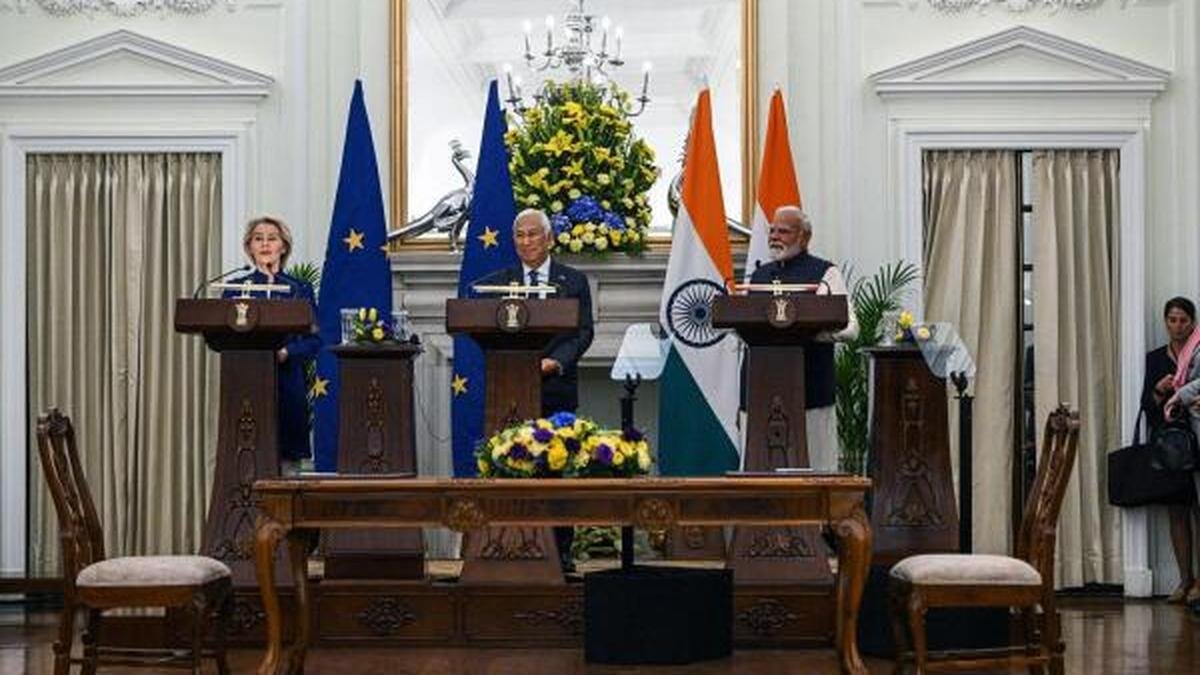
Photo shows Ursula von der Leyen, president of the European Commission, left, Antonio Costa, president of the European Council, center, and Narendra Modi, India‘s prime minister, during a news conference at Hyderabad House in New Delhi, India, on Tuesday, Jan. 27, 2026. The European Union and India concluded a free trade agreement after nearly two decades of negotiations, as both sides seek to deepen economic ties and offset the impact of Washington’s tariff policies. Photographer: Prakash Singh/Bloomberg
Global trade architecture is increasingly influencing higher education decisions rather than just academic standing. India’s Comprehensive Economic Partnership talks with the Gulf Cooperation Council and its upcoming India–European Union Free Trade Agreement negotiations will lead to economic integration which will benefit the education sector. Decision logic, not aspiration, is what is evolving. Students are matching their educational choices to employment continuity, regulatory convergence, and labour mobility linked to trade.
Trade volumes are reshaping student mobility patterns
The empirical trade data shows the importance of this trade modification. India’s annual trade with the EU reached more than USD 180 billion from 2018 until 2023 while its trade with the GCC countries exceeded USD 240 billion. A significant portion of India’s professional services exchange, including those in engineering, healthcare, finance, logistics and digital services, now takes place through these corridors. Demand for education is reacting to this alignment. With destinations integrated into India’s trade network experiencing greater growth in Indian enrollments than traditional legacy markets, student mobility patterns increasingly reflect the intensity of trade.
Mutual recognition of qualifications is reducing credential risk
Mutual recognition of qualifications is a crucial link between trade agreements and educational choices. The EU internal system has demonstrated measurable results through the implementation of standardised recognition practices. The European education data shows that EU cross-border tertiary enrollment increased by more than 30% between 2013 and 2021 while professional sectors achieved higher regulatory alignment. The India-EU negotiations specifically address professional mobility and regulatory cooperation which indicates that India will develop more recognition systems for its qualifications in the future. The system enables students to work in other countries while reducing the possibility of losing their educational qualifications.
Labor market stability is strengthening long-term education planning
The labour market data supports this transition to new technologies. According to multilateral workforce mobility datasets, over 60% of globally mobile students now value credential portability and post-study work alignment more than institutional ranking. The EU and GCC economies together supply about 38% of India’s skilled migration flows which has maintained its structural stability during the past decade. The education destinations within these blocs offer better long-term career planning options because their stable environments create predictable requirements for Indian-trained professionals who work in trade-related economies.
GCC education investment is closely tied to economic diversification
The case for the GCC region is different but equally supported by data. The governments of the Gulf Cooperation Council (GCC) have invested more than $100 billion since 2010 in institutions of higher learning, including universities, applied research centers, and sector-specific institutes. These expenditures are closely related to economic diversification plans that emphasize financial services, tourism, renewable energy, healthcare, and logistics. Indian student enrollment in GCC-based institutions has increased at an annual rate of roughly 12–15% over the last five years, according to enrollment data from public education registries. This growth rate greatly exceeds the global outbound student growth rate, which is still less than 7%.
Data at the program level shows an equally significant change. Data analytics, supply chain management, sustainability engineering, health administration and fintech are among the applied and professionally aligned fields where enrollment growth is concentrated. Enrollment in these programs at EU and GCC institutions has increased significantly faster than that of generalist or non-applied degrees, according to public higher education datasets. Demand from trade-related industries that function internationally under common regulatory standards is reflected in this.
Cost and risk optimisation is influencing destination choice
The cost and risk are an important factor in deciding whether to pursue an education abroad. A review of the cost of education in many countries compares median tuition costs for applied master’s programs across Europe (30-45% lowers than master programs available in North America). Together with access to post-study work and wage convergence for regulated professions, the total educational return becomes more predictable by comparing different countries’ returns. Cost/risk for GCC locations are further improved upon by using shorter programs and strong regional job absorption in the areas of infrastructure and services.
Institutions are responding to these dynamics by redesigning international engagement models. Universities within trade-integrated regions are aligning curriculum outcomes with cross-border employability metrics, industry co-design, and work-integrated learning. Empirical graduate outcome data consistently shows that institutions embedded within trade-linked industry ecosystems report higher employment rates and faster labor market entry for international graduates.
Education choices are shifting from prestige to trade-aligned careers
The impact of higher education for students is more structural than it is temporary. In making their decisions, higher education institutions have begun moving from prestige signaling towards signaling aligned to careers in the area of their trade. The increasing influence of global trade agreements and their effect on the movement of talent means that viewing education through the lens of trade is now a necessity; moving forward, it will simply be the requirement or baseline for making rational, outcome-driven higher education decisions.
(This piece is written by Sanjay Laul who is the Founder of MSM Unify.)
(Sign up for THEdge, The Hindu’s weekly education newsletter.)
Published – February 20, 2026 02:27 pm IST