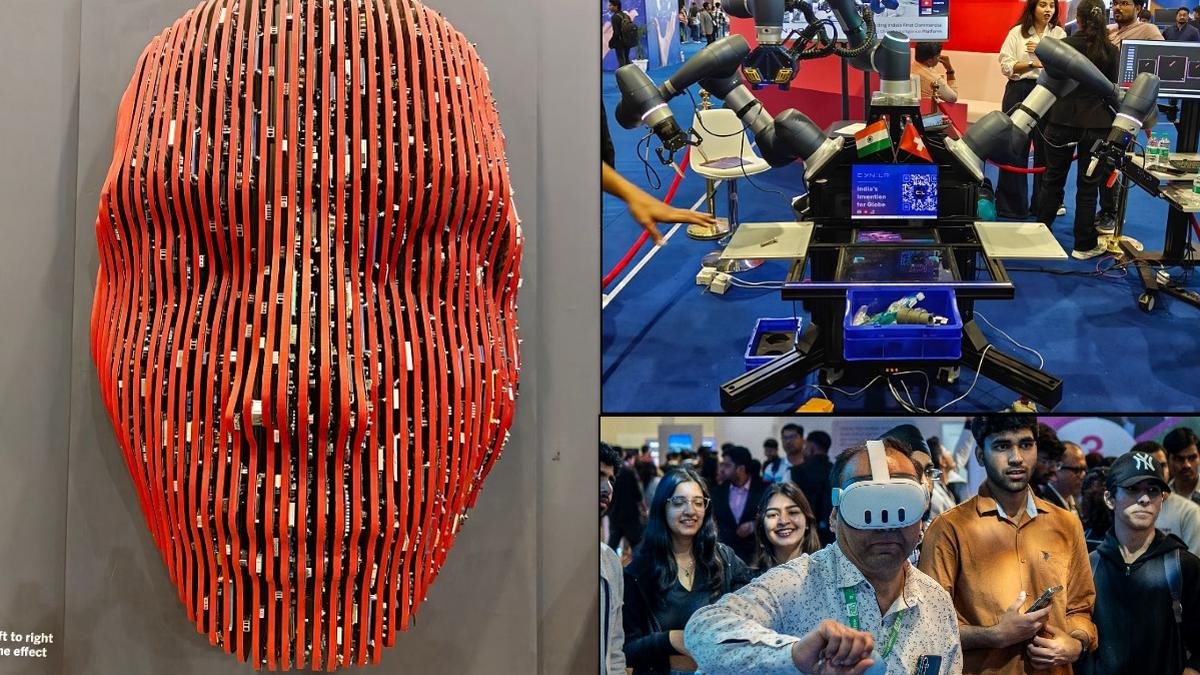
The recent India AI Impact Summit in Delhi was plagued by publicity nightmares and logistical issues: from Galgotias University parading a Chinese-made robodog as its students’ creation (and then getting kicked out of the summit) to frustrated delegates complaining about long lines and traffic, even device theft. There was no shortage of rants on national television and social media.
And yet, Bharat Mandapam, the venue, was full. Half a million people descended on the convention centre and expo halls spread over 123 acres, sending hotel prices across the city skyrocketing. That a first-of-its kind summit, with over 2,000 experts, very few of them big names, commanded crowds so massive says a lot about India’s attitude towards Artificial Intelligence (AI).
This enthusiastic optimism for AI, however, is not universal. For instance, in the U.S., which has seen some of the most impressive breakthroughs in large language models (the technology powering AI chatbots such as ChatGPT and Gemini), only 17% of people surveyed last year say that they are more optimistic about the tech than cautious. For the American tech executives who lined up at Bharat Mandapam last week, the environment couldn’t have been more encouraging: both Jensen Huang of Nvidia and Sam Altman of OpenAI have complained about public hostility to their line of work. That hostility was largely absent last week.
The India AI Impact Summit at Bharat Mandapam in New Delhi, February 20, 2026.
| Photo Credit:
Getty Images
It’s easy to see why. Crores of Indians have accessed the web for the first time in the last few years, after mobile phones became affordable to more people and improved Internet bandwidth led to over 800 million individual connections. OpenAI says 10 crore Indians use ChatGPT multiple times a week — for help with writing, learning, coding. And that number is likely to grow.
For hyperscalers such as Amazon, Meta and Microsoft, spending tens or hundreds of billions on AI, this is key to winning the race to Artificial General Intelligence or AGI. AGI is AI that is as good as, or maybe better than, humans at a wide range of tasks. “On our current trajectory, we may only be two years away from early versions of true superintelligence,” Altman declared in his keynote address at the Delhi summit.
That should give Indians pause. It certainly gave retail investors a shock — when Claude, the LLM developed by AI firm Anthropic, released its Opus 4.6 model, IT stocks in India crashed. At the summit, Infosys and TCS tried their best to paper over those shocks by entering into agreements with OpenAI and Anthropic. Soon, that may not be enough.
Visitors at the India AI Impact Summit.
| Photo Credit:
Getty Images
AI is already incredibly capable. A day before the summit, I installed Claude (belatedly, since it took a while for the $24 monthly price tag to make sense). As I tinkered around the first LLM that I dared to give access to my PC, I was able to develop little tools to jerry rig integrations that I have wished forever would exist — like a simple alert system for government gazette notifications. Claude just hammered together all the components it needed for the job. If I were a coder, I’d be able to do so much more with it.
No wonder IT stocks fell. But the real crash hasn’t arrived yet. At the summit, during a quick chat with OpenAI’s chief economist Ronnie Chatterji, he told me, “We’re not seeing a huge impact, let’s say, on unemployment rates around the world because of AI yet. Part of that is because, I think, people are still learning how to use it. They’re using it for a lot of positive value. Enterprises are figuring it out.”
Risks and guardrails
What happens once people get better at using AI? At Synapse, the annual tech conclave hosted by journalist Shoma Chaudhury, I speak to Karen Hao, who wrote Empire of AI (2025), a deeply sceptical take on Big Tech’s motivations as it pumps billions into data centres and LLM training runs. Hao is sceptical of the many definitions of AGI, but she finds the goal behind this push the most abhorrent.
Karen Hao, author of Empire of AI (2025), a sceptical take on Big Tech as it pumps billions into data centres and LLM training runs.
| Photo Credit:
Shoko Takayasu
“I find this project to be fundamentally anti-human,” Hao says. “Like, why are we creating systems that can replace and make humans duplicative when we could actually just be building technologies that assist them?” Now that tech firms have spent so much money on LLMs, there is no other way out, she adds. “They have to sell their product as a labour-replacing technology now. That’s the only justification for them charging extremely high amounts of money for their services.”
India’s IT industry employs roughly 1% of the population, but has contributed at its peak to 7% of Gross Domestic Product. If the disruption costs jobs, it robs many of a once-reliable pathway to the middle class. If Indian companies cannot leverage AGI as well as global competitors, the industry will face an existential risk.
At Synapse, I also meet with Stuart Russell, a prominent British academic who has spoken out against autonomous weapons and contributed enormously to AI safety research. AI systems “are already having a serious impact”, he says, citing the example of Sewell Setzer III, a 14-year-old from Florida, who died by suicide after developing an attachment to a chat bot on Character AI. On this platform, users can create characters with personalities and parameters of their choice, and then interact with them. For years, researchers have struggled to put infallible guardrails to prevent LLMs from doing things like encouraging suicide or assisting with bomb making, but it has been possible — if not straightforward — to get around these restrictions.
Karandeep Anand, CEO of Character AI, at the India AI Impact Summit.
Karandeep Anand, a former Meta executive who joined as CEO of Character AI after Setzer’s mother sued the firm for his wrongful death, said at Synapse that it is important to build in safety “right from the very start”, and emphasised that companies have to “take a leadership position” on the issue.
Setzer’s mother, Megan Garcia, was also at Synapse, and met Anand for the first time in person there. She said on stage that companion chatbots need more awareness among parents, and expressed relief at Character AI’s decision to ban minors from its platform.
‘Capability overhang’
In India, the government has been able to get citizens to adopt, at scale, technology initiatives such as Aadhaar, which civil society groups see as an invasive identity system that can be used for surveillance. In the U.S. and Europe, the idea of a national ID card has nearly always faced insurmountable pushback. Does India’s relative techno-optimism leave it more vulnerable to disruption?
“Techno-optimism often comes from not having experienced the potential downsides,” Russell argues. “Once you have this digital identity system, and everyone’s life is, in principle, detectable by centralised government systems, what if some future government is more autocratic, authoritarian? You’re setting up a system that basically makes that authoritarian state permanent.”
Techno-optimism isn’t nearly as widespread in some countries owing to the generational vigilance against its fallout. Not so in India, where leapfrogging into the digital age has overtaken (and outspent) any civil society voices that seek to restrain it. In her 2020 book Brand New Nation, academic Ravinder Kaur lays out how technological innovations have fit in with Indian societies, and describes a “technofriendly language well understood by a younger generation enchanted with software utopias”.
A robot on display at the India AI Impact Summit in New Delhi.
| Photo Credit:
Getty Images
During the dot-com boom and the IT industry’s early years, a large number of Indians eagerly learnt the ropes and became the foundation of an entire industry flourishing in cities like Bengaluru, which remains a tech hub to this day. “The global elite are invited to explore the nation-as-commodity — Brand India — dressed up seductively as an abundant and yet untapped container of vast natural resources, a techno-friendly labour force, middle-class consumption, and scientific innovation,” Kaur writes critically.
OpenAI and Google have showered on crores of Indians free access to some of their more advanced models. For those still on the unconnected side of the digital divide, it is unclear if the walls have become higher, or if AI will help to bridge the divide. But if there is one demographic certainty, it is that the youth will play a fundamental role in the diffusion of AI.
“India’s large and youthful population means young people will disproportionately shape how AI is adopted and used there,” OpenAI said in its Signals report, which it periodically publishes to show policymakers how people are actually using LLMs. “ChatGPT usage in India is noticeably younger than the global average — users with declared ages 18-24 now send the largest share of messages.”
Ronnie Chatterji, Chief Economist, OpenAI.
| Photo Credit:
Getty Images
Open AI’s Chatterji says that Indian users are already leveraging ChatGPT and coding tool Codex’s most advanced capabilities. He points to a metric called ‘capability overhang’, which is the gap between what an AI model can do, and what it is actually used for. “India’s a little further ahead than most countries on this. You guys have a higher percentage of people doing coding and data analysis than the average,” Chatterji says, expressing hope that the economics of AI, and its ubiquity, will lead to more value across the board.
“Of course, people are thinking about AI and its potential disruptive effects in different industries and jobs,” he concedes. “This is natural. But we don’t often think enough about the person who didn’t have access [to this technology] to begin with. That’s the most exciting thing.”
At the Delhi AI summit, during the daily press briefing, I asked IT Minister Ashwini Vaishnaw if the Indian government believes AGI is coming in the next two years? And if so, are we prepared?
After quickly running through answers for other questions, Vaishnaw skipped over whether the government believed AGI was coming. But, he insisted, India was ready. “Yes, we have a comprehensive plan,” he said, “as we have maintained right from day one. Every sector will benefit from this.”
aroon.deep@thehindu.co.in