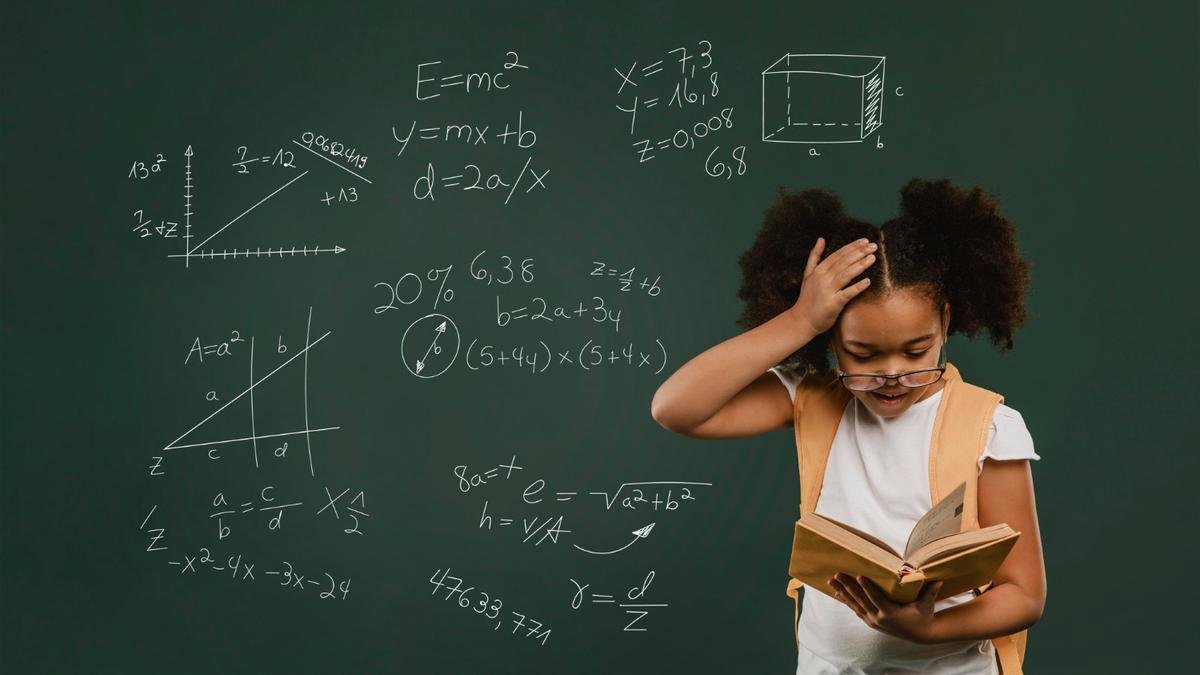
Maths is known as the language of the universe, governing patterns, structures, and change. However, despite having tech-driven classrooms, it often feels disconnected from real life, reduced to symbols and memorised procedures. Students frequently ask, “Where will we ever use this?”This question highlights a failure to connect Maths with meaningful experiences.
One main issue in our education system is the exam-driven culture that emphasises grades. This pressure leads teachers to focus on speed and completing the syllabus, stifling opportunities for exploration and real-world application. Talented students may excel at understanding concepts involving word problems, which often test only procedural skills and use unrealistic situations that fail to connect Maths with everyday life.
Maths is often taught as an isolated subject, lacking connections to fields such as Science, the Humanities, and the Social Sciences. While schools assign interdisciplinary projects where students use graphs for data representation, real-world applications such as budgeting, architecture, and public policy rely heavily on mathematical reasoning. Limiting Maths to textbook exercises prevents students from grasping its interdisciplinary relevance, reinforcing the misconception that it is limited to the classroom.
Strong teachers
Effective Maths education hinges on strong teacher preparation. Many educators lean on procedural methods from their experiences, and may lack conceptual understanding. Ongoing professional development is essential to create engaging lessons that connect Maths to real-world contexts. Creative strategies such as local illustrations or examples can help but adequate time, reflection, and institutional support are often lacking in educational settings.
The fear of losing control in open-ended discussions discourages authentic applications in the classroom. Real-life problems are complex, often requiring assumptions and multiple solutions. Teachers who are accustomed to definitive answers may avoid messy scenarios that foster debate and critical-thinking. It often feels safer to focus on routine algebraic equations than to explore how algebra connects to real-world issues such as population growth or inflation rates.
The educational landscape has grown complex with technological advancements. While educators often emphasise manual computation techniques out of concern for losing computational fluency, this focus can detract from important discussions about understanding and applying mathematical concepts.
Critical thinking
Manual computation is essential for developing number sense and understanding. When classrooms emphasise only algorithmic drills, Maths can become mechanical, leading students to solve problems without grasping their meaning. Prioritising procedural mastery over conceptual understanding hampers critical mathematical thinking. The real danger lies not in forgetting calculations, but in neglecting to think critically about Maths.
Many people believe that Maths is inherently abstract and difficult. When educators adopt this view, they may inadvertently reinforce it through phrases like “This chapter is particularly difficult”, which depicts Maths itself as a challenge rather than an exploration. Syllabus completion takes precedence over meaningful exploration. To foster real-life connections, educators should see Maths as dynamic and relevant to everyday decision-making. Otherwise, the perception of Maths as abstract will persist.
Relevant contexts
Curriculum design can limit the integration of real-life applications in education. Textbooks often present superficial problems, but authentic learning involves in-depth projects that analyse relevant contexts such as household electricity consumption and election data. These projects require a flexible and systematic approach to the curriculum. Viewing Maths as a static subject overlooks its everyday relevance, as quantitative reasoning is essential for decisions such as buying, investing, and assessing risks. Ignoring these practical aspects reduces the social significance of Maths in the classroom.
The links between real-world applications and critical-thinking are cut off in the race against time to achieve correct answers. The gap between school Maths and real-life applications results in students excelling in exams while being mathematically illiterate. They can manage equations and percentages, but struggle with real-world tasks such as evaluating loan terms and interpreting media statistics, which undermines their interest and confidence in Maths.
Restoring connection takes courage and intention. Educators should integrate real-world contexts into lessons, like analysing supermarket discounts for percentages or exploring local architecture in geometry. Asking questions such as “Where else might this concept apply?” can shift perceptions significantly.
Thus, a whole generation is intellectually wasted when the only capability developed is solving equations, but interpreting data, managing finances, or understanding risk are a struggle. Ultimately, it is not Maths that fails students, but rather the way in which it is delivered. When educators focus on contextual understanding, modelling, and interdisciplinary approaches, Maths can become relevant again. The issue is not a lack of real-world applicability, but rather an insufficient commitment to teach it effectively. Until Maths is perceived as a dynamic tool rather than a static curriculum, questions like “Why is Maths necessary?” will continue to be asked. The need of the hour is to reassess instructional methods in bridging the gap between classroom experience and real-world realities.
The writer is a Maths Teaching Professional, Central Board of Secondary Education, Hyderabad.
Published – March 26, 2026 02:30 pm IST