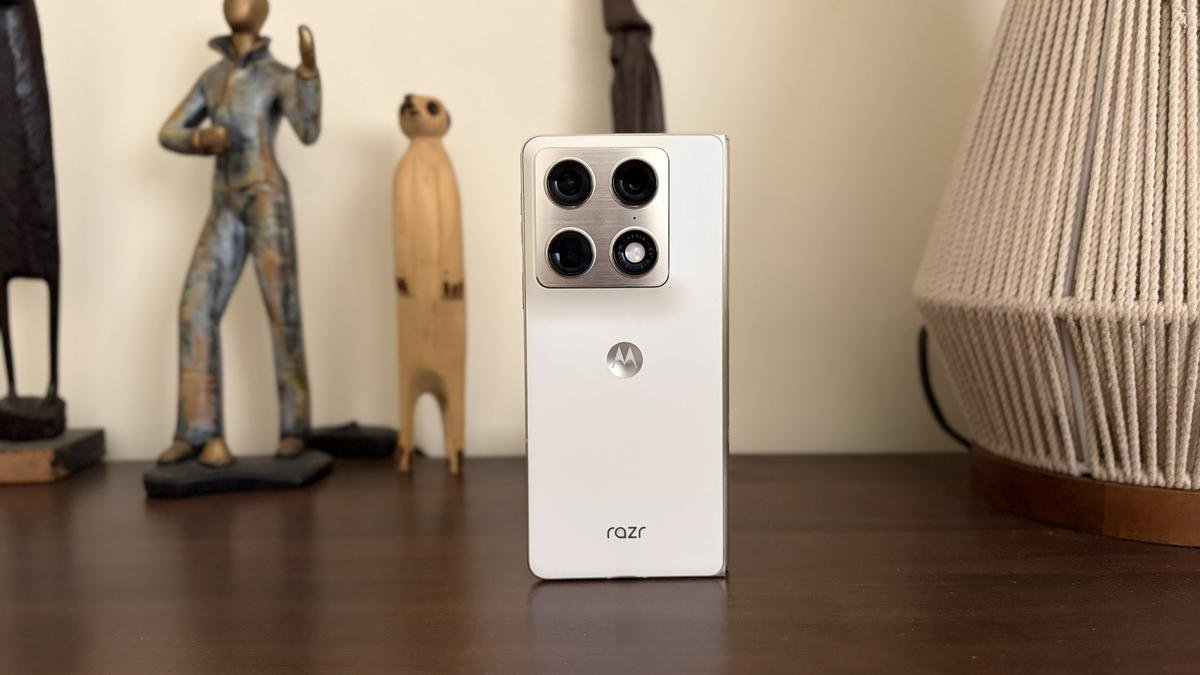
The foldable segment may not be the most crowded, but it is fiercely competitive and in India, the stakes have never been higher. Motorola steps into this evolving market with the Motorola Razr Fold, priced at ₹1,49,999. Motorola’s flip phone pedigree has clearly informed the Razr Fold’s sturdy, confident build — but flip phones and foldable phones are very different beasts. The real question is whether Motorola can match rivals like Samsung and Vivo, who have years of fold-specific learnings baked into their hardware and software. That gap in generational experience is precisely what makes this launch so fascinating to test.
So, who is the Razr Fold for? Whether you are a multi-tasker chasing screen real estate, a professional who wants a productivity powerhouse in their pocket, or simply someone who wants a phone that turns heads, Motorola wants the Razr Fold to be your answer. But wanting and delivering are two different things. We pit it against the Vivo X Fold 5, the Samsung Galaxy Z Fold 7, and the Google Pixel 10 Pro Fold to find out if it truly earns its place at the table.
Design
The Motorola Razr Fold comes with its own unique personality. With rounded edges and a broad frame, it is definitely on the bulkier and heavier side when compared to rivals like the Vivo X Fold 5 and the Samsung Galaxy Z Fold 7. Yet, surprisingly, it never feels uncomfortable in the hand. Even when unfolded, the weight distribution is balanced enough that it does not strain your wrist during longer use. It only takes a few hours before the form factor starts feeling natural.
The camera island immediately gives away that you own a Motorola phone. The large rectangular camera module stands tall, but it blends neatly into the overall design language. My Pantone Lily White review unit looked elegant with its silk-inspired finish, while the aluminium frame added a reassuring sense of rigidity. Motorola ships the phone with a protective case, but honestly, the device already feels sturdy enough on its own. Adding the case only makes the Razr Fold feel thicker. Despite the size, it still slides into jeans pockets more easily than expected.
Motorola Razr Fold
| Photo Credit:
Haider Ali Khan
Motorola has used premium materials throughout the body. The phone features an aircraft-grade steel hinge with titanium reinforcement, and the hinge itself feels reassuringly tight. The fold mechanism shuts flat with almost no visible gap. Motorola claims advanced crease-minimising engineering, and it genuinely shows. Compared to the Google Pixel 10 Pro Fold, the crease here is less distracting during everyday use. The phone is also among the few foldables offering IP48 and IP49-rated protection, giving it stronger dust and water resistance than Samsung’s Fold 7. The addition of Gorilla Glass Ceramic 3 protection further improves durability, which is still a concern for many foldable buyers.
The front display has slim bezels and looks modern without appearing overly narrow like older Samsung Fold models. Open the phone and the massive inner display stretches edge to edge beautifully. The buttons are tactile, the fingerprint scanner is quick, and the USB-C port placement feels natural. At 240 grams, it is heavier than the Vivo X Fold 5’s 217 grams and the Samsung Galaxy Z Fold 7’s 215 grams, but Motorola compensates with a sturdier in-hand feel.
Display
Motorola has gone all out with the displays here. The outer 6.6-inch AMOLED panel feels spacious enough to function like a normal flagship phone. Unlike earlier foldables where the cover screen felt secondary, this one is genuinely practical. It supports a 165 Hz refresh rate, which is currently among the highest on a foldable, and reaches a claimed 6,000 nits peak brightness. Outdoors, visibility remains excellent even under harsh sunlight. Colours appear rich, blacks are deep, and scrolling feels incredibly fluid.
When unfolded, you get to see an 8.1-inch 2K LTPO AMOLED display that has 6,200 nits brightness support. It is immersive in every sense. Watching HDR content, gaming, reading documents, or multi-tasking across split screens feels fantastic here. The crease is present if you deliberately look for it, but during normal usage it almost disappears. Motorola deserves credit for this because crease visibility remains an issue with several foldables, including the Google Pixel 10 Pro Fold. Compared to the Vivo X Fold 5, the Razr Fold’s display feels brighter, while Samsung’s Fold 7 still slightly edges ahead in display calibration and efficiency.
OS and AI
The Razr Fold runs Hello UI based on Android 16, and the software experience feels cleaner than expected. Motorola has stayed close to stock Android while adding foldable-specific optimisations. Split-screen multi-tasking, floating windows, adaptive layouts, app continuity, and laptop-style fold positioning all work smoothly. The larger display genuinely improves productivity rather than just acting as a bigger screen.
AI is deeply integrated. Motorola bundles Moto AI 2.0 alongside Google Gemini and Microsoft Copilot integration. Features like Catch Me Up 2.0, AI Recall, Pay Attention, Next Move Suggestions, and intelligent memory retrieval make the phone feel smarter during daily use. There is also a dedicated AI key for quick access to Generative AI tools. While Samsung still leads in terms of foldable multi-tasking polish with One UI 8, Motorola’s implementation feels cleaner and less cluttered. Vivo’s Funtouch OS still trails behind both in AI integration and software maturity.
Performance
Powering the Razr Fold is Qualcomm’s Snapdragon 8 Gen 5 processor built on TSMC’s 3nm architecture. Here, I am disappointed because the same processor can be found in phones that cost under ₹40-50,000. My review unit came with 16 GB LPDDR5X RAM and 512 GB UFS 4.1 storage, and performance was flagship-grade throughout. Apps opened instantly, multi-tasking remained fluid, and even heavy workflows never slowed the phone down. Motorola’s liquid cooling system also deserves praise because thermal control stayed impressive during extended gaming sessions.
Benchmark scores further reinforce the performance story. On Geekbench, the Razr Fold scored 2614 in single-core and 8905 in multi-core tests. The GPU score stood at 17159, while AnTuTu returned a massive 2847343 points. That comfortably places it ahead of the Google Pixel 10 Pro Fold’s Tensor G5-powered performance, which scored 1486598 on AnTuTu. It also edges past the Vivo X Fold 5’s Snapdragon 8 Gen 3 setup in raw benchmark output, while competing closely with Samsung’s Fold 7 Elite chipset in real-world usage.
Gaming performance is excellent too. The large inner display makes gaming feel more immersive — almost like carrying a mini gaming tablet in your pocket. The stereo speakers tuned by Bose also add noticeable depth and volume to the experience.
What stands out most, though, is how stable the phone feels under pressure. Foldables often prioritise form over sustained performance, but Motorola has balanced both well here. Whether editing videos, juggling multiple apps, or gaming for hours, the Razr Fold rarely feels overwhelmed.
Camera
Motorola has clearly made the cameras a major selling point here. With five cameras in total — three at the back and two selfie shooters — the Razr Fold aims to be more than just a productivity device. And honestly, this might be one of the best camera systems currently available on a foldable phone.
The rear setup includes a 50 MP Sony LYTIA 828 main sensor, a 50 MP periscope telephoto lens with 3x optical zoom, and a 50 MP ultrawide plus macro camera. There is also a 32 MP inner selfie camera and a 20 MP outer selfie shooter. Motorola’s use of Pantone colour validation and Pantone SkinTone calibration gives images a more natural and premium look compared to Samsung’s sometimes oversaturated processing.
Daylight images are sharp, vibrant, and detailed without looking artificially boosted. Motorola’s AI refinement is visible, but thankfully, it does not aggressively overprocess shots. Dynamic range is excellent, textures remain intact, and highlights are handled cleanly. Portrait shots especially impressed me. Edge detection was reliable, skin tones looked natural, and the DSLR-style focal lengths added a cinematic feel to photos.
Low-light photography is another strong point. Motorola’s larger sensor and AI noise reduction help preserve shadows and reduce grain effectively. Night shots looked closer to real-life lighting conditions instead of unrealistically bright scenes. Compared to the Samsung Galaxy Z Fold 7, the Razr Fold consistently produced cleaner low-light images with better texture retention. The periscope lens also performed surprisingly well even at higher zoom levels.
Video performance deserves a mention too. The phone supports 8K Dolby Vision recording and 4K 60fps recording from all sensors with stabilisation. Video quality looks cinematic, and the 3.5-degree OIS genuinely helps with stability while walking. Selfies from both cameras are detailed and social-media ready, though the rear cameras paired with the cover display naturally produce the best results. Overall, Motorola has managed to deliver a foldable camera experience that feels flagship-grade.
Battery
The Razr Fold packs a massive 6,000 mAh silicon-carbon battery, which is currently among the biggest batteries on any foldable phone. On paper, the large displays may make that number seem necessary, but in actual use, battery life turned out to be excellent. Even with heavy multi-tasking, gaming, camera use, and extended screen time, the phone comfortably lasted a full day and often stretched beyond that.
Charging speeds are equally impressive. Motorola offers 80W wired charging, 50W wireless charging, and even reverse charging support. Compared to Samsung’s painfully slow 25W charging on the Fold 7, the Razr Fold feels dramatically quicker. Vivo’s X Fold 5 remains competitive here, but Motorola still delivers one of the best overall battery experiences in the foldable category.
Verdict
The Motorola Razr Fold is a genuinely impressive package — especially for a brand stepping into the fold form factor for the first time. The camera system is impressive, the displays are the brightest in the segment, the software commitment is strong and the battery/charging performance is compelling. But stepping into a market where Samsung has iterated for years and Vivo has refined its own formula comes with inherent questions that buyers will inevitably ask.
The Razr Fold convincingly answers most of them. At ₹1,49,999, it matches the Vivo X Fold 5 in terms of its price while offering a newer processor, better cameras, and stronger displays. Against the Samsung Galaxy Z Fold 7 at ₹1,74,999, it undercuts significantly while trading blows where it matters. Whether consumers will back a first-time fold entrant over established names is the real unknown. But when considering hardware merit alone, the Motorola Razr Fold boldly claims a seat at the power players’ table.