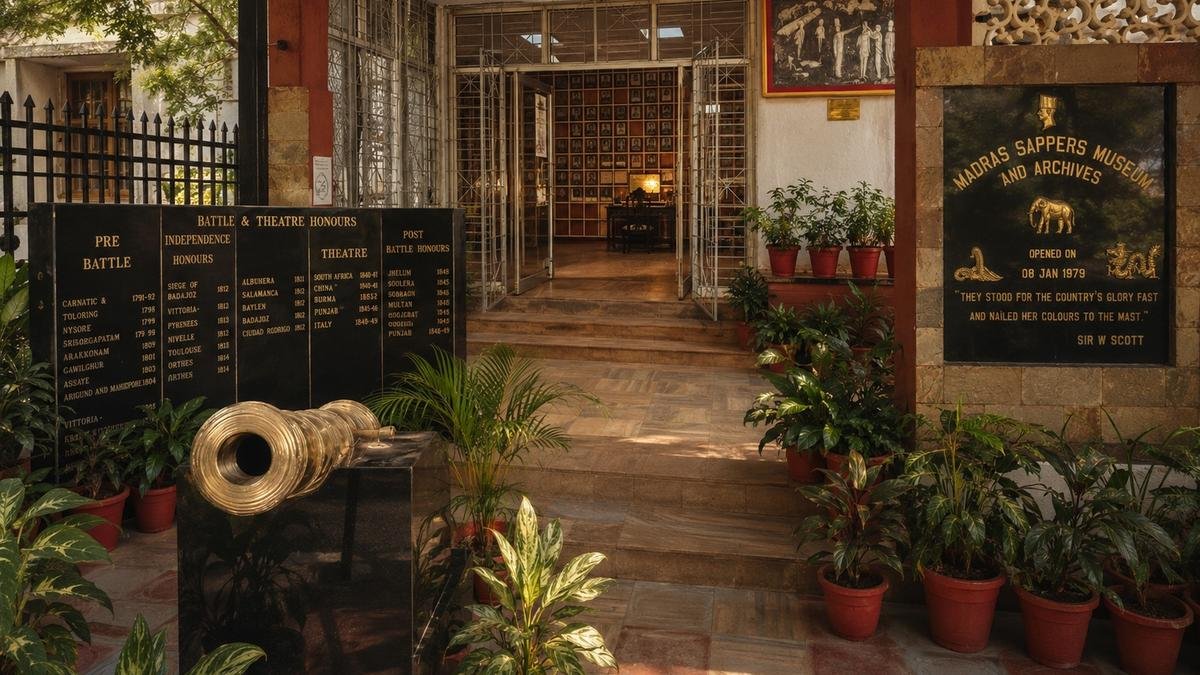
Two years ago, Kayal Kanni, the granddaughter of a Sapper, Marimuthu, visited the Madras Sappers Museum and Archives (MSMA) — that showcases the history of the Madras Engineer Group (called the Sappers, a regiment raised in 1780 ) — in Bengaluru to learn about how her grandfather passed away.
Kayal, who visited with her mother, sister, and cousins, says, “My mother Maheshwari was just a year old when he went to Singapore to fight in the Second World War. She was only two when he passed away there. The family came to know of his death only after the war ended and a prisoner of war from a neighbouring village informed us after he returned home.” Kayal initially went to Singapore looking for his burial spot but “we found only Christian and Muslim graves. We were told that the Hindus were cremated. After we learnt that my grandfather was in the Madras Sappers, we visited the museum to learn more.”
Over 250 photographs have been restored, many enhanced using AI, that showcase the Sappers’ history
| Photo Credit:
Special Arrangement
Colonel Uday Sankeshwar (Retired), Director, MSMA, which opened to the public on June 1, 2026, says, “We showed them his photographs and this also helped us identify images from that period as many were undocumented. It was an emotionally-charged meeting.”
This experience, among many others, is perhaps what led the Indian Army to open the Madras Sappers Museum to the public for the first time since it was first set up in 1979. The museum, he shares, was started with the intention of telling the history of the Sappers, the oldest regiment of the Corps of Engineers of the Indian Army. “The team began with collecting artefacts such as workshop instruments, medals, machinery, weapons, and photographs that were gifted to the museum by retired officers,” says Colonel Uday, who took charge in 2024 with the intention of making it “permissible to the younger generation”.
A snapshot of the outdoor gallery
| Photo Credit:
Special Arrangement
The museum houses an outdoor gallery, and an indoor one that spans three halls. Over 250 photographs have been restored, many enhanced using AI, that showcase the Sappers’ history: snapshots of drill practice at Ulsoor Lake, a group repairing a breach in a railway line near the Tigris in West Asia, recruitment drills, and victory parades to name a few. The meticulously detailed artefacts displayed across the halls tell the story of the wars fought, regimental history, and detail engineering equipment, instruments, and prototype mines. Some of the prized artefacts include a 13th Century fired clay vase from China, a bronze bell from China’s Peiping Temple, a Japanese samurai sword, intricately hand-drawn Burma and Indo-China maps on silk, and a mural made by a thambi (the Madras Sappers’ troops are fondly referred to as thambis) that outlines their footprint pre and post the World Wars.
A snapshot from the heritage walk
| Photo Credit:
Special Arrangement
Overlooking documentation aside, exposing young minds to the Indian Army is a priority at the museum. And this is being done by way of an internship programme that was launched two years ago. The team is open to college students studying the Arts — Political Science, History, Sociology, and Psychology. “A student who interned with us and studied military psychology has now landed a job at the Army school in Jaipur,” he shares.
The indoor gallery spans three halls
| Photo Credit:
Special Arrangement
In a bid to make the museum accessible to diverse audiences, it has been made accessible to people with disabilities by including a ramp, and audio, braille guides are in the works. “These are small steps we are taking to be inclusive and self-reliant. Having said that, updating the museum is an ongoing programme and we are open to volunteers and donors with CSR funds.” Since January 2026, heritage walks have been hosted at The Madras Sappers Headquarters by Bengaluru Prayana. “Held on one Saturday every month, this walk tells the history of the city, how Bangalore Cantonment came into being, how it expanded, and how the city has grown around it,” he says. Initiatives, he believes, are crucial for the younger generation to get involved. “They not only build character and personality, but help youngsters get over the fear of uniformed personnel. They get to see things beyond social media,” he concludes.
Madras Sappers Museum and Archives is open Monday to Saturday from 9am to 3pm. It is located at The MEG Centre, Kensington Road, Ulsoor. Tickets are at ₹50 for an adult, and ₹20 for a child below 10 years. For details, call 6363838095.
Published – June 16, 2026 04:44 pm IST