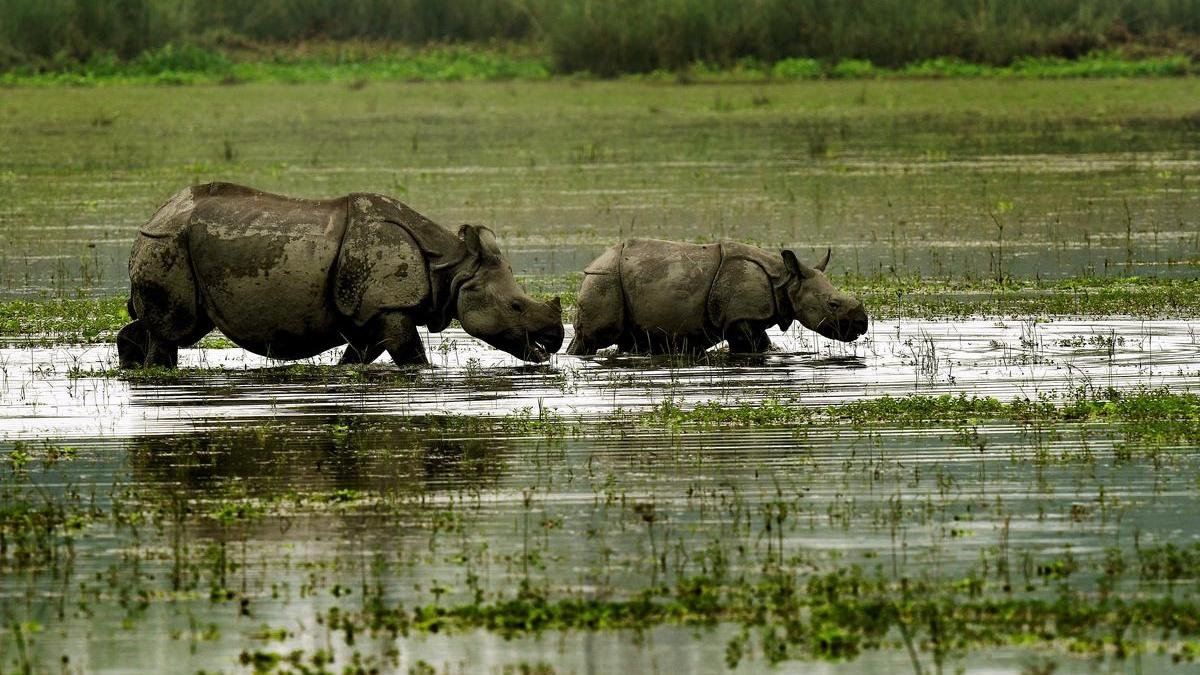
Image for the purpose of representation only.
| Photo Credit: File
GUWAHATI
Eight wildlife sanctuaries and 281 reserve forests are under encroachment in Assam, the State’s Forest and Environment Minister Jayanta Mallabaruah told the 126-member Assembly on Tuesday (July 7, 2026).
Presenting data on encroachment and human-elephant conflict in the House, he said 315,996.1251 hectares of land in these protected areas and reserve forests were under illegal occupation on February 12, 2016. The State government has so far evicted squatters from 25,588.7675 hectares, including 16,937.2466 hectares during the last five years.
Kerala seeks amendments to Wildlife Protection Act for effective management of human-wildlife conflicts
The Bharatiya Janata Party-led National Democratic Alliance formed the government in Assam in 2016, ending the Congress’s 15-year rule.
According to the data, Sonai-Rupai Wildlife Sanctuary in Sonitpur district has the largest area under encroachment at 10,000 hectares, followed by Marat Longri Wildlife Sanctuary in Karbi Anglong district with 4,429 hectares. Laokhowa Wildlife Sanctuary in Nagaon district has the least encroachment at 11.7 hectares.
Replying to a question by Asom Gana Parishad MLA Diptimoyee Choudhury, Mr. Mallabaruah said 17,421.5 hectares across the eight wildlife sanctuaries and 296,717.935 hectares across the 281 reserve forests remain under encroachment.
He also said the Forest Department has so far re-greened 2,531.2 hectares of the total land freed from encroachment.
The Minister, replying to a related question by Congress MLA Rekibuddin Ahmed, said the area under forest cover in Assam increased by 208.55 sq. km, from 28,105 sq. km in 2017 to 28,313.55 sq. km in 2023. He cited data from the India State of Forest Report for the two years.
“Assam’s total forest cover is 36.1% of its total geographical area of 78,438 sq. km,” Mr. Mallabaruah said.
Human-elephant conflict
The Minister admitted that the human-elephant conflict situation has remained grim despite efforts to evict squatters from protected areas and re-green areas flattened by encroachers.
The data he presented showed that such conflicts have claimed 1,150 human lives since 2016. Fifty-three people were killed between January and June 2026, more than half the number of deaths recorded across the State’s 45 forest divisions in 2016, when 98 people were killed. The data also showed that 2025 was the worst year, with 138 deaths.
According to the data, farmers in the conflict zones have consistently suffered crop damage. They lost crops on 6,286 bighas in 2016 and 8,084 bighas in 2017, but the losses decreased thereafter, reaching 3,519 bighas in 2025.
A bigha in Assam equals 0.33 acres.
The number of houses damaged in these conflicts increased from 1,310 in 2016 to a high of 1,759 in 2023. The figure for 2025 was 1,139.
A total of 246 elephants died in these conflicts during the period. Most died due to electrocution, followed by train hits and poisoning.
Published – July 07, 2026 03:15 pm IST