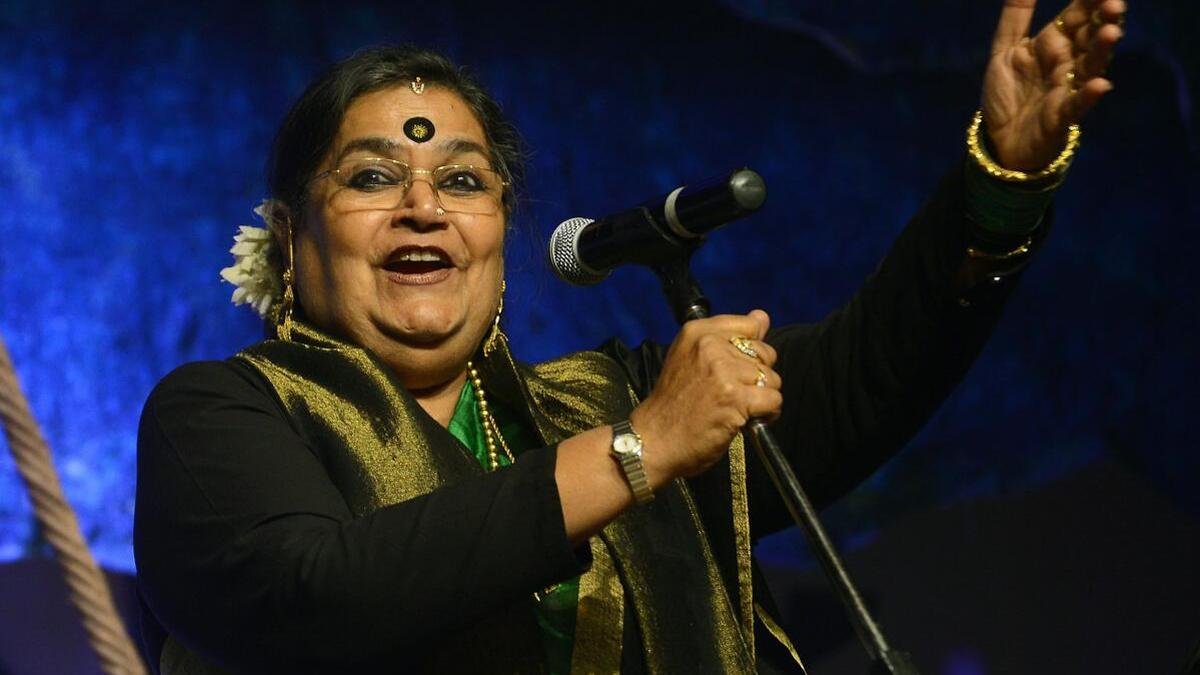
“Trincas is like home to me. It is my mandir, it is my masjid, it is my girija. It is my hallowed ground, really. I still feel a lump in my throat when I enter it. Trincas is my everything,” says legendary singer and Padma Bhushan and Padma Shri awardee Usha Uthup, with a reservoir of gratitude in her heart.
On July 19, some of this rich history will be brought back to life. As part of The Hindu Lit for Life Unplugged, legendary singer and author Usha Uthup and historian Anand Puri, third-generation custodian of Trincas, will come together at the iconic Park Street institution for When Park Street Sings: A Conversation on Music, Memory & Kolkata. Moderated by The Hindu‘s Associate Editor Shonali Muthalaly, the evening will trace Usha Uthup’s musical journey while revisiting the story of Trincas, Park Street, and a city that once made music every night of the week.
Usha Uthup with her first band, The Conquerors
| Photo Credit:
Special Arrangement
A city remembers
For nearly a century, generations have walked through Trincas carrying vastly different ambitions. Some came looking for music. A few arrived before they became famous. Many left having witnessed history without quite realising it.
The Park Street Circuit
In the 1960s, Park Street functioned as India’s live music capital.
Almost every major restaurant employed resident bands, creating what musicians called the Park Street circuit. Audiences could move from venue to venue in a single evening, discovering different orchestras, singers and dance bands.
Trincas became the circuit’s marquee address, known for its expansive dance floor, discerning talent scouting and jam sessions that drew the city’s young Anglo-Indian musicians.
Industrialists shared tables with actors. Maharajas crossed paths with musicians. Indian and West Indian cricket legends unwound here after matches. A young Amitabh Bachchan walked through its doors before superstardom. So did Sharmila Tagore, Saira Banu, and Randhir Kapoor. One evening in the 1980s, members of the British rock band The Who wandered in and found a live band playing their songs, unaware that the original band members were among the audience.
A 1936 image of Flurys and Trincas in Park Street. Both started off as tea rooms. Trincas, began in 1927 as a Swiss confectionery and tea room, established by Quinto Cinzio Trinca and Joseph Flury.
| Photo Credit:
Special Arrangement
Usha remembers the time when Bengal’s most acclaimed and loved actor Uttam Kumar walked in. “I didn’t even know who Uttam Kumar was when I first arrived in Kolkata. On my second or third day at Trincas, he came to watch me perform. One of the musicians leaned over and said, ‘The crowd is going wild because that’s Bengal’s biggest star’. I remember thinking how incredibly debonair and handsome he looked,” recalls the singer.
A poster of the event
| Photo Credit:
The Hindu
For Anand, who has spent years researching his forthcoming book chronicling 100 years of Calcutta through the story of Trincas, the restaurant is far more than a celebrated address on Park Street.
Anand Puri at Trincas
| Photo Credit:
Special Arrangement
In the 1960s, Park Street had become what Anand calls “the most exciting entertainment destination in India”. Every restaurant had a live band. Diners drifted from one venue to another, following the music as naturally as they followed dinner. Trincas stood at the centre of that constellation.
“It had the biggest dance floor. The talent selection was spot on,” Anand says. “The younger crowd, especially Anglo-Indian musicians, gathered there for morning and afternoon jam sessions. By evening, the city’s glitterati took over,’’ he adds.
A 1964 image of Ken Gnanakan, Raj Menon, Hazel Hughes and Biddu Appaiah
| Photo Credit:
Special Arrangement
Stories from the tables
Long before they became international names, performers such as Engelbert Humperdinck, then still performing as Arnold Dorsey, and music producer Biddu Appaiah performed on the Trincas stage. Biddu would later go on to produce ‘Kung Fu Fighting’ before reshaping Indian pop through artistes including Nazia Hassan, Alisha Chinai, Shaan, and Shweta Shetty.
Usha Uthup, with Shankaramurthi from BBC Tamil Service on April 14, 1981.
| Photo Credit:
The Hindu Archives
In 1969, during a hotel association conference in Madras, Anand’s grandfather watched a young singer named Usha Iyer perform. Convinced he had discovered an extraordinary voice, he returned to Calcutta and spoke to his business partner Ellis Joshua, who handled Trincas’ music programming. Soon afterwards, an inland letter was sent inviting the young singer to Park Street. The rest belongs to Kolkata’s cultural memory.
Anand believes Usha’s arrival transformed the room almost overnight.
“No one expected a sari-clad lady with a large bindi to sound like a Western crooner. The singers on Park Street usually wore gowns and evening dresses. Ushaji surprised everyone,’’ he says.
A recent picture of Trincas in Park Street, Kolkata
| Photo Credit:
Special Arrangement
Soon there were queues stretching outside Trincas. Audiences came as much for her wit as her unmistakable voice.
Anand has spent years working on the Trincas Timeline Project, an ongoing archive of anecdotes shared by former patrons scattered across the world. His forthcoming book, which will be announced at the event, follows those stories across continents, tracing migrations from the Swiss Alps, Lahore, and Rangoon into Calcutta.
Usha Uthup at Trincas
| Photo Credit:
The Hindu Archives
The conversation at The Hindu’s Lit for Life event will also turn the pages of Usha Uthup’s memoir, The Queen of Indian Pop: The Authorised Biography of Usha Uthup.
What to expect at Lit For Life Unplugged
How a young Tamilian singer from Mumbai became synonymous with Kolkata.
Why Park Street became India’s entertainment capital.
The untold stories behind Trincas’ century-long history.
The making of Anand Puri’s forthcoming book chronicling 100 years of Calcutta through Trincas.
Why restaurants often become repositories of a city’s memory.
Speaking of the book, published by Penguin Random House, Usha recollects, “It actually began as an interview I was supposed to do with journalist Vikas Kumar Jha. We started talking, and the interview became so interesting. At one point I wondered, “How can this remain just an interview?” That’s when he suggested, “Let’s make it a biography.” The book was originally written in Hindi and titled Ullas Ki Naav. We managed to draw out memories that had been deeply embedded in my mind, tucked away in forgotten corners. The English translation, The Queen of Indian Pop, was beautifully done by Srishti Jha.”
“When I revisit it now, my favourite chapters are the ones about my childhood. I remember spending afternoons with my brother, lying on the crook of a guava tree, reading comics. Another chapter I love is about making strings for my brothers’ kites,” outlines the singer.
Usha Uthup and Kolkata
For Usha, Kolkata became the city that shaped her life in indelible ways. “I love Calcutta,” she says simply. “It gave me my husband. It gave me my music. My children grew up here, “ she recalls.
Then she reaches for a metaphor that only someone who has lived in a city for half a century could find: “The thing about Calcutta is that it grows on you. One day, you realise it’s in your bloodstream. You never quite know when you started loving it.”
Over the decades, the city became home and was more than the backdrop to a remarkable musical career.
“I want it to be peaceful. I want it to be clean, green, safe and secure for everyone. I want us to move towards bringing back the beautiful things that have always defined this city: unity and complete secularism. And like I always say, why spend so much time to fight when there’s so little time to love?”, says the singer.
That outlook, she says, comes from her father, whose advice has remained her compass through success and uncertainty alike.
“Whenever you come to a crisis,” he would tell her, “ask yourself three questions: Who am I? Where did I come from? Where am I going?”
“If you answer those honestly,” she says, “you’ll have no reason to feel frustrated.”
The lesson has shaped the way she measures success. Her first salary, she remembers, was ₹750 a month. Today, despite global acclaim, she refuses to compare herself with others. “My father always said, ‘Never compare yourself with anyone else. Compare yourself with who you were.’ When I think about where I came from and where I am today, I feel nothing but gratitude.”
It is this blend of warmth, wit, and groundedness that has endeared Usha Uthup to Kolkata for more than five decades. On July 19, at The Hindu Lit for Life Unplugged at Trincas, audiences will hear her reflect on that lifelong relationship with the city through stories of music, memory, family and the unlikely journey that turned an invitation to sing into a place called home.
For one evening, the stage that launched careers, hosted legends and the soundtrack of Kolkata will once again become a place where stories are performed.
The Hindu’s Lit for Life Unplugged
| Photo Credit:
The Hindu
Lit for Life Unplugged, part of The Hindu‘s Lit for Life festival, comes to Trincas on July 19 at 4.30 p.m. Entry is free with prior registration. Drinks and food are on you, the stories are on us. With just 100 seats available, register early and step into the room where Kolkata’s soundtrack was once written. Click on the following link to register: https://forms.thehindu.co.in/LFLunplugged/