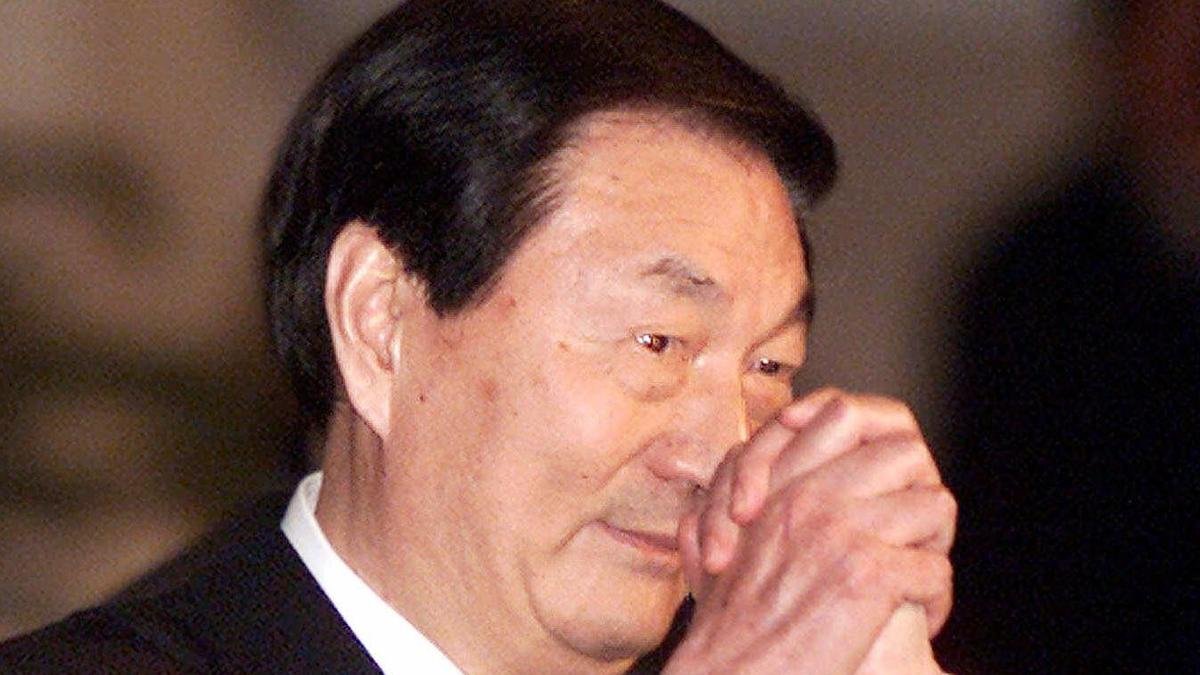
Zhu Rongji, the former Premier of China who played a key role in driving China’s economic reforms and transforming the country into a global economic power, died on Wednesday (August 12, 2026), aged 97.
Zhu passed away in Beijing from illness, the State-run Xinhua news agency said, adding that an obituary issued by the ruling Communist Party “extolled Zhu as an excellent Party member, a time-tested and loyal communist fighter, and an outstanding proletarian revolutionist, statesman and leader of the Party and the State.”
Also read: In China’s parliament, a long list of millionaires
“Boss Zhu”, as he came to be known, played a transformative role in driving China’s economic restructuring and reforms under then leader Deng Xiaoping, first as the head of the central bank and then as Premier from 1998 until 2003.
“In his one term as Premier,” writes the economist Arthur Kroeber in China’s Economy, “he masterminded the reorganisation and downsizing of State-owned Enterprises (SOEs), recapitalisation and reform of the banking system, privatisation of the housing market, and China’s long-delayed entry into the World Trade Organisation. Zhu is widely considered the most effective economic leader in the history of the People’s Republic.”
Zhu’s rise to the top and his emergence as the face of China’s reforms were by no means straightforward. Zhu was born in October 1928 in Changsha, the provincial capital of southern Hunan province, sharing the same home as Mao Zedong.
Former Chinese Premier Zhu Rongji stands during a parade commemorating the 70th anniversary of Japan’s surrender during World War II held in front of Tiananmen Gate in Beijing, on September 3, 2015. File
| Photo Credit:
AP
Their similarities ended there. Graduating from Beijing’s Tsinghua University, Zhu found himself in Mao’s crosshairs during the “Anti-Rightist” purge launched by Mao in the late 1950s.
During the “Hundred Flowers” campaign in 1957, when Mao invited criticisms of his policies, Zhu spoke out about the flawed focus on high growth, an obsession that later had devastating consequences during the “Great Leap Forward” and famine that claimed millions of lives between 1958 and 1962. For his views, he was purged from the party in 1958, accused of being a “Rightist.” During Mao’s Cultural Revolution (1966-76), Zhu was sent, along with thousands of other Chinese intellectuals, to do labour in the villages.
After Mao’s death, Zhu and many others were rehabilitated by Deng Xiaoping. Zhu was sent to lead Shanghai in 1988, first as mayor and then as the party boss. He spearheaded the setting up of Pudong – then barren farmland – as a pilot area of reforms and opened up Shanghai to foreign investment.
Former Chinese Premier Zhu Rongji, centre, listens to a speech by Chinese President Xi Jinping during the opening session of China’s 19th Party Congress at the Great Hall of the People in Beijing, on October 18, 2017. File
| Photo Credit:
AP
In 1989, amid inflation and corruption during the first decade of Deng’s economic reforms, the student movement calling for democracy and political reforms had posed an existential threat to the Communist Party before its brutal crushing by Deng and then Premier Li Peng.
Zhu was brought to Beijing to help fix the economy. He was appointed Governor of the People’s Bank of China, the central bank, and Vice Premier. Zhu helped bring down inflation and protect the economy during the Asian Financial Crisis. His reward was his appointment to succeed Li as Premier in 1998.
Zhu broke up the SOEs — a painful reform that led to millions losing their jobs and the end of the “iron rice bowl” of state-guaranteed jobs and benefits — and opened up the housing market. In five years, he transformed the economy and shepherded the negotiations leading to China’s entry into the WTO in 2001.
In 2002, Zhu visited India as Premier as the guest of Prime Minister Atal Bihari Vajpayee, pushing for closer economic ties between two countries that were then in the early steps of their reforms journeys.
Then German Chancellor Helmut Kohl, right, welcomes then Vice Prime Minister of China Zhu Rongji to talks in Bonn Chancellor’s office on Feb. 9, 1996. File
| Photo Credit:
AP
Zhu told Vajpayee then that both countries had “similar national conditions as both of them are engaged in all-round economic reform”, and “faced with the common task of developing their economies should compare notes and learn from each other in their process of development.”
Trade between the two countries grew rapidly from around $4 billion at the time of his visit, to more than $70 billion within a decade, when China, which had grown into a lynchpin of global trade, became India’s biggest trade partner.
Visiting the Infosys campus in Bengaluru, he famously declared that “India is number one in software, and China is number one in hardware.” “If we put these together, we can become the world’s number one,” he said.
He reportedly took “15 minutes” to approve, on the spot, a request from Infosys to open an office in Shanghai, which remains today.
Published – August 12, 2026 05:03 pm IST