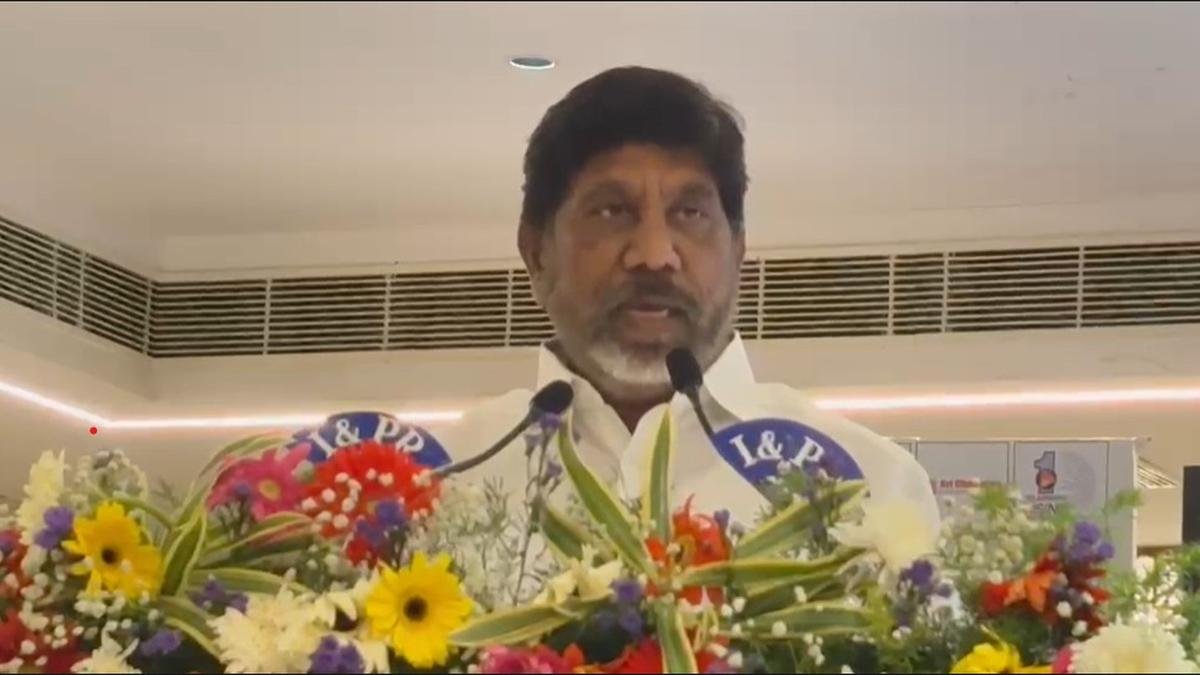
Telangana Deputy Chief Minister Mallu Bhatti Vikramarka while speaking at the Federation of Press Clubs National Conclave in Hyderabad
| Photo Credit: Special Arrangement
Telangana Deputy Chief Minister Mallu Bhatti Vikramarka said a strong democracy means people in power accepting the legitimacy of criticism from the media and described journalism as a tool to make power explain itself.
“Governments and journalists were not expected to agree all th4e time, and if they did, citizens should perhaps start worrying,” he remarked while speaking at the Federation of Press Clubs National Conclave in Hyderabad on Saturday (August 22, 2026).
Bhatti Vikramarka charges BRS leaders with attempts to mislead people against govt.
“Journalism performs one of democracy’s most necessary functions: it makes power explain itself,” he said, calling upon the newly formed Federation of Press Clubs to evolve into a strong institution that protects journalists, upholds professional standards and safeguards journalism as a democratic public function rather than merely a commercial enterprise.
Mr. Bhatti invoked former Prime Minister Jawaharlal Nehru’s famous message to cartoonist Shankar, “Don’t spare me, Shankar”, to underline the importance of criticism in a democracy.
The Deputy CM recalled that journalism had historically played a crucial role in the making of India and had never been “just another profession”. He referred to Mahatma Gandhi’s Young India, Navjivan and Harijan; B.R. Ambedkar’s Mooknayak and Bahishkrit Bharat; Lokmanya Tilak’s Kesari and Mahratta; Dadabhai Naoroji’s Rast Goftar and Maulana Abul Kalam Azad’s Al-Hilal.
“Publications such as Amrita Bazar Patrika and The Hindu had also helped shape public opinion during the colonial period,” he said.
The common thread, according to Mr. Bhatti, was that journalism was not merely about producing news but about “producing citizens” by informing people, awakening them, challenging authority and giving a voice to those with little power. “Their reason for existence was larger than their balance sheet,” he said.
Referring to the role of journalism in contemporary India, he said the media should not stop at reporting events but should sometimes examine what those events meant for society. He referred to a recent “purification” ceremony at a venue in Haldwani after Congress president Mallikarjun Kharge had addressed a gathering there, saying, “The political party is incidental. The principle is not.”
He also questioned whether the institution of the editor continued to command the same authority it once did. Recalling the influence wielded by editors and newspaper proprietors such as Ramnath Goenka, Mr. Bhatti said the media should introspect on whether it retained the ability to make governments uncomfortable.
While acknowledging the commercial realities of running news organisations, he cautioned against allowing journalism to become “only a trade”. “A newspaper must have a market. But journalism must have a purpose,” he said.
On the challenges posed by social media and artificial intelligence, Mr. Bhatti said: “Technology has democratised the right to speak, with discipline compromised. In such an environment, credibility has become journalism’s most valuable asset,” he said.
“For a government prepared to listen, a good reporter is sometimes the best early-warning system we have,” he felt. He said Telangana had a long tradition of people speaking their minds and asserted that the State government respected freedom of expression. “Speak freely. Question freely. And let those in power have the courage to listen,” he said.
N. Ram, director of The Hindu Group; K Sreenivas Reddy, chairman of Telangana Media Academy; Gautam Lahiri, Chairman of the Federation; Ananthnath, editor, Caravan; Sangeeta Barooah Disharoty, president, Press Club of India; and S. Vijay Kumar Reddy, president of Press Club Hyderabad were among those who spoke.
Published – August 22, 2026 04:48 pm IST