Twenty years ago, Sabyasachi Mukherjee went to New York with a collection called ‘Snail’, a move perversely quiet for a designer known for bohemia and handcraft: school uniforms, maternity wear, clean shapes, cotton and restrained embroidery, arguing for slowing down in an age of mass production. New York Fashion Week, he thought, would be the start of something; instead, it became a lesson in timing. His own account is blunt: too ambitious, too little power. He promised himself he’d return when the time was right.
Sabyasachi Mukherjee at New York Fashion Week
| Photo Credit:
Dan Lecca
On Tuesday afternoon, he did. American supermodel Christy Turlington opened ‘Bengal Byzantine Broadway’ in a denim-on-denim Canadian tuxedo, wearing high jewellery, a sly pairing of the everyday and the spectacular. A gold cuff set with garnet and tourmaline cabochons, its form borrowed from a third-century Roman sarcophagus, moved up and down her wrist. A Byzantine animal panel elsewhere became a tiger-claw necklace, brown diamonds catching the light with each step. Museum objects acquired bodies, gestures and attitude.
Christy Turlington opened ‘Bengal Byzantine Broadway’ in a denim Canadian tuxedo, wearing high jewellery
| Photo Credit:
Dan Lecca
Christy Turlington for Sabyasachi Mukherjee
| Video Credit:
The Hindu
“It was an homage to how Indians dress and how Americans dress,” Mukherjee said backstage, referring to the look as “a bridge between the east and the west”. But a bridge implies two banks that still need connecting; the clothes suggested otherwise. He doesn’t translate himself for the room anymore.
When denim met Bengal embroidery
That ease came slowly. With the ‘Save the Saree’ campaign around 2010, Mukherjee began experimenting with the sari’s proportions, introducing the shorter ‘Chotu Sabya Sari’. By ‘Big Love’ in 2015, his approach expanded into a wardrobe of jumpsuits, ’70s little dresses, trousers and safari suits, silhouette over embroidery. The Royal Bengal Tiger emerged as the house’s defining logo, a shorthand for the brand moving beyond bridalwear.
By his 25th-anniversary show in Mumbai in 2025, the experiment had settled into practice. He called it an “introspection,” not a retrospective, building an imagined Calcutta around more than 150 looks made in West Bengal, with tartan trench coats and faux fur alongside saris and familiar craft signatures. Turlington closed that show. By then, New York was the logical next step; ‘Bengal Byzantine Broadway’ made its case in clothes rather than declarations.
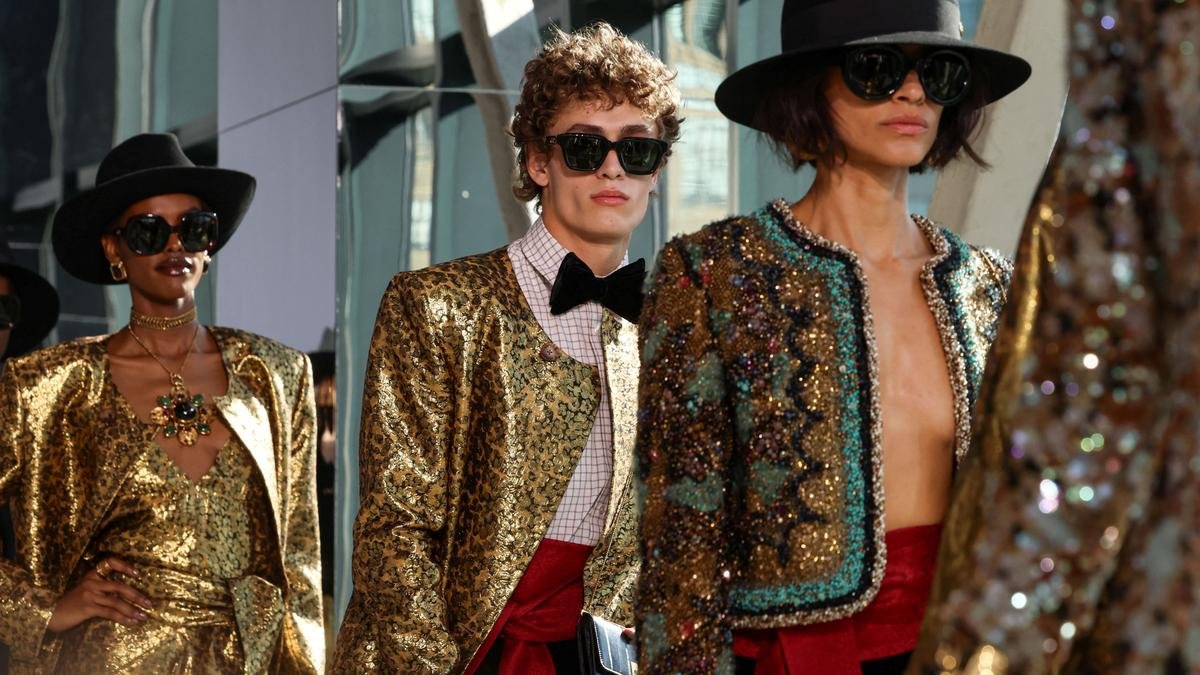
Japanese denim and British tweed, gingham and workwear, prairie dressing, cowboy and Panama hats, silk scarves and ’70s bohemia met Bengal embroidery, beadwork and jewelled Tiger motifs. Some embroidery masqueraded as tweed; draped skirts were worn over bandhgalas. On Instagram, Sabyasachi called it, “Bringing Americana to America.”
Of saris and kamarbands
Only one actual sari appeared on the runway, worn by model Avanti Nagrath near the end in black, styled with a wide belt and gold cuffs, cut close to eveningwear to look plucked from a red carpet. Actor Rani Mukerji, in the front row, wore a clear echo of it: the same drape with a sleeveless blouse, as spare as the one that had just walked.
Avanti Nagrath in a black sari, styled with a wide belt and gold cuffs
| Photo Credit:
Dan Lecca
Rani Mukerji in the same drape but with a sleeveless blouse
Everywhere else, the Chotu sari’s logic appeared without the sari itself: at least seven looks featured wrap skirts knotted at the hip and slit to the thigh, their tuck and fall doing the work of a drape without the six yards. By the third or fourth, it was clearly deliberate. The jackets over them gave the game away, cropped hard at the ribs, stopping well short of the waist, a choli’s logic, not a bolero’s — the short upper layer lets the drape below set the shape.
A model in a wrap skirt knotted at the hip and slit to the thigh
| Photo Credit:
Dan Lecca
The sash made the same point differently. Mukherjee tied one over a rust wrap skirt, another in black over a man’s trousers, exactly where a cummerbund sits at a black-tie dinner. The cummerbund was never Western to begin with, making it a small joke at black tie’s expense. The word comes from kamarband, the Indian waist sash that British officers adopted, later absorbed into Western evening dress. Every man in a cummerbund has been wearing a piece of India without knowing it. Mukherjee just said so out loud.
A black sash tied over a man’s trousers, where a cummerbund sits
| Photo Credit:
Dan Lecca
Clothes built to survive
An Indian designer in New York, Paris or London doesn’t need to arrive with an annotated glossary of India. He starts with clothes people already recognise and alters the grammar. Denim stays denim, gingham stays gingham, a cowboy hat needs no explanation. What changes is what sits beside it. “If you have to wear a dress and hire a bodyguard, don’t come to me. If you wear my couture, get into an Uber,” Mukherjee said. These were clothes built to survive contact with a city, not just the runway inside it.
The Met’s multi-year collaboration extended this idea into jewellery: the first Byzantine-inspired chapter debuted alongside denim, tailoring and workwear. Even the title follows the same logic. Bengal is the lens, Byzantium the crossroads, and Broadway New York itself: commerce, immigration, spectacle and constant remix.
The strongest looks shrugged off their references and simply became clothes. That’s the distance from ‘Snail’. In 2006, Mukherjee arrived in New York hoping for entry into an international conversation. In 2026, he seems free of the burden of having to look Indian to be recognised as Indian.
The irony is that the designer who first came to New York with a collection about slowing down has returned with a much larger luggage allowance. The clothes still carry India, they just don’t announce it.
The writer is a columnist and critic, with a keen focus on fashion, textiles, and culture.
Published – September 16, 2026 06:13 pm IST