There’s a tear in the fabric of Singapore’s thin, spontaneous nights. The bar hopper, heroic after a few cocktails, sees what seeps through it. Memory stirs with migration, cultures collide, flirt, borrow each other’s spices and leave with one another’s recipes. What emerges is a cocktail without an address, glimmering at the rim of consciousness, its aftertaste impossible to place and hard to forget.
To find out what goes into this elixir, I set out to visit four of Singapore’s bars, two of them — Nutmeg & Clove and Jigger & Pony featured on The World’s 50 Best Bars list 2026. I found that a drink could be a portrait of a place, a private joke, a cultural inheritance and each permitting the barhopper to find zany expressions that melts into ice, flavours and memories – as you will.
Nutmeg & Clove
Our first stop is Nutmeg & Clove on Purvis Street, in Bugis, where the city seems to have found a way of talking about itself without getting too earnest. Founded by Colin Chia 12 years ago, the bar has climbed its way up the World’s 50 Best Bars rankings, coming in at number 38 in 2026, after placing 50th in 2025 and 28th in 2024. But it is the menu, rather than the rankings, that tells you what Colin is up to.
Nutmeg & Clove
| Photo Credit:
Special Arrangement
It looks less like a drinks list than a comic book. Illustrated characters occupy the pages, accompanied by phrases and stories in “Singlish” (Singaporean English), the wonderfully elastic colloquial language shaped by Singapore’s many linguistic influences. The characters are based on people who have actually passed through the bar: friends, fellow bartenders and regulars, collected over the years and given a second life on paper.
Alamak, a playful reworking of the Singapore Sling
| Photo Credit:
Special Arrangement
Colin remembers a cocktail scene that, when he started out, looked elsewhere for its cues. There were American-style speakeasies, Japanese cocktail bars and grand hotel establishments. What was missing, he felt, was a bar that looked closer to home.
“I decided to take what was, in retrospect, a rather bold step and open a bar that told stories about Singapore through cocktails,” he says.
The current menu tells those stories in Singlish. There is a certain cheekiness to the enterprise. The language is full of shortcuts, affectionate insults, borrowed words and expressions that can leave an outsider blinking for a moment. Colin, who is proud that he was born on Singapore National day, says, “Singlish is part of our identity. We wanted to share what Singlish is all about and help visitors understand the joy we find in speaking the language,” he says.
The illustrations are by a local artist A Good Citizen who has also drawn for The Straits Times. The faces come from real life friends from around the world, bartenders from China, Korea and Hong Kong, familiar customers who have become part of the bar’s story. There is something rather lovely about the idea of a menu doubling as a thank-you note to the people who have helped make a place what it is.
I begin with the Alamak, a playful reworking of the Singapore Sling. Gin meets soursop, passion fruit and pomegranate; the mixture is clarified with milk and finished with carbonation. The drink takes a familiar national cocktail and gives it a different accent, while its name, an expression of surprise or dismay, sets the tone for a menu that knows better than to take itself too seriously.
Then there is Huat Ah, a clarified milk punch whose name calls up prosperity and good fortune. Atas, meanwhile, brings together cold-brew coffee and Darjeeling tea. As someone from West Bengal, I find myself unexpectedly pleased to encounter Darjeeling in a Singapore cocktail bar. A familiar ingredient has travelled, slipped into a new company and acquired a different life. It is a small reminder that ingredients, like people, rarely stay put.
Die Die Must Try
| Photo Credit:
Special Arrangement
For something more savoury, Colin points me towards Die Die Must Try. The bar’s signature Nutmeg & Clove takes its cue from the Ramos Gin Fizz, while Garden City has earned a place in its Hall of Fame, a collection of cocktails that have survived successive menus.
The food draws from Singapore’s hawker centres, reworking familiar local dishes without sanding away their edges. At Nutmeg & Clove, the ambition seems to let the everyday language of food, drink and conversation do the talking.
Jigger & Pony
From the easy irreverence of Singlish, the evening moves towards the careful grammar of the cocktail. Jigger & Pony, founded in 2012 by Gan Guoyi and Indra Kantono, has built its reputation on the classics, hospitality and the sort of attention to detail that is easy to admire and rather harder to pull off consistently. Jigger & Pony ranked number 5 on The World’s 50 Best Bars list in 2024 and number 9 in 2025, while placing number 3 on Asia’s 50 Best Bars list in both years; in 2026, it ranked number 18 globally and number 9 in Asia.
Jigger & Pony
| Photo Credit:
Special Arrangement
Neither founder came from a conventional bartending background. Guoyi spent about five years working as a flight attendant with Singapore Airlines; Indra worked in strategy consulting and private equity. They were drawn to bars through the experience of being in a place where you could settle in and stay awhile.
Uno Jang, the bar’s creative director says that the bar’s latest menu, BLOOM, explores growth and renewal through four chapters — Hope, Growth, Beauty and Just Be. Across 21 cocktails, familiar formats are revisited with an emphasis on flavour, texture and balance rather than technique for its own sake. The philosophy is in keeping with the group’s stated ambition to create spaces where people can “find comfort, forge friendships, and share happiness”, he says .
Mango Margarita
| Photo Credit:
Special Arrangement
The Mango Margarita is a case in point. Made with Patrón Silver tequila, green and ripe mango, Cointreau, lime, Sichuan peppercorn and mezcal, it moves between the tartness of unripe fruit and the sweetness of ripe mango, with the peppercorn lending a savoury finish. It is recognisably a Margarita, but one that allows a familiar ingredient to reveal several sides of itself.
The Champagne Ramos Gin Fizz is more elaborate. The Botanist gin, cream, lemon, vanilla, ruby port, sourdough and egg white are finished with Telmont Reserve Brut Champagne, creating a layered combination of sweet, sour, creamy and fruity notes with a sparkling finish. The drink is a reminder that complexity need not come at the expense of balance.
Manhattan and Champagne Ramos Gin Fizz
| Photo Credit:
Special Arrangement
Jigger & Pony’s approach rests on the relationship between technique and hospitality. The drinks are carefully constructed, but the point is not to turn the bar into a laboratory or make the guest feel they need a glossary to order. It is to make the craft pleasurable, accessible and worth returning for either on a date or after a long day.
“A jigger and a pony are old units of measurement used by bartenders when pouring spirits,” Indra explains. The connection carries over to BOP, whose logo features an inverted version of the jigger-and-pony shape. But the two bars have distinct personalities. “BOP has a younger energy, with Korean motifs and elements running through the space. Jigger & Pony, by contrast, is more contemporary and versatile in its appeal. Being located within a Amara hote, it attracts a wider mix of people and groups.”
BOP: A little bit of Korea
A short walk away, BOP offers a different expression of the same hospitality ethos. The name stands for Bartenders of Pony, a reference to its relationship with Jigger & Pony, but it also evokes bap, the Korean word for cooked rice, and a bop, a catchy piece of music. The associations are deliberate: this is a bar built around the pleasures of Korean food, drink and social life.
Iced somaek
| Photo Credit:
Special Arrangement
BOP serves original cocktails alongside somaek, the familiar mix of soju and beer, with Korean-inspired food designed for sharing. The menu was developed with Jason, founder of Tak Seoul, and brings a contemporary sensibility to Korean dishes and drinking snacks. Rather than simply borrowing ingredients to give cocktails an East Asian inflection, the bar takes its cues from the rituals surrounding Korean drinking — mixing drinks, passing plates around, teasing friends and lingering over another round.
Bokbunja Pop
| Photo Credit:
Special Arrangement
That distinction matters. BOP is less interested in presenting Korean culture as a theme than in recreating the conviviality of drinking within it. The result is a more relaxed counterpoint to the precision of a cocktail bar such as Jigger & Pony, while remaining part of the same larger conversation about how a bar can express a particular place and culture.
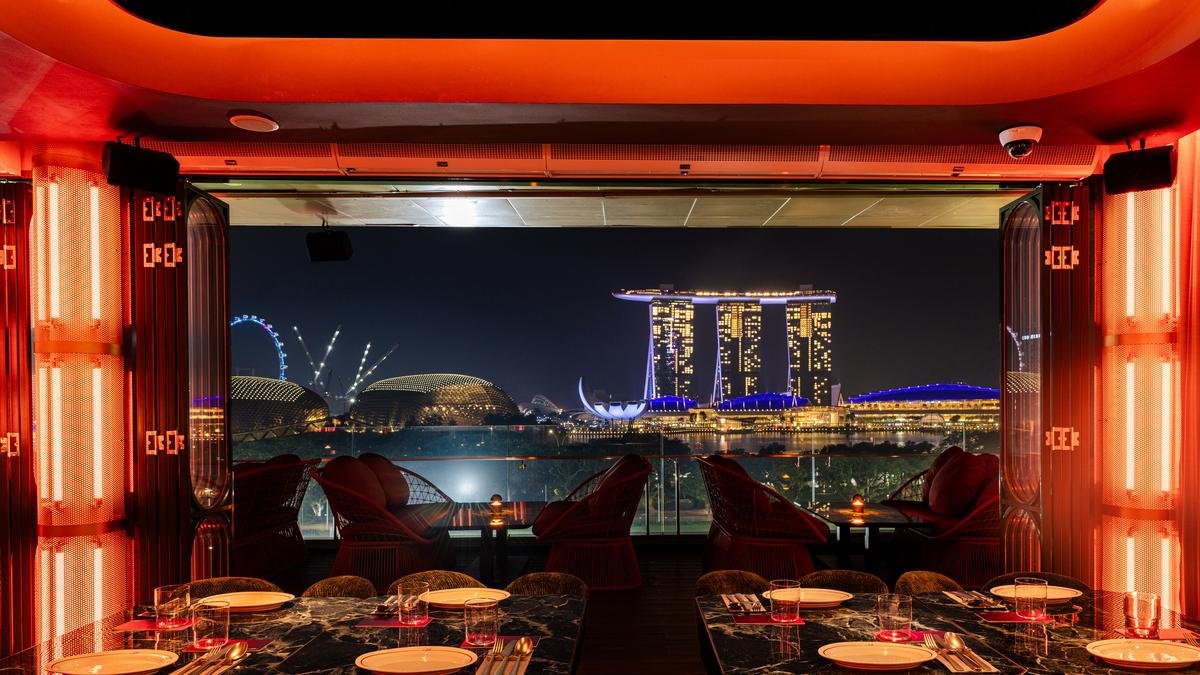
Milli Sky Dining Bar
At Milli Sky Dining & Bar, spread across the fifth and sixth floors of the National Gallery Singapore, the city opens out below me. Milli brings together chef LG Han of the one Michelin-starred Labyrinth and bartender Vijay Mudaliar, co-founder of Native. Both have made a name for themselves by looking at familiar ingredients and cultural memories from a different angle. At Milli, that impulse runs from the kitchen to the bar, where the Singaporean reference points are recognisable even when their forms are not.
Milli the sky dining bar
| Photo Credit:
Special Arrangement
The cocktails, meanwhile, offer their own tour of Singapore’s culinary memory. The bar reworks the Singapore Sling, clarifying the pineapple for a cleaner finish and adding chrysanthemum tea as a nod to local childhoods. A bag of peanuts, served alongside, tips its hat to the Long Bar at Raffles Hotel, where the cocktail was created.
The Singapore Breakfast
| Photo Credit:
Special Arrangement
The Singapore Breakfast takes the espresso martini in a distinctly local direction. Martell Noblige cognac replaces vodka, meeting cold-brew coffee and a coffee liqueur inspired by Vietnamese coffee. Coconut water, coconut milk and gula Melaka lend sweetness and roundness, while soy sauce adds a savoury edge. Kaya, the coconut-and-egg jam eaten with toast at breakfast, makes an appearance, along with a lotus biscuit meant for dipping. It is a familiar morning meal, reassembled for a different hour of the day.
The Milli Million draws on the Million Dollar Cocktail, another drink associated with Singapore, with Hendrick’s gin, homemade mandarin grenadine, yuzu and clarified pineapple, balanced by dry vermouth and fino sherry. A final drink pays tribute to Peranakan culture, the meeting of Malay and Chinese traditions, through ingredients including ginger flower, calamansi, coconut water and blue butterfly pea flower. Finished in a spritz style, it arrives with a pandan-topped dessert. The suggested ritual is to take a sip, have a bite, then return to the glass.
Peranakan Spritz
| Photo Credit:
Special Arrangement
Across the menu, Singapore’s identity emerges through layers of culinary memory. It is an approach that makes the city’s cultural crossings tangible
The writer was in Singapore at the invitation of the Singapore Tourism Board.