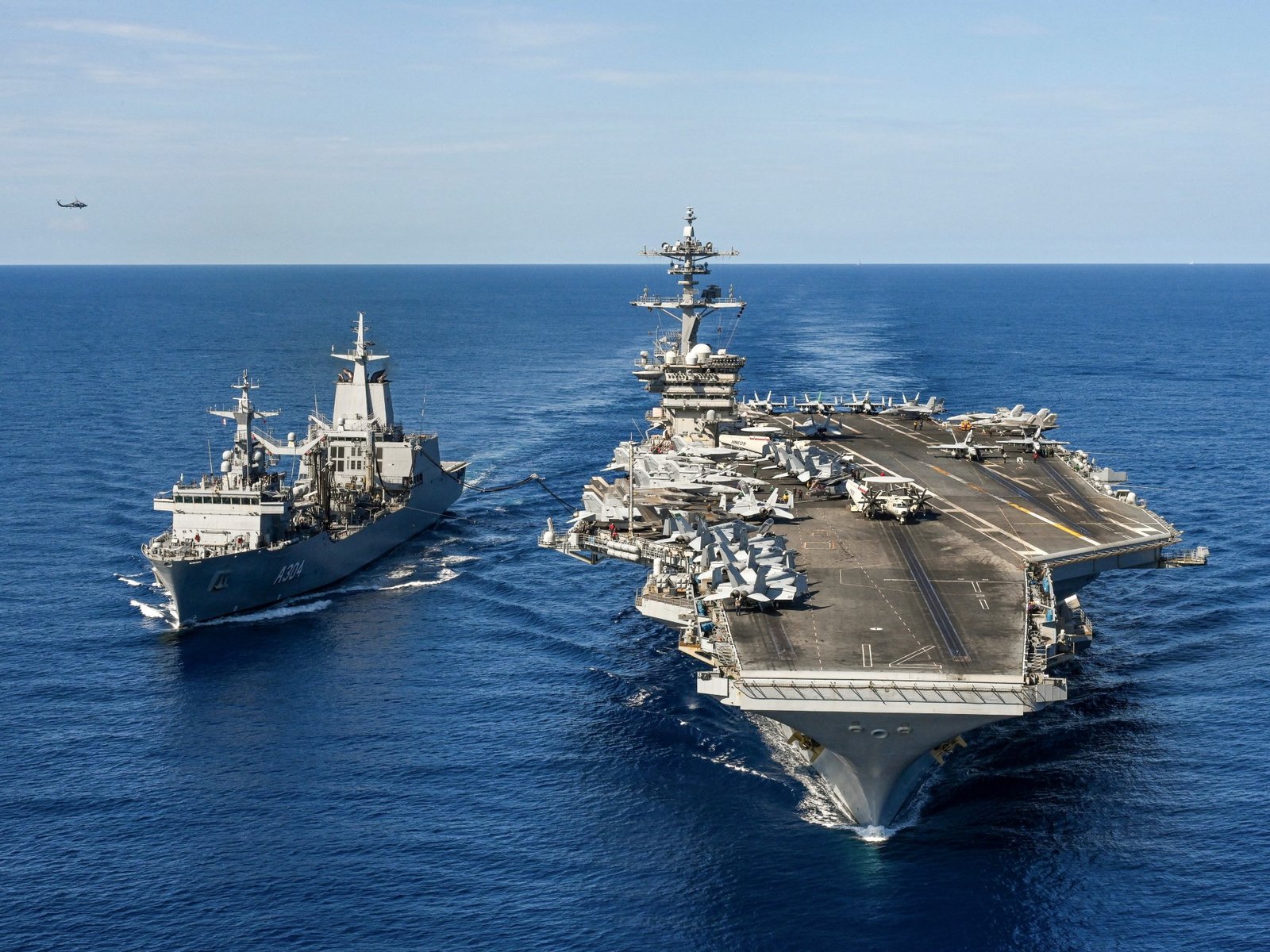
The United States military presence across the Middle East is sprawling.
There are as many as 50,000 US troops and about 19 major military installations in the region, as well as assets spread across countries such as Bahrain, Jordan and Saudi Arabia.
Recommended Stories
list of 3 itemsend of list
But experts warn that the US-Israel war on Iran has exposed vulnerabilities in protecting Washington’s military assets in the region, leading some to speculate that a downsizing may occur once the war is over.
Michael O’Hanlon, senior fellow at the Brookings Institution, a Washington-based think tank, is among those who expect the US to eventually scale back its military presence in the Middle East.
“I think we will go smaller, more dispersed, more hardened, and generally further away from Iran — but not in each and every case,” O’Hanlon said.
As the war enters its 10th month on Saturday, the damage inflicted on US installations in the Middle East could one day translate into a strategic shift — not just for the US but for other countries that have been shaped by its military presence as well.
Billions of dollars in damage
One of the long-term obstacles to maintaining the US military presence will be the cost of repairs.
Repairing damaged infrastructure on US bases in the region could cost $9.4b, according to the Center for Strategic and International Studies, a Washington, DC-based think tank.
Hundreds of structures on US bases have been damaged by Iranian attacks since February 28, when the war began.
One of those bases was in Bahrain, home to the US Naval Forces Central Command and its Fifth Naval Fleet. The US has established a naval command presence in the country as far back as 1948.
But according to a report from the Congressional Research Service, the base — called Naval Support Activity (NSA) Bahrain — “sustained serious damage” in the early days of the Iran war. It estimated the cost of repairing the base at more than $400m.
Other US military assets in the region have also been impacted by the war.
In September, a Department of Defense inspector general report found the US had lost dozens of aircraft during the war, among them attack helicopters and sophisticated fighter jets like the F-35A and the F-15E.
By October, the total cost of the Iran war reached more than $47bn, according to Pentagon figures.
An image verified by the news agency AFP appears to show a US Air Force Airborne Warning and Control System (AWACS) aircraft destroyed at the Prince Sultan airbase in Saudi Arabia [File: AFP]
Rethinking the need for large bases
Rebuilding the US bases is unlikely until the Iran war is over, according to Mark Cancian, a senior adviser with the Defense and Security Department at CSIS.
“If the war ends with some sort of ceasefire or we get to a place where it’s somewhat stable,” Cancian said, “then you will see some reduction in US forces and reduction of the surge forces certainly and some rebuilding of the bases.”
But Cancian expects that the US will not rebuild all the military sites struck by Iran.
He pointed to the Bahrain headquarters of the Fifth Naval Fleet and the Combined Air Operations Center at Al Udeid airbase in Qatar as examples.
Some military facilities, he explained, will likely be moved underground to protect against aerial attack. Others may be relocated further from the Gulf, to places such as Israel or Jordan.
Major bases like those in Bahrain or Qatar were a liability because “they are right within the range of Iranian missiles and drones”, according to Kelly Grieco, a defence policy expert and senior fellow at the Stimson Center, a global security think tank.
But simply moving bases further away will not protect them in the long term. Grieco pointed out that Iran keeps improving its ability to reach longer-distance targets with drones and missiles.
One alternative to rebuilding bases, she said, would be instead to cultivate access to a network of airstrips and temporary bases in the Middle East that could be used if another conflict erupts.
In the Iran war, for instance, the US has relied extensively on facilities like Israel’s Ben Gurion airport for refuelling combat aircraft.
“What mattered more was access to places and the ability to move around those places, more than having a permanent operating facility,” Grieco said.
What the region wants
Experts say downsizing the US military presence in the Middle East has been a goal across several administrations.
President Donald Trump, for instance, has completed troop withdrawals from Syria and Iraq since the start of his second term in 2025. His predecessor, Joe Biden, also oversaw the US military pullout from Afghanistan in 2021.
But practical realities — including the emergence of new conflicts involving the US — have put that aspiration of a large-scale drawdown out of reach.
“The Biden administration wanted to reduce the force posture. The Trump administration wanted to reduce the force posture,” Cancian said. “They haven’t been able to, and it’s not clear they will be able to.”
Allies and adversaries alike also help to determine the heft of the US military presence, he added.
“The world gets a vote, and even if the administration wants to reduce the force posture, it may not be possible, because of continuing tensions,” Cancian said.
New alliances, however, have emerged that might make certain regional allies less reliant on US military resources.
In August, Saudi Arabia, Turkiye and Pakistan signed the Mecca Joint Defence Agreement, a pact that theoretically commits the countries to come to each other’s aid in case of an attack.
Experts say the deal could trigger a regional realignment away from the US and its military might.
Saudi Arabia, Turkiye and Pakistan could potentially wield formidable force: Together, they have more than 1.4 million active military personnel, own thousands of tanks and military aircraft and spend more than $124bn on their combined defence budget.
The pact is also likely to expand to include Egypt and Syria, further increasing its resources.
Such agreements might prove to be the first step in diversifying each country’s military strategy beyond their cooperation with the US, according to Grieco.
“The region had already been engaged in strategic diversification before this war started,” she said. “The real question moving forward is: Will they decide to pursue greater strategic dependence, or slowly decrease their dependence on the US for security?”
(Al Jazeera)
Domestic frustrations grow
In the US, voter frustration could also disincentivise any effort to rebuild military installations in the Middle East.
The Iran war and US support for Israel’s genocidal war on Gaza have proven to be unpopular among the American public.
This month, for instance, the research firm Ipsos and the Reuters news agency found that 71 percent of Americans wanted Congress to end the war on Iran.
The conflict proved especially unpopular at the polls, with Trump’s Republican Party losing key races in the 2026 midterms to Democrats who were vocal in their opposition.
There was even backlash from within Republican ranks. Vice President JD Vance, who once touted his opposition to foreign wars, blamed the Iran conflict for his party’s poor showing in the midterm elections.
“The reason we lost is the war. The president himself said so,” Vance wrote on social media. “Everyone knows why we lost. And any honest conversation about where we go from here must start there.”
Both parties are leaning away from a foreign interventionist stance, according to Grieco.
Although politicians are split over topics like US support for Israel, Grieco has observed that there is an overall inclination to extricate the US military from the Middle East.
“For most Americans, they’ve looked at the region since 1990 or 1991 and seen we are constantly conducting these interventions,” Grieco said. “None of them have gone well.”