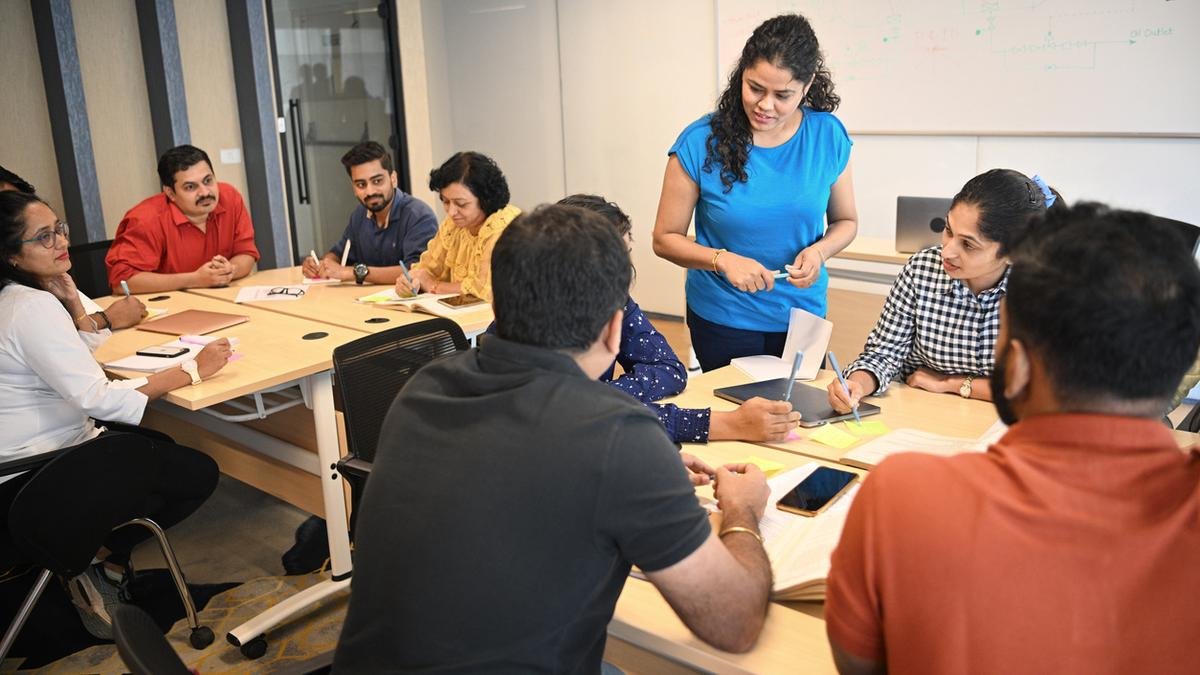
Business education, globally as well as in India, has been undergoing a radical transformation, driven by an intricate interplay of evolving industry demands, aspirations of the students, and technological advancements. The contours of management education are being redrawn, with innovative formats coming up suiting the requirements of the industry and the needs of the students.
Recent initiative by some IIMs to launch a five-year Integrated BBA-MBA as a premium program signal winds of change.
Also read: Choosing management after Class 12: Why Integrated BBA-MBA programs are gaining popularity
This article examines the evolution of the different formats of management education over the years and how they address the needs of the stakeholders. It presents an outlook for the future.
Origins and growth of business education in India
Formal Business Education in India is 72 years old, with the Indian Institute of Social Welfare and Business Management (ISWBM) in Kolkata being the first Business School in India. Started in 1953, it offered an MBA program. This was followed by the establishment of the Indian Institutes of Management (IIMs) in Kolkata and Ahmedabad, as premier Business Schools.
The economic liberalization policies of India in the 1990s created a huge demand for professionally qualified managers to fuel the growth of the economy, leading to the proliferation of over 5,500 Business Schools, churning out more than four lakh post-graduates in management every year.
The New Education Policy (NEP) 2020 has enabled Higher Educational Institutions to innovate and introduce multiple formats and modes of academic delivery, going beyond the traditional format of the two-year MBA campus education.
Drivers of change
The relentless march of technologies such as Artificial Intelligence (AI) and data analytics have been transforming how businesses operate and decisions are made. Now, the industry demands a new breed of professionals with the skills going beyond qualification.
In the last three years, due to the rapid automation of industry and geo-political-economic factors, campus placements for MBA graduates have slowed down, even in the premier Business Schools. While there has been a steady increase in the fees of the MBA programs, this has not translated into commensurate improvements in campus placements. This has forced students to evaluate alternative formats of business education so as to get a better return on investment of their time and money.
Evolution of diverse formats
The response to these changes has been a remarkable diversification of program formats, moving beyond the one-size-fits-all two year campus MBA model. The major factors driving the students’ decision for a specific program format are profile of the students in terms of their prior educational qualification and experience, career aspirations in terms of placement outcomes, convenience, and the fees.
The traditional two-year PG program
Historically, the two-year Post-Graduate Program in management (MBA/Post-Graduate Diploma in Management (PGDM)/Post-Graduate Program certificate in Management (PGP/PGPM ) catered to fresh graduates as well as working executives with limited work experience.
During 2024, 2.93 lakh students appeared for the IIMs competitive Common Admission Test through which students were selected for about 5,500 seats in 21 IIMs. This worked to a selection ratio of about 1.9% of the applicants. The number of candidates taking the CAT has remained more or less the same in the last two years, possibly due to intense competition, coupled with increased fees compared to the quality of campus placements in recent times.
A cursory analysis of the graduation profile of MBA admissions in the last three years shows that the percentage of students with B Tech graduation continue to be the highest in premier institutions, going up to 60%. While fresh graduates in the top five IIMs constitute 15% to 25% of total admissions, in the remaining institutions, it ranges anywhere from 30% to as high as 75%.
In the recent few years, recruiters have been increasingly preferring students with at least 2-3 years work experience so that they are productive from day one. Also, students with graduation in B Tech are preferred, as they are considered to have better analytical and technology integration skills.
Standalone BBA in three-year, four-year formats
Besides the traditional three-year BBA degree, in pursuant of NEP-2020, a number institutions have been offering a four-year BBA program with the option of Honours or by research in the fourth year. Recently, three IIMs (Sirmaur, Kozhikode and Sambalpur) announced the launch of a four-year Bachelor of Management Studies (BMS) with fee tags of ₹20-25 lakh for the entire course.
Programs for working professionals
Executive MBA programs of one-year duration for the working professionals have been in vogue for some time. They offer a flexible and convenient learning format and seek to enhance their skills for growth into senior management roles without a long career break. Though most of the premier Business Schools insist on a minimum three years of prior experience as an eligibility criterion, some schools have been accepting less experienced ones also.
The recent launch of the two-year Post Graduate Program in Management for Young Leaders (PGP-YL) by Indian School of Business (ISB) for candidates with up to two years of work experience underlines the need for an extended duration to provide additional inputs to the younger students so as to bring them on a par with the more experienced ones.
Online BBA and MBA
Designed primarily for working professionals seeking flexibility and affordability, online BBA and MBA programs approved by the UGC were started during the pandemic by universities. In the last three-four years, they have gathered momentum as they also appeal to freelancers and housewives looking for career re-entry.
As per the UGC list for 2023-24, 76 institutions were approved to offer online programs. Some 95,000 students enrolled in 2024. Enrollment is expected to go up by 30% in 2025.
Due to the initial hesitation in acceptance by the industry and internet bandwidth issues, the take-off for them was slower than expected. As per the Graduate Management Admission Council (GMAC) survey of recruiters July 2025, over 50% of recruiters, particularly from technology sectors, value the graduates of online programs on a par with the in-person programs provided they have the requisite skills.
New-age schools the unregulated disruptors
Recent years have seen the launch of the new-age business schools, which operate outside the purview of regulatory authorities like the UGC and the AICTE, and have been offering niche courses, with a distinct focus on industry relevance, technology integration, practitioner-led education and experiential learning. Attractive campus placements are also promised.
In line with the industry’s requirement for technology integration in business, institutions like the Masters’ Union , Scaler School of Business and TETR College of Business offer interdisciplinary Post-graduate courses in technology and business management for fresh graduates and working executives.
Capitalising on the recent surge in technology start-ups and the keenness of family-owned businesses to groom their successors professionally, Business Schools such as the Mesa School of Business, Institute of Venture Building, and Physicswallah Institute of Innovation School of Management offer courses in Entrepreneurship, Family business, Start-up leadership etc.
The common theme among these is the provision of aspirational and aesthetic campus infrastructure, coupled with the association of industry veterans, successful entrepreneurs and angel investors on the advisory boards. These appeal to youngsters, lending them a premium positioning. No wonder, fees charged by some of them are much higher than the ones by even the premium Business Schools.
Perspectives for the future
The Indian business education market is poised for steady growth. However, the value proposition of business education is increasingly evaluated through the lens of Return on investment (ROI ) on time and money, and its ability to create future-proof careers against the disruptive impact of AI. So, the programs, irrespective of the format, should focus on future-proof skills such as critical thinking, problem-solving, leadership, communication, adaptability, and emotional intelligence. These are skills that AI cannot replace and are increasingly valued by employers.
Besides, they should integrate topics such as AI strategy, machine learning, predictive analytics, and digital transformation deploying technology tools into their core offerings, and ensuring graduates possess the technical fluency to manage AI automation initiatives.
Though the traditional two-year MBA will remain a cornerstone, it is likely to face increasing pressure to adapt and deliver placement outcomes in line with the aspirations of the stakeholders. Going by current trends, as more students opt for early career decision on management, IPMs are expected to grow significantly. Though their fees is high, they offer a structured and accelerated pathway into management career for youngsters.
Online/hybrid delivery models will also have a healthy growth, driven by student preference for flexibility, accessibility, and affordability. The Executive Education Market is exected to see sustained growth, driven by demand for leadership development in emerging technologies. Specialized Skill Certifications and Micro-credentials will continue to rise as employers prioritize specific, in-demand skills and continuous upskilling.
Way forward for stakeholders
In order to thrive in this dynamic environment, all stakeholders in the business education space must adapt to the changing environment and adopt agile and forward-thinking strategies. The business schools should design programs tailored to specific target student profiles with distinct value propositions. Students should have clarity on their career aspirations, commensurate with their academic and prior experience profile, and financial capacity to pay the fees and learning preferences, before choosing a program. They also should recognize the need for life-long learning and plan for continuous upskilling through micro-credentials. Industry should partner with Business Schools to co-design curricula, offer internships, and provide real-world projects to ensure a pipeline of industry-ready talent.
By strategically adapting to the emergent market trends, Indian business education can ensure its continued relevance and leadership, in shaping the next generation of agile, ethically grounded, and globally minded tech savvy leaders for an increasingly challenging world.
(O. R. S. Rao is the Chancellor of the ICFAI University, Sikkim. Views are personal)