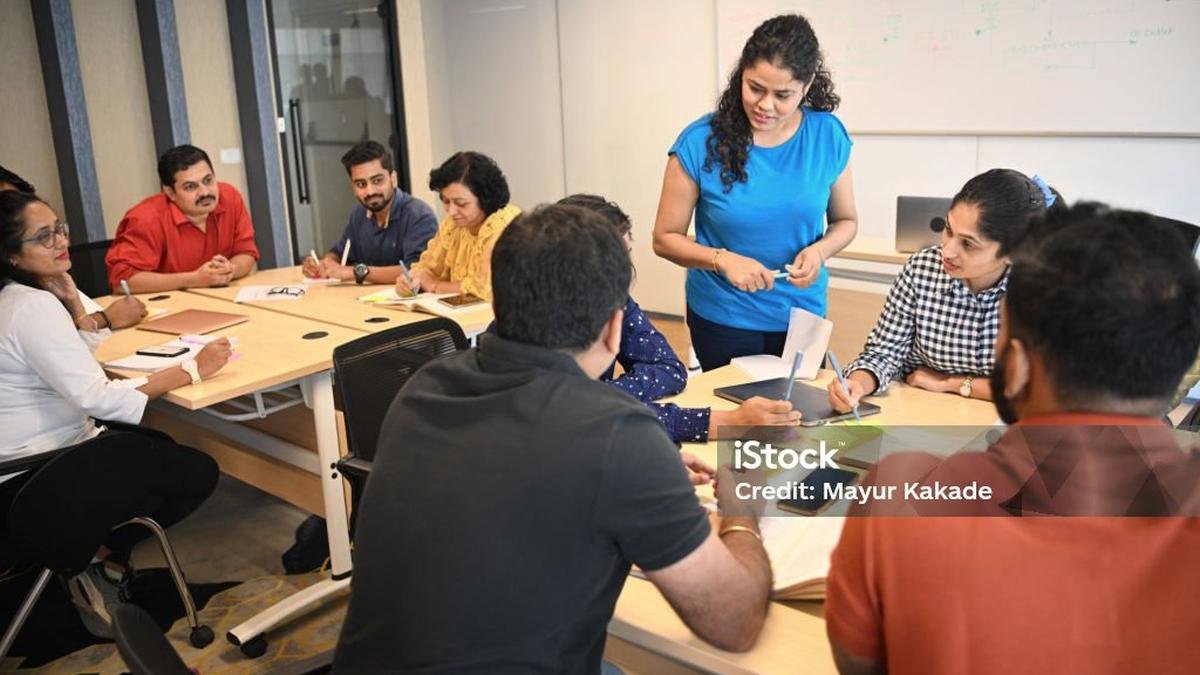
Indian B-schools must embrace international best practices such as hybrid learning models that blend in-person, digital, and experiential components, making education more accessible, personalised, and future-ready. | Photo: iStock/ Getty Images
As international universities from the U.K. and Australia steadily set up campuses across the country, India is an up-and-coming global education hub. This educational disruption follows the regulatory changes introduced in the National Education Policy (NEP) 2020, which allows foreign universities to enter the Indian educational landscape due to eased regulations and the benefit of full control over their curricula and admission criteria. Given the saturation in the education industry, domestic universities, particularly business schools, will have stiff competition in the upcoming years.
A market ripe for growth
With over 65% of India’s population being under 35 and more than 43.3 million students in higher education, we are home to a booming education market that is predicted to have a sustained demand for higher education, particularly for premium degrees in Business, Technology, and Leadership. The tightening visa rules across the globe don’t help, of course. With growing challenges in pursuing education abroad, it would not be surprising to see students opting for international branch campuses closer to home.
Given, as well, the increased demand for a future-ready workforce, companies are substantially seeking a holistically well-rounded workforce. The demographics, in addition to the aforementioned regulatory shifts and the high demand for skills and foreign degrees, lay the groundwork for the lucrativeness of branch campuses in India.
Learn from global educational practices
Management education in India is at the cusp of change. In the coming years, we have the opportunity to redefine management education as we know it, enhance our pedagogical methods and initiate cross-industry collaborations to drive meaningful output and change. While Indian B-schools have grown in scale, they are still behind their global counterparts in terms of high-impact research output.
Management education also cannot remain derivative – it must shape narratives on emerging markets, inclusive growth and innovation. Faculty exchanges and industry collaborations are key to elevating Indian B-school standings on a global level. International faculty members bring not only academic credentials but also diverse perspectives into the classrooms, fortifying pedagogy and the overall academic environment. This can be complemented by deepening industry linkages, ensuring curricula, research and placements remain aligned with and relevant to the industry.
There is much to learn from global education practices, where academic institutions often have partnerships with industry to augment classroom learning with on-the-job experience, ensuring students develop theoretical understanding and practical skills. Such practices can lead to the inception of a glocalised curriculum – where global business insights can be used for Indian markets. Furthermore, the introduction of flexible learning models such as part-time and distance learning MBAs allow for a wider scope of students.
The future of management education is shifting rapidly, Indian B-schools that fail to evolve risk becoming obsolete. We deal with outdated and oftentimes irrelevant curriculum that cannot keep up with the ever-evolving business landscape. If B-schools continue with the current transactional nature of management education, we will find ourselves overshadowed by the more agile and research-driven schools abroad. Without a proactive shift in mindset and method, many schools will be reduced to degree-dispensing institutions with little credibility, attracting neither the best talent nor industry attention.
Be ahead of the curve
To thrive in this new landscape, Indian B-schools need to act decisively. We must embrace international best practices such as hybrid learning models that blend in-person, digital, and experiential components, making education more accessible, personalised, and future-ready. Emphasis should also be placed on curating niche learning programs in domains such as healthcare and sports management, given their popularity domestically and abroad.
Fundamentally, Management education is about being ahead of the curve. Industry alliances can produce meaningful outcomes for both the institution and students, such as co-designed curriculum, live projects and co-funded research. Leveraging their soft power is also necessary for Indian B-schools. Our access to the local market, cultural insight and demographics gives us the leverage to design management education that is not only globally relevant but also deeply rooted in the Indian context. Finally, meaningful transformation cannot happen without significant investment in faculty development. Investing in MDPs, interdisciplinary exchanges, allowing faculty sabbaticals in corporate setting is a must for curriculum and institutional relevancy.
This is a defining moment for Indian B-schools, a chance to not just catch up, but to lead. Complacency is not an option as global campuses set foot in India and expectations keep evolving. Indian business schools must shed legacy mindsets, build global ambition and act with urgency. It is time to reimagine, not replicate, the future of management education. If Indian institutions aspire to compete on a level playing field with their foreign counterparts, the time to get the act together is now.
(Raman Ramachandran is the Director at K.J. Somaiya Institute of Management)
Published – August 07, 2025 11:13 am IST