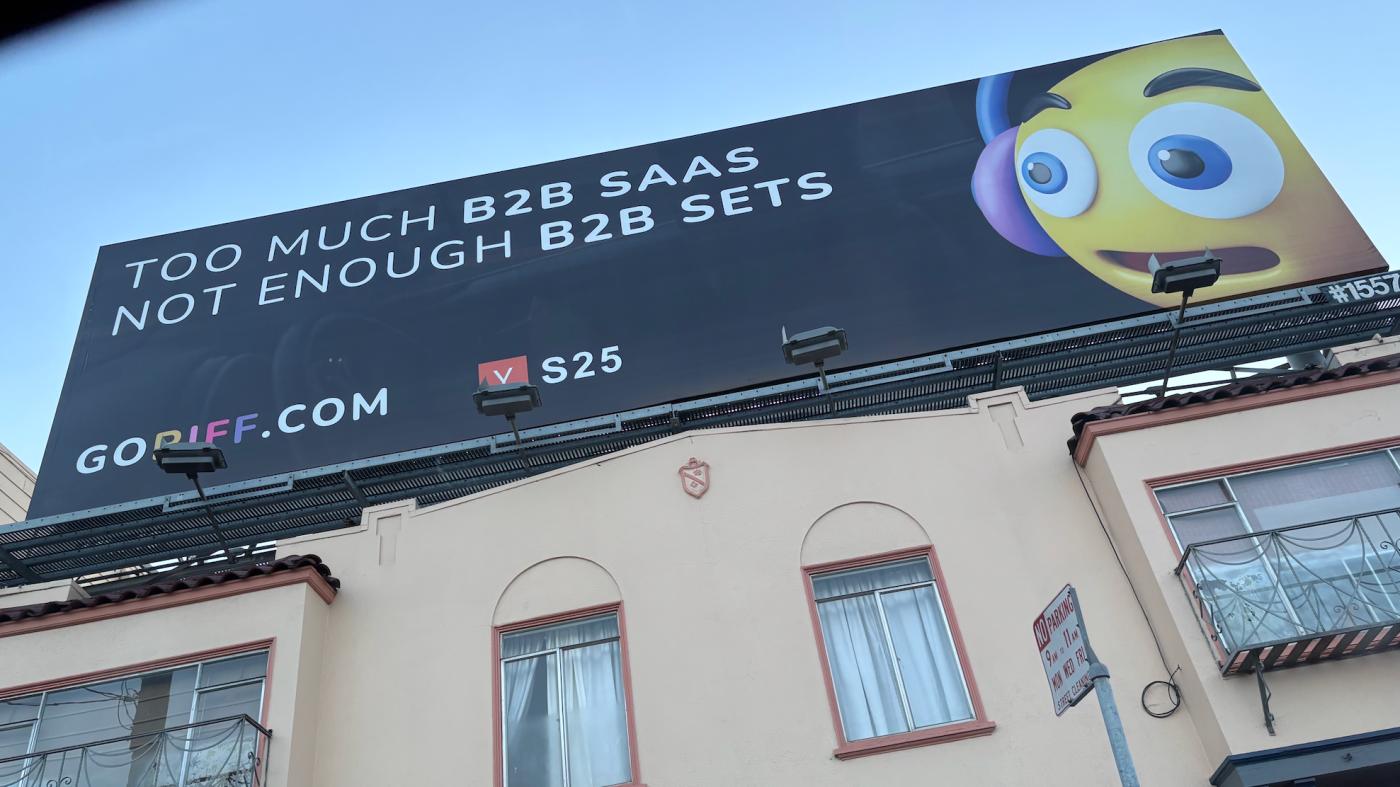
Cryptically-worded billboards, such as this one in San Francisco’s Mission District, have been springing up all over the city in the past year or two. They are intended to be understood only by a small audience.
Chloe Veltman/NPR
hide caption
toggle caption
Chloe Veltman/NPR
Billboards in San Francisco used to be easy to understand, whether advertising Coca-Cola, Toyotas, iPhones or AirBnB.
But these days, that’s often not the case.
Ads bearing slogans like “Agents don’t work without evals,” “Too much B2B SAAS,” and “Intelligent AF” have sprung up across the city over the past couple of years, in a bid to grab attention by AI startups flush with venture capital cash. “I look at these billboards and have absolutely no idea what they’re advertising,” said Louise Mozingo, who runs the urban design program at the University of California, Berkeley, and has studied the tech sector in the context of corporate landscaping extensively over the years. “They’re quite clearly not advertising to the average consumer.”
University of California, Berkeley, professor Louise Mozingo has studied the tech sector in the context of corporate landscaping for decades. But she is is as baffled by the cryptic billboards and bus shelters as most other San Francisco Bay Area locals.
Chloe Veltman/NPR
hide caption
toggle caption
Chloe Veltman/NPR
And yet these billboards are everywhere. Billboard rental revenue in the city grew by around 30% between 2023 and 2025, according to data provided by the outdoor advertising company Outfront Media. And advertisers said they are waiting many months for spots in the most desirable locations to open up.
Intentional exclusivity
These ads are meant to be inscrutable to most passersby.
“The goal is intentional in a kind of ‘if-you-know-you-know’ type of way,” said Mike Bilodeau, head of marketing at the AI infrastructure startup Baseten. The company has many billboard, bus shelter and street kiosk ads across the city, bearing slogans like “Own your models,” “Own Your SLAs,” and “Own Your Nines.”
Baseten is one among many tech startups to create messaging that’s in the public thoroughfare but explicitly targets a select audience of software engineers.
Chloe Veltman/NPR
hide caption
toggle caption
Chloe Veltman/NPR
“For a lot of folks, the ads don’t really mean anything,” Bilodeau said. “But we’re selling to engineers. They’re like, ‘Oh, we know exactly what this is.'”
The difference between this messaging and that of a traditional billboard campaign is intent. “Traditional campaigns often try to clearly explain a product to a defined audience,” said Outfront Media’s west region senior marketing director, Christine Rose. “These cryptic tech ads assume the audience already understands the context, and rely on shared language, inside jokes, or cultural cues, rather than specific messaging.”
Tech’s passion for billboards
Other cities like Los Angeles also have billboards aimed at specific audiences. Consider the annual “For Your Consideration” campaigns in Los Angeles around the Academy Awards.
In San Francisco, these low-tech roadside signs might seem odd for high-tech advertisers. But PR and marketing consultant Michelle Garrett said billboards signal legitimacy to these companies and the people who buy their services.
“This makes them look like they’re big and successful, helps build momentum for them,” Garrett said.
Garrett added that the insider-baseball language can also create buzz beyond the target audience. “There’s kind of a mystique almost about it,” she said. “And that almost adds to the viral piece of it, because people want to share it and talk about it.”
The in group and the out group
But there’s a flip side.
Marketing professor Karen Anne Wallach of the University of Alabama in Huntsville has studied how the use of exclusive language in marketing campaigns influences business outcomes. She said the tech companies’ approach divides people into two camps – an “in group” and an “out group.”
Wallach said there are short-term benefits to appealing to the select few.
“The tech companies are speaking to the people that know all these acronyms and probably that makes that ‘in group’ of people feel even more tied to who was giving the message,” Wallach said.
A billboard from the finance platform Brex is located in the high-end San Francisco neighborhood of Laurel Heights, where many tech executives have homes.
Chloe Veltman/NPR
hide caption
toggle caption
Chloe Veltman/NPR
But Wallach added the feelings of the far bigger “out group” matter, too.
“Long term, you tend to remember that kind of negative branding,” Wallach said. “And negative language then becomes part of what you associate with the brand.”
The tech startups NPR spoke with for this story said they understand the risks of alienating large numbers of people with their cryptic ads. But the upside is too great.
Broader cultural implications
Meanwhile, the negative associations also impact how people feel about San Francisco more broadly.
“The billboards here are actually something that makes me feel really pessimistic about the city,” said Allie, a San Francisco resident who was among the dozen or so people to comment on current billboard trends on NPR member station KQED’s Forum talk show last summer. (Forum typically doesn’t give the full names of callers.) “They kind of give this feeling that like the rumors are true and tech has overrun the city, and that’s the whole culture here now.”
Jennifer Vanasco edited this story for broadcast and digital.