The early 2000s saw the first appearance of smartphones as expensive devices used only by a few. By around 2012, they had become common in urban households, and with the availability of inexpensive 4G internet access after 2016, their use spread rapidly.
At the same time, India’s academic coaching culture expanded dramatically. What was once limited mainly to students preparing for engineering and medical entrance examinations gradually became routine even for younger school children.
The COVID-19 pandemic accelerated another major shift in childhood by normalising online classes, digital homework, virtual tuitions, and smartphone-based learning. Even after schools reopened, children spent long stretches of their day engaged in screen-based learning, completing assignments sent through messaging apps, attending online coaching classes, and using smartphones for entertainment.
What links these changes is the growing amount of near work in children’s daily lives, combined with reduced outdoor activity. Children today spend far less time outdoors in natural daylight and much more time indoors, either at school, tuition classes, or in front of screens. In genetically susceptible children, these environmental changes are contributing to the rapidly increasing prevalence of myopia (short-sightedness).
Myopia arises from a complex interaction between genetic predisposition and environmental exposures, and modern childhood appears to be amplifying both the onset and progression of the condition.
I have seen infants as young as eight months being exposed to screens while being fed, particularly during the transition from breastfeeding to complementary feeding. For many parents, smartphones and televisions have become convenient tools to distract children during mealtimes, resulting in screen exposure beginning remarkably early in life.
Rahul’s story
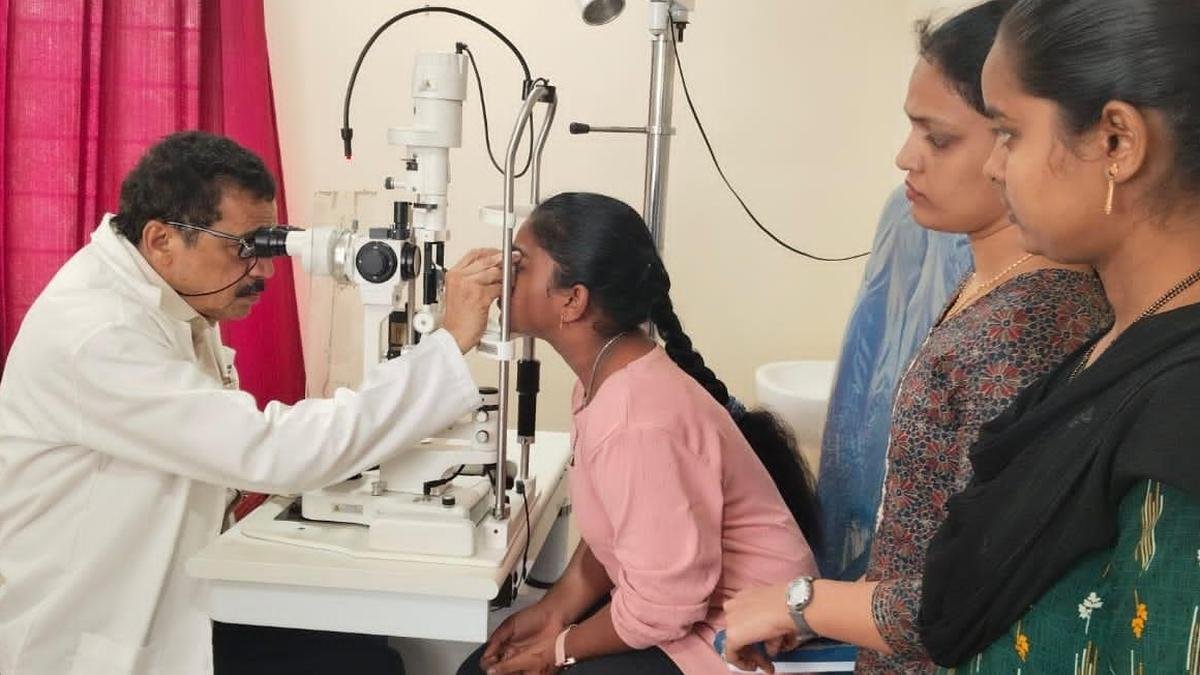
Take the case of Rahul (name changed), a 13-year-old boy studying in class 8, who came to us for his routine six-monthly eye examination. He had started wearing glasses at the age of 10 and was already myopic with a refractive error of −2 dioptres when he first presented to us. Although he had repeatedly complained to his mother that he could not see the blackboard clearly, she initially dismissed it, assuming he was joking. It was only later that she realised he had been copying notes from his classmate’s notebook because he was unable to read the board. Rahul’s mother is also myopic, though she began wearing glasses only at the age of 17. From an early age, he had had significant exposure to television and smartphones.
At his current visit, Rahul was wearing glasses of −3 dioptres, but over the preceding six months, his myopia had progressed further to −3.5 dioptres. This progression had occurred despite treatment with anti-myopia eye drops and the use of myopia-control spectacles. I found myself wondering what more could be done to slow the progression of his myopia. Eventually, I decided to increase the concentration of the prescribed eye drops to achieve better control.
We routinely advise lifestyle modifications for all children with myopia. These recommendations include limiting recreational screen time to less than half an hour a day, ensuring at least two hours of outdoor activity in daylight, and following the 20-20-20 rule — for every 20 minutes of near work, the child should look at an object 20 feet away for at least 20 seconds. We also emphasise the importance of good lighting while reading or studying and ensuring adequate sleep.
I decided to explore Rahul’s daily routine in greater detail. He leaves home at 7 a.m. to reach school by 8 a.m. and returns only at 4:30 p.m. After school, he attends coaching classes in preparation for the IIT entrance examinations, reaching home around 7:30 p.m. He then must complete his homework, much of which is sent in PDF format to his mother’s smartphone. At the end of the day, he unwinds by watching television during dinner and later spends time scrolling through reels on his phone. I realised that I had very little control over many of the factors driving his near-work burden. Individual counselling alone cannot address a problem that is increasingly shaped by educational systems, digital learning practices, urban lifestyles, and societal expectations. This highlights the need for policies that encourage a balanced use of digital learning and reduce unnecessary screen-based academic work, particularly for younger children.
Sadly, this has become the reality for many children growing up in urban India today.
The burden of myopia
Rahul’s progressive myopia is part of a much larger trend seen across the world.
Myopia is no longer merely a problem corrected with glasses. It is now a major global public health concern. In 2000, roughly 1.4 billion people, approximately 22.9% of the world’s population, were myopic. By 2010, this had risen to nearly 2 billion people, or 28.3%. Current projections from the Brien Holden Vision Institute suggest a steady increase. By 2050, approximately 4.75 billion people, nearly half the world’s population are expected to be myopic. Of these, nearly 10% are expected to have high myopia
The prevalence of myopia among urban children in India has increased from 4.44% in 1999 to 21.15% in 2019 and is projected to rise to nearly 48% by 2050.
What is myopia?
Myopia is primarily a refractive condition caused by excessive axial elongation of the eye. In a myopic eye, the axial length, which is the distance between the front and back of the eye, becomes too long. As a result, incoming light rays focus in front of the retina instead of directly on it, causing distant objects to appear blurred. Concave lenses, either in the form of spectacles or contact lenses, are used to shift the focus back onto the retina and restore clear vision.
Myopia is not merely about needing glasses. As the axial length of the eye increases, the tissues of the eye, including the sclera, choroid, and retina, undergo stretching and thinning. This increases the risk of retinal detachment, myopic macular degeneration, glaucoma, and early cataract formation.
High myopia, generally defined as a refractive error of −6 dioptres or greater, is associated with potentially irreversible visual impairment and blindness. The increasing prevalence of high myopia therefore, represents a major future public health challenge.
What needs to be done?
Like most epidemics, the myopia surge demands prevention at multiple levels. Efforts to address myopia must begin even before the onset of the condition.
Primary prevention: One of the most evidence-based strategies for preventing myopia is increasing outdoor exposure to natural daylight. Exposure to bright outdoor light stimulates retinal dopamine release, which is believed to inhibit excessive axial elongation of the eye. Current evidence suggests that children require at least two hours of outdoor activity per day.
This can be promoted through: school-based outdoor activity programmes, reduction of unnecessary indoor screen-based learning, public awareness campaigns, and parental education regarding healthy visual habits.
Secondary Prevention
Compulsory eye examinations before preschool entry (around 3 years of age) and before formal schooling (around 6 years of age) should be considered as part of public health policy. In addition, annual school eye screening programs should be made mandatory so that children with myopia can receive timely spectacles and anti-myopia interventions.
Tertiary prevention:The goal of tertiary prevention is to prevent low myopia from progressing to high myopia and its associated complications. This involves: optical interventions, pharmacological treatments such as low-dose atropine, behavioural modifications, and regular long-term follow-up.
Equally important is counselling families regarding lifestyle changes and adherence to treatment.
A public health challenge
If Rahul had undergone an eye examination when he was three, before entering preschool, he may have been identified as being at a higher risk because of his parental history of myopia. His parents could have been counselled regarding the importance of outdoor activity, reduced recreational screen exposure, and regular monitoring. Earlier school-based screening may also have detected his myopia sooner, allowing treatment to begin earlier.
Rahul is fortunate that his parents can afford anti-myopia spectacles and long-term pharmacological treatment. However, from a public health perspective, access and affordability remain major concerns. Advanced myopia-control interventions are expensive and often inaccessible to families in low- and middle-income countries such as India, where these treatments are usually not covered by insurance or public health systems.
Improving lifestyles
The rise of myopia is not merely an ophthalmic problem; it reflects how childhood itself is changing. Children today are growing up within the four walls of their home or school, in screen-dependent, academically pressured environments with limited opportunities for outdoor play and rest. The consequences of this lifestyle on the eye carries lifelong risks.
Preventing a future epidemic of high myopia will require far more than stronger glasses or better eye drops. It demands coordinated efforts from parents, schools, healthcare systems, urban planners, and policymakers. Ultimately, the challenge is not only to protect children’s vision, but also to rethink how children learn, play, and grow in the modern world.
(Dr. Vasudha Kemmanu is a paediatric ophthalmologist and a public eye health specialist at Narayana Nethralaya, Rajaji Nagar, Bengaluru. vasudhakemmanu@gmail.com)