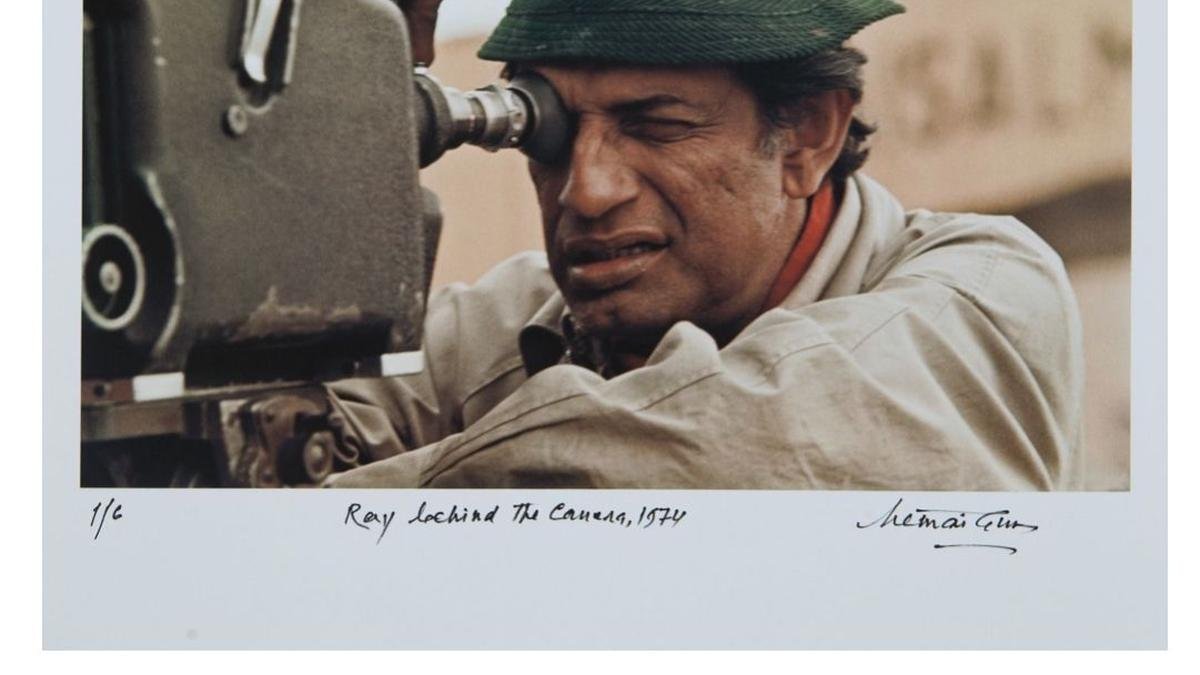
For generations, Satyajit Ray has lived in public memory in shades of black-and-white. The celebrated filmmaker appears in iconic portraits with his trademark spectacles, directing actors on set, smoking thoughtfully between takes or gazing into the distance with characteristic intensity. These images, etched in India’s cultural imagination, seem inseparable from the man himself.
Nemai became Ray’s shadow, capturing every moment
| Photo Credit:
Courtesy: DAG
Yet, a remarkable exhibition at Delhi Art Gallery (DAG) is challenging that familiar image. Faces and Facets; Satyajit Ray in Color, on view till July 4, presents the filmmaker through a series of rarely-seen colour photographs by Nemai Ghosh, who documented Ray’s life and work for over two decades. The exhibition offers something rare: a chance to encounter one of the world’s most-studied filmmakers anew.
The exhibition is a collection of photographs by Ghosh, Ray’s trusted collaborator and principal still photographer. Beginning with Goopy Gyne Bagha Byne in 1968, Nemai documented the filmmaker with rare access, eventually creating an archive of thousands of images. The display at DAG draws from that vast groundswell revealing not only the celebrated filmmaker; but also the man behind the lens.
Interestingly, photography was not Ghosh’s first calling. As a young man, he was immersed in theatre, performing with Utpal Dutt’s Little Theatre in Calcutta and starring in the landmark 1959 production Angar. His entry into photography was accidental. A friend who owed him ₹240 showed him a Canonette QL-16 camera that had been left behind in a taxi. Ghosh immediately asked for it in lieu of repayment — an act that altered the course of his life.
On a trip to Burdwan with friends, he carried the camera to the set of Ray’s Goopy Gyne Bagha Byne and took several photographs with no particular intention. Seeing them, art director Bansi Chandragupta took Ghosh to Ray, who was impressed by his photographic skills and invited him to join his unit in 1968 — beginning a collaboration that lasted until the filmmaker’s passing in 1992.
Over the years, Ghosh distilled his extraordinary archive into a series of books including Satyajit Ray at 70 (1991, featuring a foreword by Henri Cartier-Bresson); Satyajit Ray: A Vision of Cinema (2005, co-authored with Andrew Robinson); Manik-Da: Memories of Satyajit Ray (2011); Satyajit Ray and Beyond (2013); and Faces and Facets: Ray in Color (2020). Beyond Ray, he also documented the streets, people and the evolving character of Calcutta with remarkable sensitivity, while also undertaking significant photographic studies of indigenous communities across India.
Warm light filtering into his workspace with books scattered around him
| Photo Credit:
Courtesy: DAG
What makes the images, at DAG, compelling is not just the fact that they are in colour, but the manner in which colour alters our perception of a personality — long frozen in a monochrome-memory. Suddenly, Ray feels less like a distant legend and more like a living, breathing artiste.
The trust Ray had in Ghosh, is evident throughout the exhibition. The images feel unguarded and spontaneous, capturing Ray in ways that formal portraits rarely can.
A genius absorbed in thought
| Photo Credit:
Courtesy: DAG
The transition from monochrome to colour may seem cosmetic, but in this exhibition, it becomes transformative. The earthy tones of Ray’s clothing, the warm light filtering into his workspace, the textures of books, papers and sketches scattered around him — all emerge differently.
These photographs capture Ray in moments both public and personal — studying scripts, sketching storyboards, directing and conversing.
Few filmmakers have shaped modern Indian culture as profoundly as Ray. His debut film, Pather Panchali (1955), transformed Indian cinema and introduced international audiences to a new cinematic language — rooted in realism, empathy and everyday experience. Together with Aparajito and Apur Sansar, it formed the celebrated Apu Trilogy.
Over the next four decades, Ray created an extraordinary oeuvre that included classics such as Charulata, Jalsaghar, Mahanagar, Nayak, Aranyer Din Ratri and Ghare Baire. His films explored social change, urbanisation, class, gender and human relationships with a subtlety rarely matched in cinema.
On the sets of Shatranj Ke Kilari with Sanjeev Kumar
| Photo Credit:
Courtesy: DAG
Seen in this context, the colour photographs possess an additional resonance. They offer a glimpse into the creative environment from which some of cinema’s most enduring works emerged.
The exhibition is equally a tribute to Ghosh, whose photographs have become inseparable from the visual history of Ray’s career. Reflecting on the relationship years later, Ghosh wrote: “I followed him like his shadow. I was crazy about capturing him on my camera every moment.”
Ghosh’s works have been exhibited extensively in India and overseas, and became part of the permanent collection of the National Gallery of Modern Art. He passed away in Kolkata on 25 March 2020, leaving behind an invaluable visual chronicle of one of cinema’s greatest masters and the world around him.
Published – June 08, 2026 04:13 pm IST