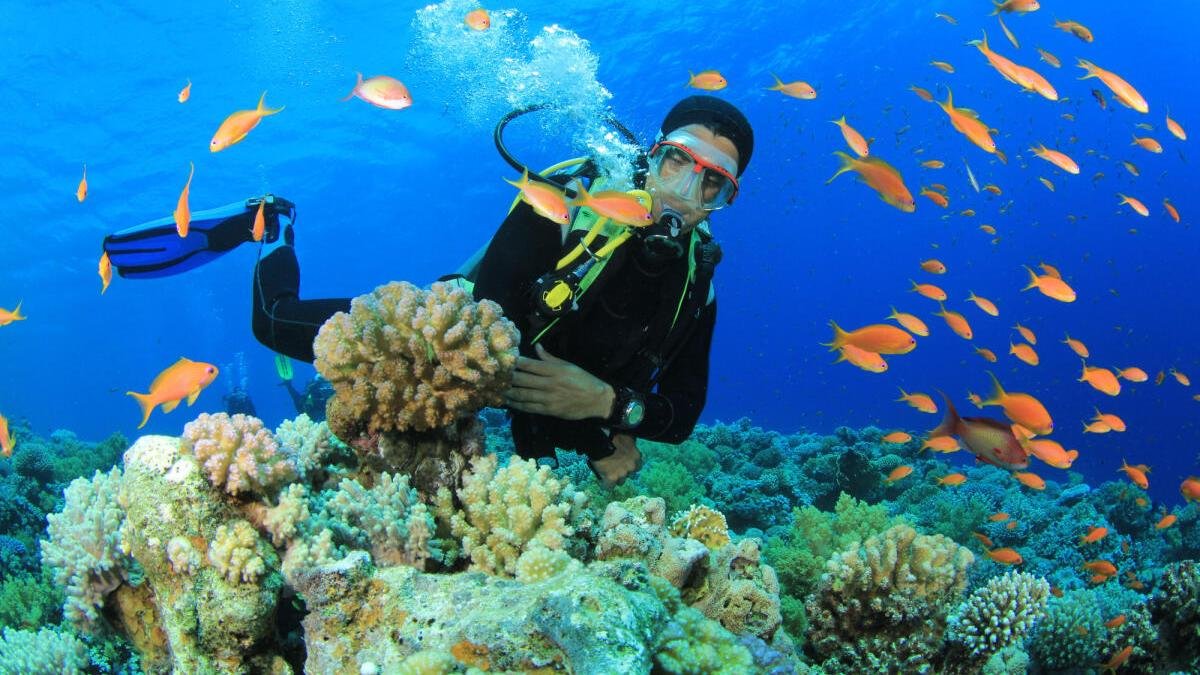
Children from the Karen and Ranchi ethnic groups of the Andaman Islands learned about the sea the way other children learn a family language.
They inherited it from their fathers and grandfathers, who could read the weather in a shifting cloud, sense currents in the movement of water, and spot a turtle or reef fish at a place where outsiders saw only blue. The ocean was never something to be conquered or discovered. It was simply part of everyday life, as familiar as a sidewalk that shared a border with home.
For generations, this intimate knowledge of the sea rarely translated into economic opportunity. Today however, in a transformation unfolding across Havelock Island, descendants of fishermen and boatmen are becoming diving instructors and marine guides, turning an inherited relationship with the ocean into a profession that is reshaping lives, families and entire communities.
Blue economy offers unlimited opportunities for ‘Puthuyuga Keralam’: Chief Minister V.D. Satheesan
Husna, Gypsy Diver’s first dive boat that has carried divers to safety.
| Photo Credit:
Special Arrangement
Helping steer this transformation are Poonam Darne and her husband D Santosh, founders of Gypsy Divers, a PADI (Professional Association of Diving Instructors, one of the world’s most recognised dive training organisations) affiliated five-star dive school and resort located on Havelock’s Beach No. 2.
Who are the Karen and Ranchi communities?
The Karen community
According to Wikipedia, The Karen (also spelled Kayin) are an ethnic minority group originally from Myanmar’s Kayin State, where they comprise approximately 7% of the country’s population. British colonial authorities recruited Karen families to the Andaman Islands in the early 1920s, with the first organized group of 12 families arriving in April 1925. They were specifically chosen for their exceptional forestry skills and familiarity with tropical forest ecosystems similar to their Burmese homeland. Today, approximately 2,500–3,000 Karen people live primarily in North and Middle Andaman, with settlements in villages like Webi, Karmatang, and Borang.
For generations, the Karen have been known as skilled woodsmen, boat builders, farmers and naturalists. The Karen remain among the islands’ most environmentally knowledgeable communities and continue to seek Scheduled Tribe status in India.
The Ranchi community
The Ranchi community in Andaman is not a single tribe but a collective term for Adivasi or tribal settlers whose ancestors migrated from Jharkhand, northern Odisha, and Chhattisgarh. This diverse group includes tribes like Oraon (Kurukh), Munda, Kharia, Mahli, Turi, Ghasi, and Cheek. According to anthropologist Philipp Zehmisch’s 2015 paper The Invisible Architects of Andaman: Manifestations of Aboriginal Migration from Ranchi , migration began during British colonial rule and continued through post independence settlement programmes, with approximately 50,000–100,000 Ranchiwalas now living across South Andaman, Middle Andaman, Little Andaman, and Nicobar Islands. The community is currently demanding Scheduled Tribe status (which they hold in Jharkhand) to gain constitutional protections and benefits in Andaman.
Also Read | Turn the tide
Poonam, 50, is among India’s earliest female scuba divers and instructors, while Santosh, a theatre actor who has worked alongside Amitabh Bachchan and Mithun Chakraborty , brought his own unconventional journey to the islands. Together, they established Gypsy Divers in 2016 with a vision that extended beyond tourism. In the decade since, the school has trained more than a 1,000 divers from the Karen and Ranchi community, school children and recreational enthusiasts and Army personnel undertaking rescue diver certification programmes.
However, some of its most lasting impact has unfolded far from the coral reefs.
Poonam Darne with Saw Khelay from the Karen community
| Photo Credit:
Special Arrangement
When Poonam first encountered young men from the Karen and Ranchi communities, many were working as fishermen or helping operate wooden boats that ferried tourists between islands. What struck her was how intimately they knew the sea. They could read currents, spot marine life with astonishing ease and free dive for long periods without equipment. “The practical skills came naturally to them. What was difficult was the theory, the language and the certification process, “ she says.
Working with translators and mentors, Gypsy Divers began training local youth as professional divers. The first batch consisted of around 10 Karen boys. They became divemasters (diving specialists), secured jobs and inspired others to follow. Today, hundreds of Karen and Ranchi men and women work across the Andaman diving industry as diving instructors, marine guides and boat captains.
Poonam and Santosh Darne
| Photo Credit:
Special Arrangement
Poonam says that families that once relied solely on fishing now have stable year round incomes. “Children are receiving better education, wives and parents often visit the dive school to share milestones that would have been difficult to imagine a generation ago,” Poonam narrates.
Gypsy Divers’ Kabira is an MS-class (Motor Ship) dive vessel, certified under Indian maritime regulations for commercial passenger operations in offshore waters
| Photo Credit:
Special Arrangement
Women, too, are finding a place within the industry. At Gypsy Divers, Ashrita Kissipota, a 33-year old Ranchi woman who initially joined as domestic help gradually learned administrative work, paperwork and computer operations. Today, she manages key aspects of the dive school’s operations. Across the islands, more women from Karen and Ranchi communities are entering a profession that was once overwhelmingly male.
Ashrita Kissipota, a 33 year old Ranchi woman
| Photo Credit:
Special Arrangement
For Poonam and Santosh, diving is only part of the mission. Marine biologists regularly conduct workshops on coral reefs, conservation and ocean ecology for students and local staff. “The ocean has given us purpose,” she says. “If people learn to love the sea, they naturally develop a relationship with it and want to protect it, “ affirms Poonam. The goal, she explains, is not merely to create divers but a community of ocean custodians.
The Darnes are quick to point out that their story is larger than Gypsy Divers. The success belongs equally to the Karen and Ranchi communities whose generations-old relationship with the sea laid the foundation for everything that followed.
Dive masters and boat captains at work
| Photo Credit:
Special Arrangement
Twenty-five-year-old Saw Tooaye, who lives in Mayabunder in the Andaman Islands, has been working with Gypsy Divers for the last eight years. “I joined as a ground staff but now I am a boat captain,” he says with pride. As a boat captain, he ferries divers to dive sites and oversees operations on the water, often beginning his day at 5 am and working until 2 pm, when sea conditions are at their calmest and most suitable for diving. This year, during the off season between June to September, he is building a concrete home for his family. Earlier, like many in his community, he lived in a hut made from leaves. He speaks about his work with unmistakable affection, and a spark lights up his eyes when he says, “Aur bhi bada karna hai life mein (I want to do bigger things in life).”
Thirty-five-year-old Saw Toole has been associated with Gypsy Divers for the past 17 years and today works as a dive master. His role involves teaching safe diving practices to both young and older divers, while also assisting with the various PADI-certified courses offered by the school. “Before leaving, guests shake my hand and tell me that they will visit us again,” says Saw, a shy half smile spreading across his face.
The Andamans is home to 2,500 – 3,000 Karen people and approximately 50,000 – 1,00,000 Ranchiwalas.
| Photo Credit:
Special Arrangement
The impact of his journey extends far beyond his own career. “Seeing me, many people in my community have become interested in diving, becoming dive masters and earning a livelihood for themselves. I would also encourage my kids or the younger generation to take this up,’’ he says.
As dive boats leave the shore each morning, they carry more than tourists into the blue. They carry the hopes of a generation that is proving that in the Andamans, the sea can be both inheritance and opportunity.