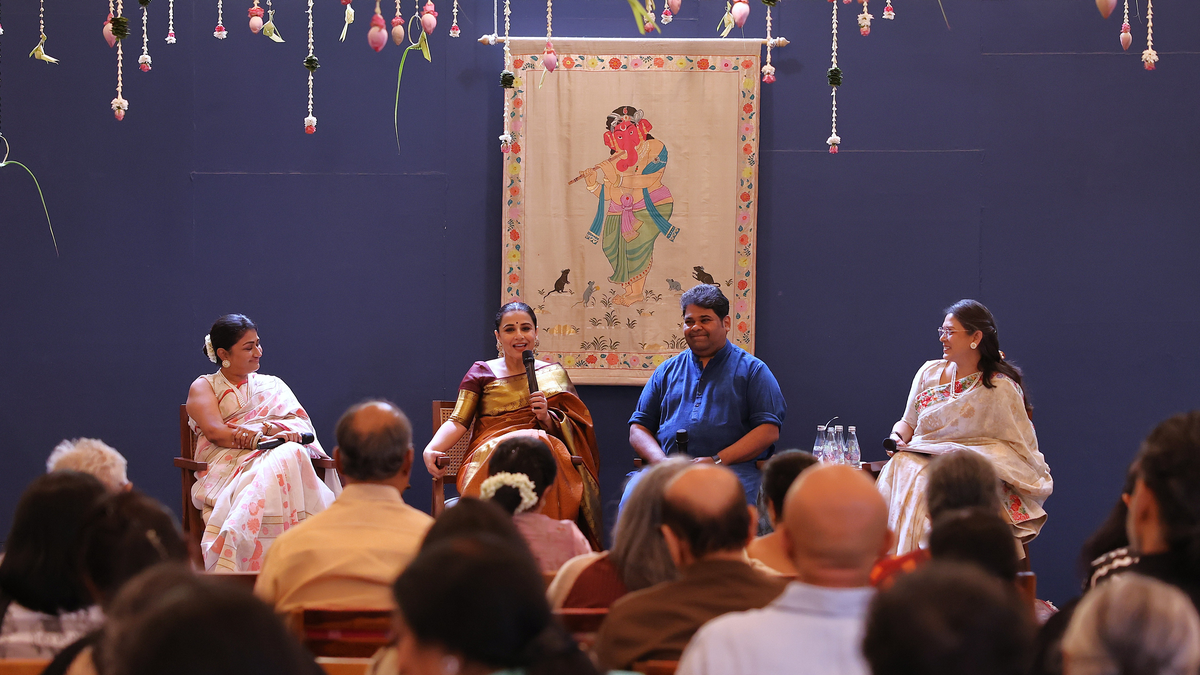
Dolly Jain, Vidya Balan, Gaurang Shah and Pratiksha Prashant during the launch
| Photo Credit: Special Arrangement
Some conversations lead to reflections on the journey so far and the road ahead. In Limitless Traditions, a coffee table book launched recently, Hyderabad-based textile designer Gaurang Shah recalls a conversation he had with a weaver in Benares.
The weaver told Gaurang that the craftswomen have been working on a motif for over 300 years, with the knowledge being passed down generations. “He said, ‘you are not starting something new, but continuing it’,” he recalls. That statement made Gaurang contemplate his role, as catalyst, in helping a craft stay afloat.
The limited edition coffee table book intersperses Gaurang’s journey alongside weaving traditions from different parts of India. Limitless Tradition was launched in Hyderabad amid a select gathering that included actor Vidya Balan and Dolly Jain, widely recognised for her skills in saree draping. Vidya recalled childhood memories of women in her family wearing elegant cotton saris and how she feels at home in handwoven saris during her international appearances as well.
As for the book, written by Shefali Vaidya, it begins with a brief history of Indian textiles, types of weaves and surface design techniques, before discussing Gaurang’s journey.
Copies of the book
| Photo Credit:
Special Arrangement
“At the age of 11, I began helping out at my dad’s matching centre,” Gaurang recalls. In 1999, he opened his own branch of the matching centre (Indian Emporium), focusing on selling blouse pieces. The larger space helped him think beyond selling textiles and work towards creating them.
Having seen his mother and other women wear handlooms, he had taken a liking for weaves since childhood. Gaurang’s initiation into the business of weaving saris began with the Uppada cluster in Andhra Pradesh in 2000.
Today, he liaises with 7000 weavers in 16 States and says, “In several clusters, we have brought back weavers who had taken up other jobs for livelihood and helped them earn a steady income. We have also trained women from beyond the weaving community and they show exceptional commitment to the craft.”
The looms supported by the designer extend from Kanchi pit looms to Patola, jamdani and Kashmir Kani. Gaurang says that around seven years ago, he wanted to document his journey. He had roughly penned his thoughts and a chance meeting with textile researcher Shefali Vaidya paved the way for a book.
“I knew about his work and visited his store as a customer. He then flew to Pune to discuss the book,” says Shefali, who was in Hyderabad for the launch.
Shefali probed further to understand his design philosophy. “The writing was done in eight weeks. It was a tight deadline, but I am happy with the book,” she says.
The text is interspersed with photographs of the weaving process, handwoven saris sported by women across age groups, and collections showcased at the Lakme Fashion Week. QR codes lead to videos detailing the weaving process. Shefali adds that while she was intrigued and keen to document the designer’s love for jamdani and exploration of the technique across States, she was also curious about his unique experiments. “For instance, he designed a khadi sari with a Patola border and pallu. It’s a fascinating combination of textures and techniques, driven by instinct and expertise.”
(The book is priced at ₹7800, available at Gaurang museum, Hyderabad. For copies, contact 90000 90581)
Published – July 22, 2026 12:10 pm IST