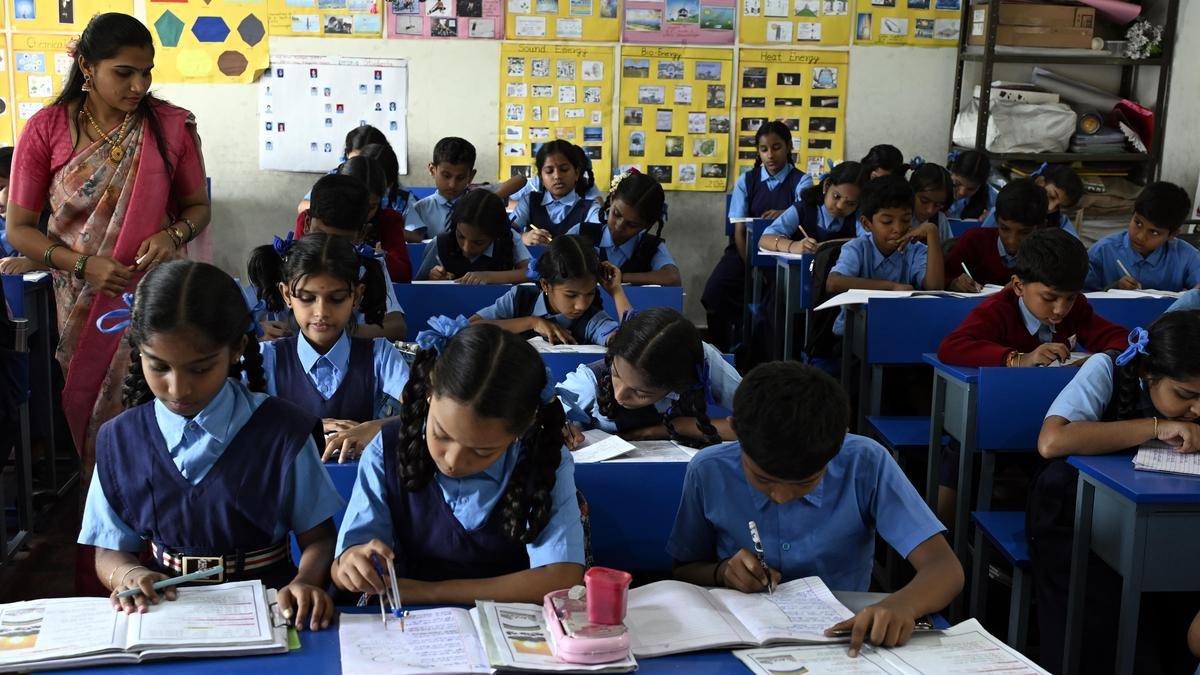
The Court said the three language scheme would eventually have to be implemented, but the CBSE would have to streamline its implementation better. File (Representational image)
| Photo Credit: Sudhakara Jain
The Union government told the Supreme Court on Wednesday (September 9, 2026) that it “has an issue” with treating English as an indigenous language, but assured the court that it would move quickly with consultations on granting current Class 6 students a one-time reprieve from a mandatory third-language Board examination.
Appearing before a Bench headed by Chief Justice of India Surya Kant, Solicitor-General Tushar Mehta, who was standing in for Additional Solicitor-General Aishwarya Bhati, representing the Union government and the Central Board of Secondary Education (CBSE) in the case, said a meeting would be arranged “today or tomorrow” with the officials concerned in the presence of Ms. Bhati for a decision on the issue of reprieve for Class 6 students.
Editorial |Language decorum: On the three-language formula in CBSE schools
When senior advocate Gopal Sankaranarayanan, appearing for the petitioners, sought an order from the court on the issue of English being shifted to the “non-native” or foreign language category, Mr. Mehta said, “We have an issue about that. We would like to make submissions on that.” He, however, sought a short adjournment as Ms. Bhati was unable to address the court on Wednesday (September 9) due to a personal difficulty.
The Court adjourned the hearing to September 17.
Senior advocate Anand Grover, also appearing for the petitioners, said parents were getting anxious and urged the court against allowing any further adjournments in the case.
At an earlier hearing, the court had asked the CBSE to consider giving Class 6 students relief from writing the third-language examination in Class 10.
Under the CBSE guidelines, students in Classes 7 to 9 were exempted, while the current Class 6 batch was slated to face full implementation of the third-language scheme, including a mandatory Class 10 Board examination in the third language by 2031.
The court said the three-language scheme would eventually have to be implemented, but the CBSE would have to streamline its implementation better.
“You have to give some time not only for students but also for infrastructure to come on par across the various education boards. It is a good policy to start with the mother tongue, then an indigenous language, and then another indigenous or foreign language. But all this should be started when the children are a little younger, in a lower class, giving them time to adapt,” Justice Bagchi said.
The court had asked Ms. Bhati, appearing for the CBSE, to get instructions on three issues — whether a one-time reprieve could be given to the current batch of Class 6 students; how human resources could be built to meet the demands of the three-language scheme; and whether the scheme should ideally be introduced in earlier classes.
Meanwhile, the court issued notice to the government on petitions filed by minority schools regarding the implementation of the three-language scheme.
Published – September 09, 2026 02:38 pm IST