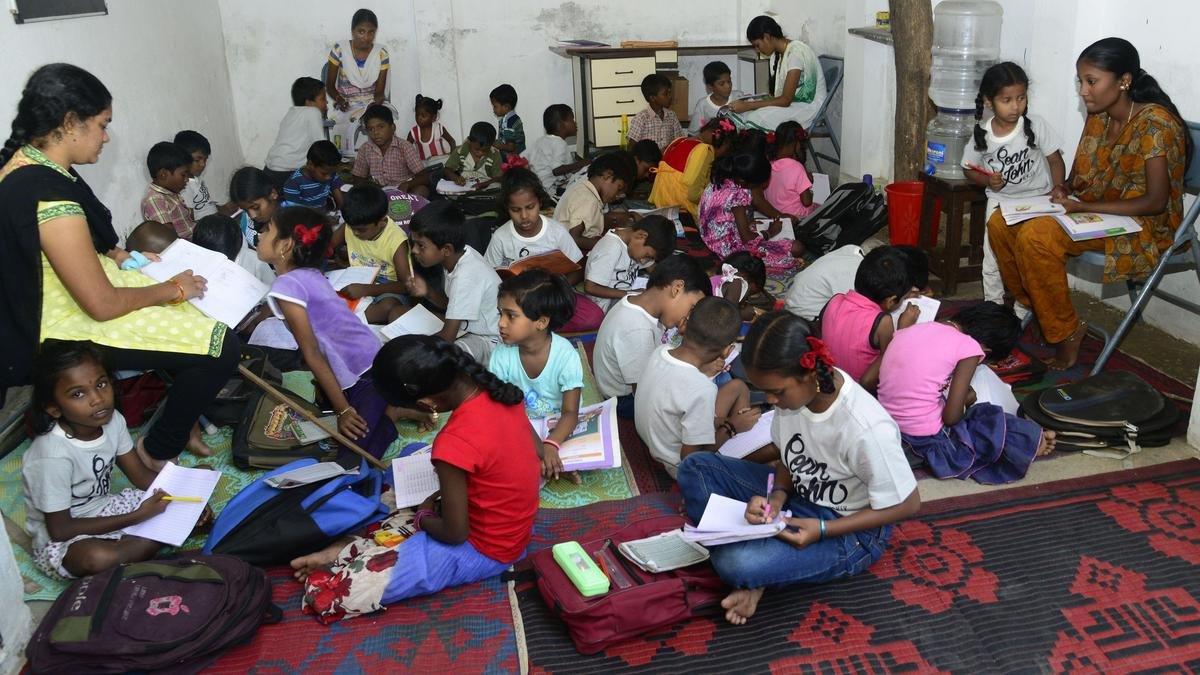
27% of India’s schoolchildren are paying for lessons outside school. The Hindu reported in September that children enrolled in private coaching are concentrated in the east of the country. Tripura is the highest at 79%, West Bengal comes second at 75%.
(Sign up for THEdge, The Hindu’s weekly education newsletter.)
What nobody has asked is why. A common reasoning is that tuition is a luxury, and students from richer families can afford it. Therefore, it’s more likely that students from richer States could afford it easily. Using unit-level data from the Comprehensive Modular Survey on Education 2025, a nationally representative survey of 52,085 households conducted by the National Statistics Office, we tested this claim. The data show that this claim is wrong and also reveal a complicated picture of who India’s coaching economy actually serves.
Money does not explain the map
We plotted every State’s coaching rate against its per-capita income, and no pattern emerges. If anything, the relationship runs backwards: poorer States have more students opting for coaching. However, this explanation falls short.
Look at the individual cases, and you see why. Delhi is among India’s wealthiest States and sits mid-table at 39%. Bihar, among its poorest, records 53%. Kerala, which has high income and high literacy, sits at 28%. Karnataka and Himachal Pradesh, both prosperous, sit at 8%. Hence, income is not the only factor influencing the coaching belt.
Private coaching participation against State per-capita income, 2025. Each dot is a State.
This shows another trend. Coaching fills a gap left by the school. We cannot test that directly with this survey’s findings alone. But it fits what we see, and thus reframes the entire debate. Tuition in Bihar is not a top-up bought by the comfortable. It is a substitute purchased by families who cannot rely on the school.
Influence of caste
Across India, 34% of children belonging to the General category take coaching, compared with 26% of Dalit and Other Backward Class children and 14% of Adivasi children.
We then compared children who were alike in the ways that should matter. Same household spending per person. Same age, sex, and stage of schooling and from the same State.
Household spending barely moved the needle. It explains about a tenth of the coaching gap, and money, again, is not the driver.
But comparing children within the same State changed the picture almost completely. The gap between Dalit students fell from eight percentage points to under two, and became statistically indistinguishable from zero. The OBC gap vanished entirely.
Put plainly: a Dalit child and a General-category child living in the same State, from households spending similar amounts, are about equally likely to be in a tuition class. The national caste gap in coaching is mostly an artefact of where different communities live. India’s coaching belt runs through the east; Dalit and OBC populations are not evenly spread across it.
This is not reassuring. It means access to supplementary teaching is decided by which State a child was born in, which is no more defensible than caste, only different.
The caste gap in private coaching, before and after comparing children in the same state with similar household spending.
The exception
Adivasi children are the exception, and they are the most important finding here.
Their gap halves once State is accounted for, but it does not close. Roughly nine percentage points remain. An Adivasi child in the same State as a General-category child, from a household spending the same amount per person, at the same stage of school, is still substantially less likely to be receiving coaching.
Income does not explain it. Geography explains half of it. Something else accounts for the rest.
This is likely because Adivasi households are concentrated in remote settlements even within coaching-rich States, where a tuition centre may be several villages away rather than around the corner. Residential schooling, a large part of tribal education policy, may also cut children off from neighbourhood tuition markets in ways the survey cannot see. What we can say is that for this one group, neither of the standard explanations is sufficient — and that the same residual appears when we look at private school access.
What this adds up to
Two things largely decide whether an Indian child gets coached, and household income is not one of them. Where a child lives matters most, and for Dalit and OBC families, it swamps caste almost entirely. This points to a situation where in-school teaching is not satisfactory enough, due to which families feel obliged to buy a second version of it. This cannot be fixed by giving households money alone, because money is not what is binding. For Adivasi children, the reason is unclear.
Thus, private tuition is not just an aspirational purchase made by families doing financially well. In much of India, it is a compensatory one, made by families who cannot count on the school.
Source: Comprehensive Modular Survey on Education (CMS-E) 2025, unit-level data, Ministry of Statistics and Programme Implementation. Estimates are survey-weighted. State income figures are NSDP per capita at constant 2011-12 prices (RBI). Chandigarh, Andaman & Nicobar, Goa, Sikkim and Puducherry rest on fewer than 150 sampled children each and are indicative only.
(Raunak Maitra is a Master’s student at the Centre for Development Studies, Thiruvananthapuram. Karan Babbar is an Assistant Professor of Economics at XLRI Jamshedpur.)
Published – August 25, 2026 08:30 am IST