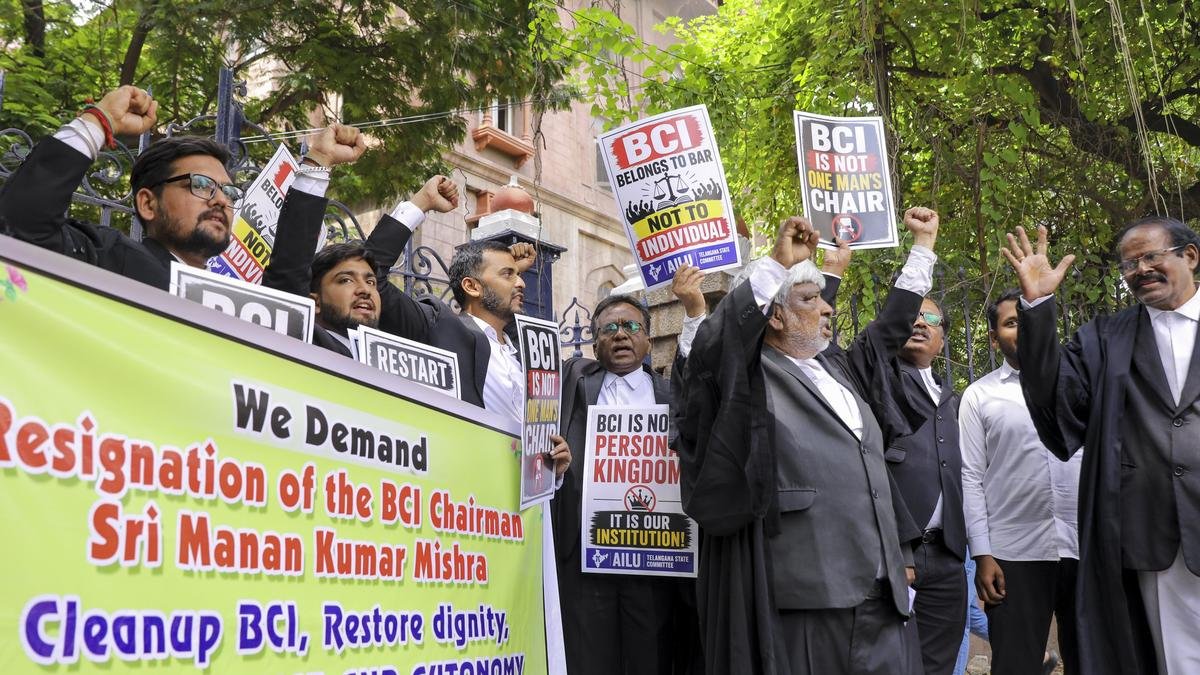
The recent controversy over Bar Council of India’s (BCI) chairperson, Manan Kumar Mishra, ordering that the outgoing batch of National Academy of Legal Studies and Research (NALSAR) University, Hyderabad, students be prevented from enrolling as advocates in State Bar Councils has drawn attention to the adversarial relationship between law students and BCI over the years. A Bench led by the Chief Justice of India Surya Kant ruled that the BCI has no power to “take disciplinary action against a law student” and noted that the BCI may prescribe and enforce standards of legal education, but its functional role comes in only after law students graduate and register as advocates.
(Sign up for THEdge, The Hindu’s weekly education newsletter.)
It seems like a tidy end to an untidy story that has been almost six decades in the making. This was not the first time the Bar Council has been questioned about the scope and limits of its power to regulate the lives of law students who were not, strictly speaking, its business yet.
The BCI was created by the Advocates Act of 1961 with two primary, connected purposes: to lay down standards for those who get to practise law in India, and to lay down standards for the institutions that provide legal education for these future practitioners. But when the question turns to the conduct of students, the waters grow murky. For decades, the authority has found itself at loggerheads with certain peculiar student interests.
Some of the earliest disputes revolved around the validity and recognition of law degrees, the qualifications required, and the competence needed to enter into the profession. A pre-enrolment training requirement was built into the original 1961 framework for enrolment as an advocate, but the relevant provisions were removed in 1973 through a legislative amendment. The BCI tried to revive pre-enrolment training in 1998, but the Supreme Court struck it down in the subsequent year, holding that the BCI lacked statutory authority to reintroduce a requirement Parliament had deliberately removed.
In the late 80s and early 90s, the council stressed on the mandate of regular attendance at lectures, tutorials and moot courts. In the late 1990s and early 2000s, the BCI moved to phase out evening law courses. The apex court has largely concurred with these requirements as measures intended to preserve the quality and rigour of legal education. Evening and distance programmes, however, were often viewed as routes into legal education for people who worked during the day. What therefore becomes a recurring theme is that measures intended to improve the quality of legal education have often come at the cost of access.
A decade later, a dispute over the affiliation of a Bhopal law college developed, on the Supreme Court’s own initiative, into a much broader inquiry into the “diminishing standards” of legal education. The solution was seen to be a uniform, nationwide compulsory (bar) examination. The first All India Bar Examination followed in 2010. The Council described the examination as a mechanism for establishing a basic hygiene-level standard of professional competence. The students, however, saw this as another additional hurdle between their degree and their livelihood.
In Tamil Nadu in 2011, the disagreement became a mass movement with law graduates boycotting the examination, tearing up exam tickets, staging road and rail blockades. Some State Bar Councils also opposed the BCI’s approach, arguing that graduates had already completed council-prescribed legal education over 3 or 5 years.
The Supreme Court has since affirmed the BCI’s power to prescribe an examination before or after enrolment, with students eligible to enter their final semester being permitted to take the AIBE. In 2024, however, the BCI issued a notification excluding final-year students from AIBE XIX, prompting another Supreme Court intervention; the Court ultimately allowed eligible final-year students to take the examination.
Addressing students’ grievances
The boundaries between regulating the quality of the legal profession and controlling the conditions under which law students can enter the profession have repeatedly been contested. The contest has not, however, always been unidirectional. Students have often opposed the BCI regulation when it has created hindrances to access, but at times students have also demanded a greater degree of regulation and control. At times, student resentment has been towards university administration, with the demands directed to the BCI to exercise stronger regulatory oversight.
In 2013, more than 800 law students petitioned the BCI to create an All India Law Students Grievance Redressal Authority. Their argument was that since the BCI regulated law schools, it should also facilitate a mechanism through which students could escalate grievances concerning inadequate facilities, arbitrary administration and weak student representation.
Recurring issues have also emerged regarding the college administration’s failure of renewal of required BCI recognition. In 2014, the council announced that graduates of Delhi University’s three law centres would not be eligible for enrolment because they had not obtained the necessary extension of the BCI affiliation. Students, now marked ineligible to enrol as advocates, protested against both the university and the BCI.
Similar issues cropped up in 2018 for Rajasthan University when the institution’s BCI recognition lapsed. The affected students went on a hunger strike. Students of Meerut College also protested in 2017 as a reaction to the college reducing its LL.B intake from 1,140 to 300, with the college attributing the reduction to a BCI directive. The students burned effigies of the college administration.
More recently, in May 2026, students from RML NLU Lucknow protested due to the college’s lack of BCI affiliation. Similar affiliation lapses in 2026 landed GLC Kozhikode in Kerala High Court. Similar issues have surfaced in Mumbai in 2018, Gujarat in 2023, Barabanki, UP in 2025, among several others.
The Courts and the BCI have, in such cases, largely ensured that the interests of students are not jeopardised due to an institute’s dereliction. However, the regulatory clashes do not end there.
In 2016, the BCI’s directive to law colleges to prescribe dress codes “befitting the profession” generated criticism from students in Bengaluru, who saw it as unnecessary regimentation.
That same year, students at Delhi University yet again protested the BCI’s recommendation to shut down evening law classes.
During the pandemic, students confronted the BCI over examinations and practical training and clinical course requirements that were difficult or impossible to satisfy during lockdowns.
In the following years, student concerns have also emerged recurrently over the conditions and costs of compulsory internships, costs of entering the profession, unpaid work and inadequate stipends.
In 2023, the council, through a resolution, urged the Supreme Court to leave the questions surrounding same-sex marriage to legislative wisdom. Queer and allied collectives from 36 law schools publicly condemned the resolution, arguing that it was inconsistent with constitutional values.
BCI’s 70% attendance mandate, however, has been an even more consequential and recurring battleground. In 2010, Delhi High Court dealt with students challenging the enforcement of attendance requirements under the BCI’s Legal Education Rules. The court ruled in the council’s favour, holding the attendance mandate as an important component of maintaining the quality of legal education.
In 2016, however, the BCI took a sympathetic view and allowed several hundred DU law students with attendance shortages to write their final exams. Things, however, took a tragic turn in 2016, when a law student from Amity Law School, Delhi, barred from his semester exams for falling short of the mandatory attendance mark, died by suicide.
The matter reached the Supreme Court and then the Delhi High Court, which, nearly a decade later, ruled that no law student can be barred from an exam purely for a shortfall in attendance. This holding has since been stayed by the Supreme Court. The delay in challenging the order, which led to regulatory confusion, was admitted as a lapse on BCI’s part.
Meanwhile, in 2024, the BCI issued a circular mandating criminal background checks, biometric attendance, and CCTVs in law colleges. The order has since been challenged in the Supreme Court by law students.
Within that time period, the Council had also imposed moratoriums on approval of new law colleges on three instances (2016, 2019, and 2025). These moratoriums have either not been successfully implemented or were struck down by court each time.
The council also tried to proscribe online and distance LL.M. degrees in 2025, and questioned the law schools offering such degrees without the required approval. The BCI also attempted to abolish the one-year LL.M. and was met with similar resistance. During the challenge before the apex court, the BCI reconsidered its position and decided that the one-year LL.M. could continue, subject to academic rigour, standards, and infrastructure.
A separate dispute arose when the council sought to impose additional recognition conditions on LL.M. degrees obtained from foreign universities. The issue eventually reached the Supreme Court, which again questioned the extent of the BCI’s authority over postgraduate academic matters.
These issues, clashes, and tussles have largely been heterogeneous. The BCI’s underlying concerns, however, are not entirely manufactured. Commercialisation of legal education has eroded its quality. Law colleges have remained chronically understaffed. Nor is the concern that a weakly regulated pathway into a profession entrusted with people’s liberty and property can produce poorly prepared lawyers, without foundation. India has long suffered from a legal-education quality problem. The issue arises when the quality control and regulatory line keeps getting drawn and redrawn.
The BCI’s original objective was set to a relatively narrow and defensible question relating to the standards a person needs to satisfy before practising as a lawyer. In the years that have passed, that question has generated others: What should a law school teach? How often do the students need to compulsorily attend? Where and how should they study? What should they wear? How should they be monitored? What backgrounds should be investigated? And most importantly, what happens when they voice their dissent?
The NALSAR episode of 2026 tries to answer the last question. Although it does not settle all the others, it marks an important boundary in a six-decade relationship.
(Daksh Saroha is an Assistant Professor of Law at SRM School of Law, Chennai)