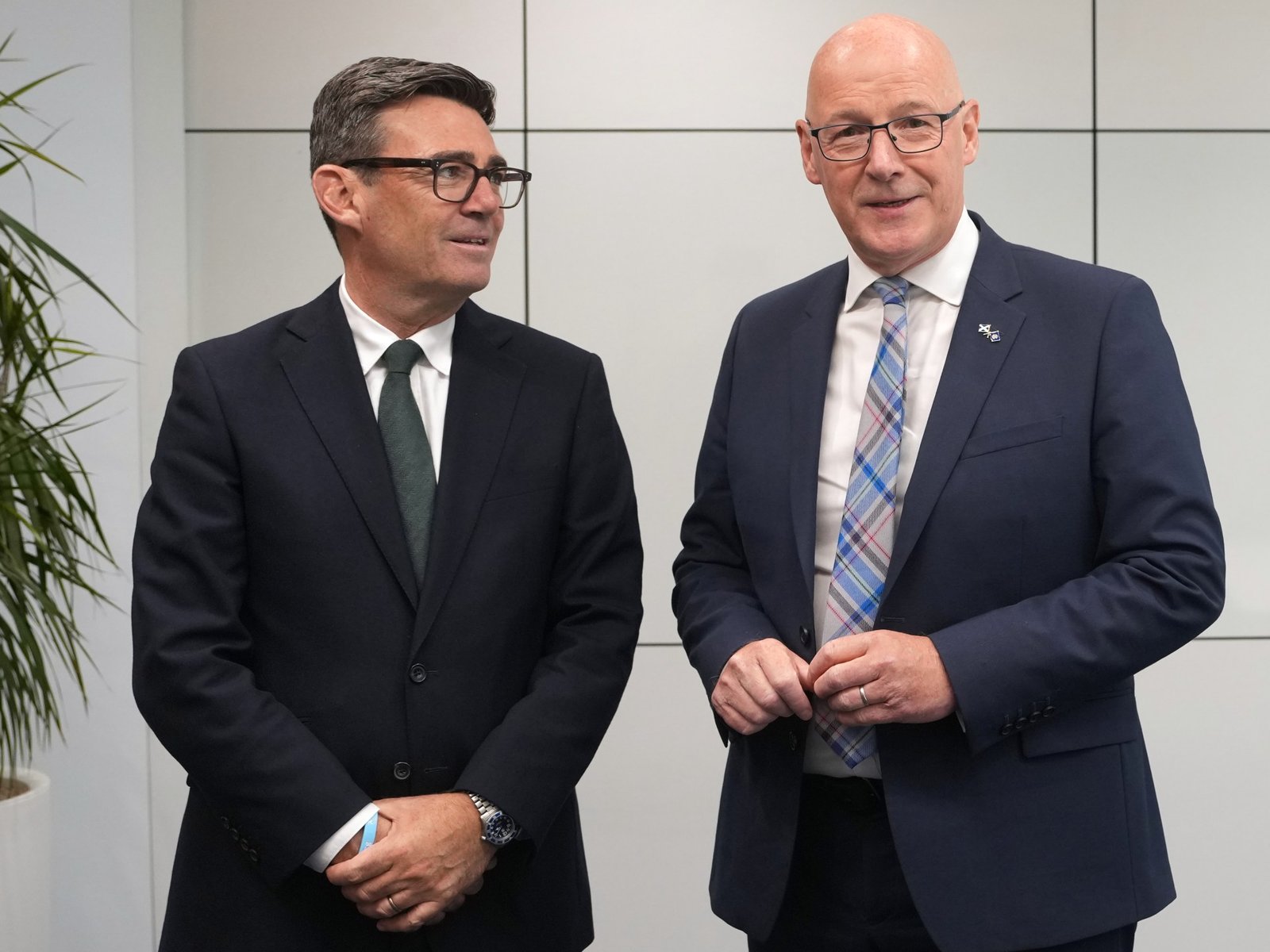
London, United Kingdom — On his fourth day as prime minister, Andy Burnham did not stay at Downing Street in London. Nor did he go to Manchester, the home of Number 10 North. He went to Glasgow.
Hours before King Charles and Queen Camilla opened the 2026 Commonwealth Games, Burnham held his first in-person meetings with Scotland’s First Minister John Swinney and Wales’ First Minister Rhun ap Iorwerth. The talks were meant to demonstrate, in Burnham’s own words, that growth is needed “in every postcode across the whole of the UK”. A meeting with Northern Ireland’s First and Deputy First Ministers, Michelle O’Neill and Emma Little-Pengelly, is pencilled in for a wider UK tour in August.
Notably absent from the agenda, at Burnham’s insistence, was any discussion of a second Scottish independence referendum.
Just days after being appointed prime minister, Burnham is testing a proposition that will define his premiership. He’s selling a vision that the office itself can be partly relocated out of London to Manchester, the city he governed as mayor from 2017 until his return to UK Parliament in the Makerfield by-election last month.
What Number 10 North actually is
Stripped of rhetoric, Number 10 North is a written ministerial statement. On July 21, Baroness Smith of Basildon, Leader of the House of Lords and Lord Privy Seal, confirmed on the government’s behalf that devolution and local growth policy functions are moving out of the housing ministry and the Treasury and into a new Manchester-based operation. There, civil servants will work inside a restructured Office for the Prime Minister and the Cabinet, led by Cabinet Secretary Dame Antonia Romeo.
Number 10 North will be based at Manchester’s Heron House in the interim and the government “Digital Campus” once it’s completed in 2032, as the new government under Prime Minister Andy Burnham seeks to establish No 10 North as “the dominant driver of the UK’s economy” [Christopher Furlong/Getty Images]
The interim headquarters is Heron House, in the New Islington area of Manchester, chosen partly for its proximity to a planned Manchester Digital Campus.
Caroline Simpson, the outgoing chief executive of the Greater Manchester Combined Authority, has been named Burnham’s deputy chief of staff, and will be in charge of day-to-day office operations. Downing Street says Burnham himself expects to work from Manchester “at least one day a week”, though officials caution his diary may change, and insists the arrangement carries no additional cost to taxpayers.
Burnham calls it “the nerve centre of a rewired Britain” and rejects suggestions it is symbolic. “Not a gimmick,” he told his first Cabinet meeting about Number 10 North.
Plumbing, but no water
Number 10 North “establishes the plumbing, but the water isn’t flowing yet”, said Mirte Boot of the Institute for Public Policy Research (IPPR) North. The institutional architecture is firming up, but fiscal devolution – ie, the transfer of money and tax-raising power – that would make such a policy meaningful doesn’t yet exist, she added.
Still, she calls it “a step in the right direction” after what she describes as “too much power condensed into one postcode”. Leaving Westminster isn’t enough; Number 10 North will need “strong political leadership aside from the prime minister”, she added.
The verdict that Number 10 North contains vision and ambition but currently lacks a detailed plan and delivery mechanism is a recurring response from independent voices.
Jonathan Carr-West of the Local Government Information Unit calls Burnham’s devolution agenda “the most ambitious statement … from a senior politician in a generation”, while warning that English councils are so financially hollowed out that the vision “requires a vehicle” it does not yet have.
Malcolm Morgan, a transport researcher at the University of Leeds, puts it more bluntly: genuine devolution means spending, taxation and regulatory power, not just relocated functions, and “devolution does not create more funding”.
That funding question sits unresolved alongside the national one. The 2026 English Devolution and Community Empowerment Act expanded mayors’ control over transport, planning and housing, but left fiscal devolution to a separate Treasury “roadmap” due alongside the autumn budget. According to Centre for Cities, a UK urban policy think tank, the UK remains the most fiscally centralised country in the G7: some 95 percent of tax revenue flows straight to Whitehall.
Devolution, or recentralisation?
For Scotland’s SNP government, the Number 10 North framing is beside the point. First Minister Swinney responded that “rhetoric alone will not cut it” and argued that four consecutive Holyrood elections have handed his party a mandate for Scottish self-determination, something Westminster keeps ignoring, he said. In Glasgow, Burnham declined to engage with that argument directly.
Meanwhile, Wales’ Ap Iorwerth struck a more cooperative note but still said he expected “that Number 10 North would not become Whitehall with a different postcode”.
He also used the meeting with Burnham to press for a new Wales Bill granting policing and justice powers, and a replacement for the Barnett Formula funding mechanism, which Westminster uses to calculate annual changes to the block grants allocated to the UK’s devolved governments, so Wales would have funding parity with Scotland.
Reform UK’s Nigel Farage, from the opposite political direction, warned that a Number 10 in the south and one in the north would simply “fight against each other”.
What it means in Manchester
In Bury, Greater Manchester, Scottish-born Debe Conway sells children’s books at markets and has lived in the area for 56 years, but remains unconvinced about the new prime minister.
Her biggest concern is immigration, which she called Burnham weak on. And as for Number 10 North, she wants to know how it’s being paid for, and asks how long it will last, considering that the UK has had seven prime ministers in the last 10 years.
Rich Carver, who has run pizza restaurants in Manchester for 15 years and is currently “soaking up the energy in the city”, says he cares more about what will happen in the next 10 years.
He’s also tired of the succession of governments and wants this one to last. He likes Burnham and is optimistic enough about the city’s trajectory that he is opening a new restaurant in the coming weeks, something he would not have done five years ago.
“We are all one country,” he says, hoping the rest of the UK (and the media) give the new prime minister time and the chance to implement his vision. Whether that time produces growth, or just relocated offices, is the question Number 10 North still has to answer.