By the time Nicky Chandam set-up her first camera at a folk performance in Delhi’s Nehru Park around 2010, she wasn’t thinking about exhibitions. She was simply watching. A self-described introvert, who grew up in Imphal’s valley, Nicky found performance art both terrifying yet beckoning — like the waves on a beach, she says.
“You know that when it hits you, you feel light. But at the same time, you are afraid the waves might carry you along.” Photography became the shore she stood on, close enough to feel the pull.
An image of Khangembam Mangi Singh — Pena Balladeer, Imphal 2014
| Photo Credit:
Special Arrangement
Her exhibition — ‘Manipur & Archives: A Visual Documentation of Live Art Over a Decade’ — opened in Chennai on May 27 and runs through May 31. It is her second show in the city, one she has been trying to mount for two years.
Presented at Alliance Française Madras, the show brings together 58 carefully-selected photographs spanning 2011 to 2025 — a distillation of images that document Manipuri performance cultures across Delhi and Imphal.
The exhibition foregrounds the work of a woman photographer from the Northeast, whose practice maps performance spaces within India. The exhibition runs through May 31, with a conversation about theatre and live performance with exponent A. Mangai on May 28; continues with an evening of ghazal and poetry on May 29 by the Amir Khusro Sangeet Academy, a conversation with filmmaker Someetharan on making art in conflict zones on May 30, and the screening of Pebet on May 31.
A long freeze
The photographs on display read like a cross-section of India’s live art landscape. Astad Deboo’s ‘Rhythm Divine’ — a blend of Pung Cholom and Manipuri dance — represents its Delhi staging at Kamani Auditorium and its Imphal performance at Chandrakriti Auditorium. There is Mamata Shankar in ‘Amritasya Putra’, Parvathy Baul in the collaborative ‘Raha’, Ratan Thiyam’s Macbeth performed at Bharat Rang Mahotsav, and the ‘One Thousand and One Nights’ from the Asia Meets Asia tour. ‘Manipuri Raas’ at the India International Centre and the Koodiyattam play Surpanakhankam are also among the documented works. The most recent image — and perhaps the most charged — is of Heisnam Sabitri in Pebet, directed by Heisnam Kanhailal, captured at its 50th anniversary celebration in Imphal in 2025. A video recording of this performance will be screened on the concluding day of the exhibition.
Heisnam Sabitri and Kalakshetra Manipur artistes in ‘Pebet’
| Photo Credit:
Special Arrangement
For Nicky, performance photography demands a particular kind of invisibility. “I have to be invisible to the audience and the performer. From there, I pick up one moment.”
What that moment can hold, she explains, is something video cannot — the single instant when a face opens, or when an emotion, slow or intense, crests. Nicky recalls a 2014 image of a 70-year-old folk singer who, mid-song, compared the sweetness of a fruit to a mother’s milk. “The emotion that came over his face — that photograph is still there, and I remember it even today,” she shares.
Although the exhibition has now arrived in Chennai, she has tried several times to organise it in Manipur.
Since the ethnic conflict that erupted on May 3, 2023, artists were among the first to be targeted — a rock-group’s musical instruments were seized, and programmes cancelled at the first sign of unrest. “No engineers were asked to stop their work. No doctors. No offices. But artists were the main target.” The unpredictability of life in the valley has made staging anything there nearly impossible today,” she says.
It is evident that the stakes of archiving, then, are not merely curatorial. Each photograph preserves what Nicky calls the “atmospheric dynamics and collaborative energies” of a performance ecology under pressure. At its core, she says, her practice is an act of resistance, especially as she also moonlights as a photographer who captures the streets of Imphal where she lives. She carries out her vision quietly and patiently from behind the lens.
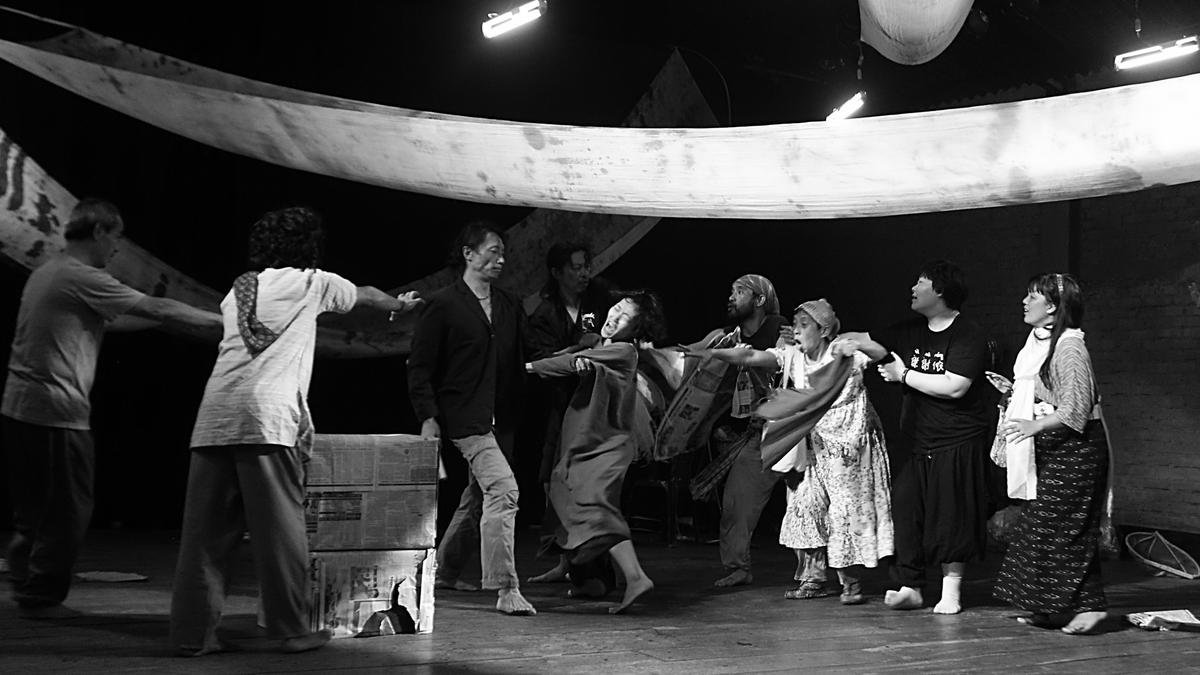
A scene from ‘Postcard Kabui Keioiba Kerala’ by School of Drama and Fine Arts, Thrissur
| Photo Credit:
Special Arrangement
Nicky belongs to the Meitei community, which is embroiled in conflict with the Kuki-Zo tribe. She describes the violence in the State as revolting, particularly because it has caused immense loss of lives, and a complete breakdown of community bonding beyond rigid partisan lines. “At this point, there seems to be no possibility of peace,” she shares, visibly distressed. “If such a conflict had happened in any other mainland state, the response would have been different. If countries can negotiate ceasefires, I wonder why that remains a distant reality for Manipur,” she asks, adding that the conflict is infinitely-layered.
“All art is political, that much is true.” .
Her photographs, captured in different tones of black and white and showcasing ancient and contemporary art forms, carry the weight of that statement.
The exhibition is on at Alliance Française Madras in Nungambakkam. Entry is free.
Published – May 28, 2026 02:04 pm IST