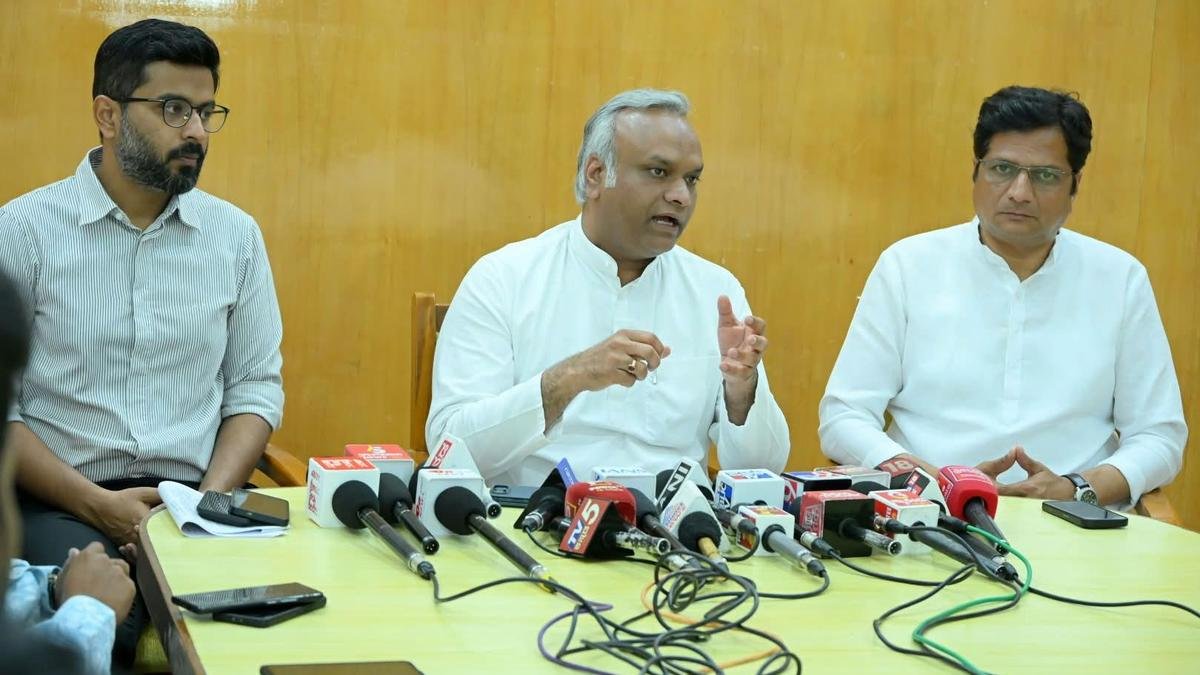
Home Minister Priyank Kharge addressing a press conference in Kalaburagi on Saturday.
| Photo Credit: ARUN KULKARNI
The proposed delimitation Bill of the Narendra Modi-led Union government is unscientific and politically motivated and could undermine the political representation of southern States, Home Minister Priyank Kharge has alleged.
Addressing a media conference at Aiean-e-Shahi Guest House here on Saturday, Mr. Kharge said Mr. Modi was pushing the proposal out of fear of electoral defeat and was seeking to retain power by altering the electoral landscape to suit his political interests.
He questioned the rationale behind increasing the number of Lok Sabha seats from the present 543 to around 850. If delimitation was carried out primarily on the basis of population, southern States that had made significant progress in population control, education, healthcare and economic development could be penalised with reduced political representation, he said.
“Even with 543 members, Parliament is unable to address people’s problems adequately. What difference would increasing the number of seats to 800 or 900 make?” he asked, demanding that the Union government explain the benefits of the proposed increase.
He stressed that the delimitation process should be free from government influence and take into account geographical conditions, administrative convenience and social justice. He also sought clarity on the composition and powers of the Delimitation Commission, including the voting rights of its members.
Questioning the proposal to give the Chief Election Commissioner voting rights in the commission, he asked whether it was appropriate to assign such a decisive role to the head of the Election Commission, particularly when the process of appointing the Chief Election Commissioner itself had been changed.
He also questioned the Centre’s urgency in undertaking delimitation on the basis of the 2011 Census and sought clarity on the criteria to be followed for reservation and representation of Scheduled Castes, Scheduled Tribes, Other Backward Classes and women.
He called upon southern States to unite against any move that could affect their interests and said political parties should set aside differences when the interests of the State were at stake.
Drinking water crisis
On the drinking water situation in the State, Mr. Kharge said the government was extending assistance even in areas where gram panchayats were not functioning effectively.
“However, there were limits to what the government could do when natural conditions affected the availability of water. Even in places such as Mangaluru and Udupi, water could not always be secured despite the availability of funds. A task force had been constituted to address drinking water problems, and the government was ready to provide additional funds wherever necessary. Legislators had also been given the freedom to take measures suited to the conditions in their constituencies,” he said.
On Bhima water
Mr. Kharge said a request had been made to the Chief Minister for the release of water into the Bhima river, while the Chief Secretary had also held discussions with officials in Maharashtra.
“The State government was in constant touch with the Maharashtra government and will pursue a united legal battle to protect Karnataka’s interests,” he said.
Published – November 28, 2026 06:06 pm IST