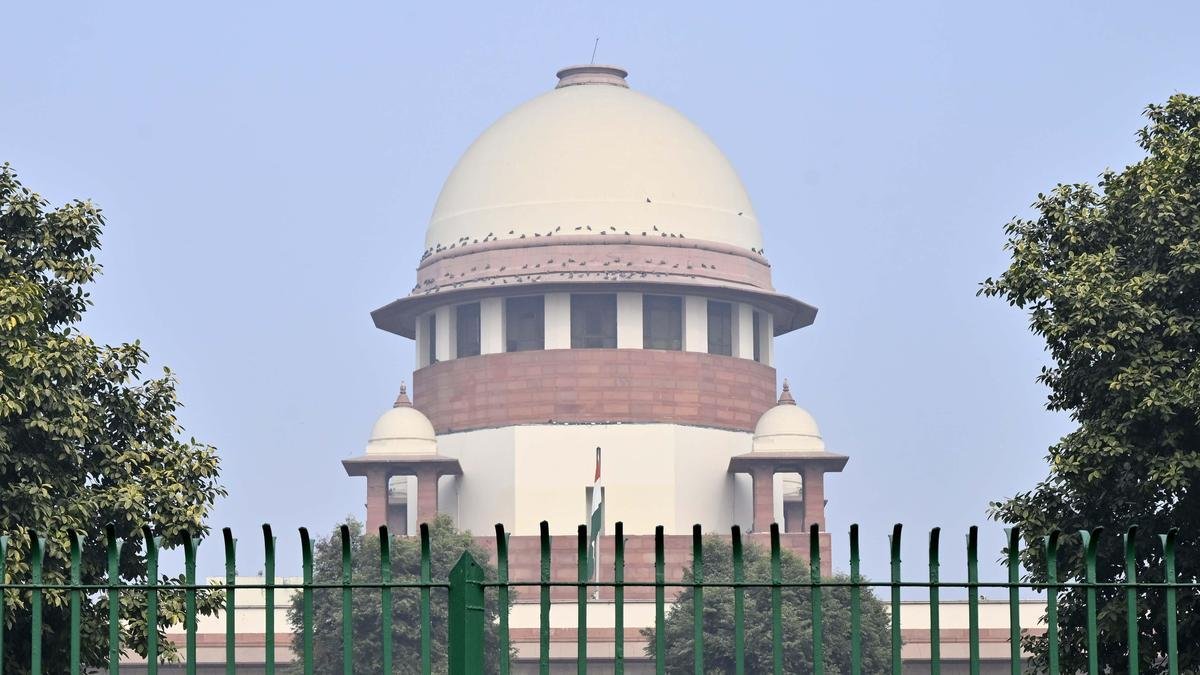
In a verdict in which judges varyingly differed on issues, nine-judge Bench of the Supreme Court on Thursday (August 20, 2026) held that a nearly half-century-old expansive interpretation of ‘industry’, which previously granted workers stronger labour rights and protection, will not apply under the new Industrial Relations Code, 2020.
The reference before the Constitution Bench headed by Chief Justice of India Surya Kant was centered around a broad definition given to ‘industry’ in a 1978 seven-judge Constitution Bench judgment, authored by Justice V.R. Krishna Iyer, in the Bangalore Water Supply and Sewerage Board v. A. Rajappa case.
The verdict had enabled workers employed in a wide range of jobs to have a legal recourse, including collective bargaining, against unfair labour practices by employers. The 48-year-old verdict had exempted only core sovereign activities such as the judiciary, law and order, defence, etc. from the purview of ‘industry’, as defined under Section 2(j) of the Industrial Disputes Act, 1947, in order to protect the state’s functional autonomy.
The 1978 judgment had further introduced a ‘triple test’ which laid down conditions that any activity which was systematic or organised, operated on the basis of employer-employee cooperation and dealt in the production of goods and services to satisfy human wants came within the ambit of ‘industry’. The judgment had brought even hospitals, educational institutions and municipalities within the fold of ‘industry’.
The majority on the Bench held that ‘industry’ under Section 2(p) of the Industrial Relations Code (IRC), which came into force in November 2025, would not be “burdened” by the interpretation in the 1978 judgment of Section 2(j) of the 1947 Act.
The majority opinion on this particular point was authored by Chief Justice Surya Kant, and supported by Justices Satish Chandra Sharma, Alok Aradhe, Vipul M. Pancholi, with Justices P.S. Narasimha and Joymalya Bagchi expressing agreement in their separate opinions.
Chief Justice Kant said the 1978 judgment and its conclusion would not act as the “sheet anchor” or the foundation for any future interpretation of Section 2(p) of the IRC. This has effectively confined the 1978 verdict to legacy industrial disputes pending before courts, tribunals, labour authorities and other fora prior to the IRC.
“The future of ‘industry’ in Section 2(p) of IRC is not burdened by the interpretation of 2(j) in the Industrial Disputes Act,” Chief Justice Kant summed up at the end of an hour-long judgment pronouncement session on Thursday.
In fact, the CJI’s opinion even suggested a “refinement” of the 1978 triple test. While acknowledging that the core principles of the test had stood the test of time in deciding industrial disputes, the CJI said its elements could have been “articulated differently so that the scope and contours of 2(j) could have been better reflected”. However, the CJI clarified that this was only a “considered opinion”, and should not be used to displace the governing legal position on pending proceedings or dig up decided cases.
“Consequently, any pending proceedings before courts, Tribunals, labour authorities or any fora under the 1947 Act should be decided as per the interpretation of Section 2(j) in the Bangalore Water Supply and Sewerage Board (BWSSB) judgment,” the CJI said .
Justice Narasimha agreed, saying an authoritative interpretation of 2(j) had lost its immediacy with the coming into force of the IRC.
In her separate opinion, Justice B.V. Nagarathna, seconded by Justices Dipankar Datta, who wrote an independent opinion shared with Justice Ujjal Bhuyan, found the reference against the 1978 verdict “unwarranted” and not maintainable. She said it was important, now more than ever, to retain the inclusive definition of industry to safeguard workers’ rights.
In a scathing dissent, Justice Nagarathna highlighted India’s shifting industrial landscape from state-owned enterprises to an era of privatisation, liberalisation and globalisation.
“Liberalisation and privatisation were meant for the welfare of the people of India. Heavy capital investment in the public sector and its failure to yield good results in the subsequent decades and the move towards disinvestment and privatisation were experiments in achieving the constitutional goals… It is in this backdrop the judgments of this court must be viewed… Liberalisation, privatisation, globalisation were embraced by the Indian economy with a view to privatise state-sponsored and managed industries by handing over these entities, goods and services to private hands,” Justice Nagarathna observed.
The change of ownership to private entities saw the transformation of workmen/employees of public sector units to workmen/employees of the private sector. It is in this context that the protection under the Industrial Disputes Act protection was provided. The judge said a pervasive definition of Section 2(j) was necessary to effectively protect workers’ right in a privatised world.
Justice Nagarathna cautioned that any tinkering with the definition of industry under 2(j), which had stood firm for nearly 50 years, would definitely cast a shadow on the interpretation of the term under the IRC. Interference would only create uncertainty and disturb “industrial peace”.
Justice Nagarathna said merely because the state was involved in an activity did not automatically qualify the venture as a sovereign function. Even social welfare activities done by the government or their instrumentalities could be construed as industry depending on the nature of the activities.
“The state engages in many activities which are not stricto sensu sovereign. Mainly because a function is performed by the state does not mean it would be exempted from the definition of industry. Justice Iyer’s interpretation was the correct law,” Justice Nagarathna said.
She upheld the ‘Dominant Nature Test’ introduced in the 1978 judgment concerning organisations which perform multiple or integrated activities. In such cases, the nature of the dominant activity of the organisation would be considered to determine if the entity was an industry or not.
Justices Datta and Bhuyan corroborated Justice Nagarathna’s view that the 1978 verdict did not require any re-consideration. The two judges concluded that the triple test has prevailed through time. “Institutional credibility lies in respecting finality and not in perpetuating doubt,” Justice Datta said.
Justice Bagchi, though agreeing with the CJI and Justice Narasimha on the validity of the reference, took the views of Justices Nagarathna, Datta and Bhuyan that the 1978 judgment correctly determined the scope and ambit of ‘industry’.
The judge, however, crucially weighed in with the majority on the Bench to hold that IRC should not be encumbered by the 1978 verdict in future disputes.
Published – August 20, 2026 12:15 pm IST