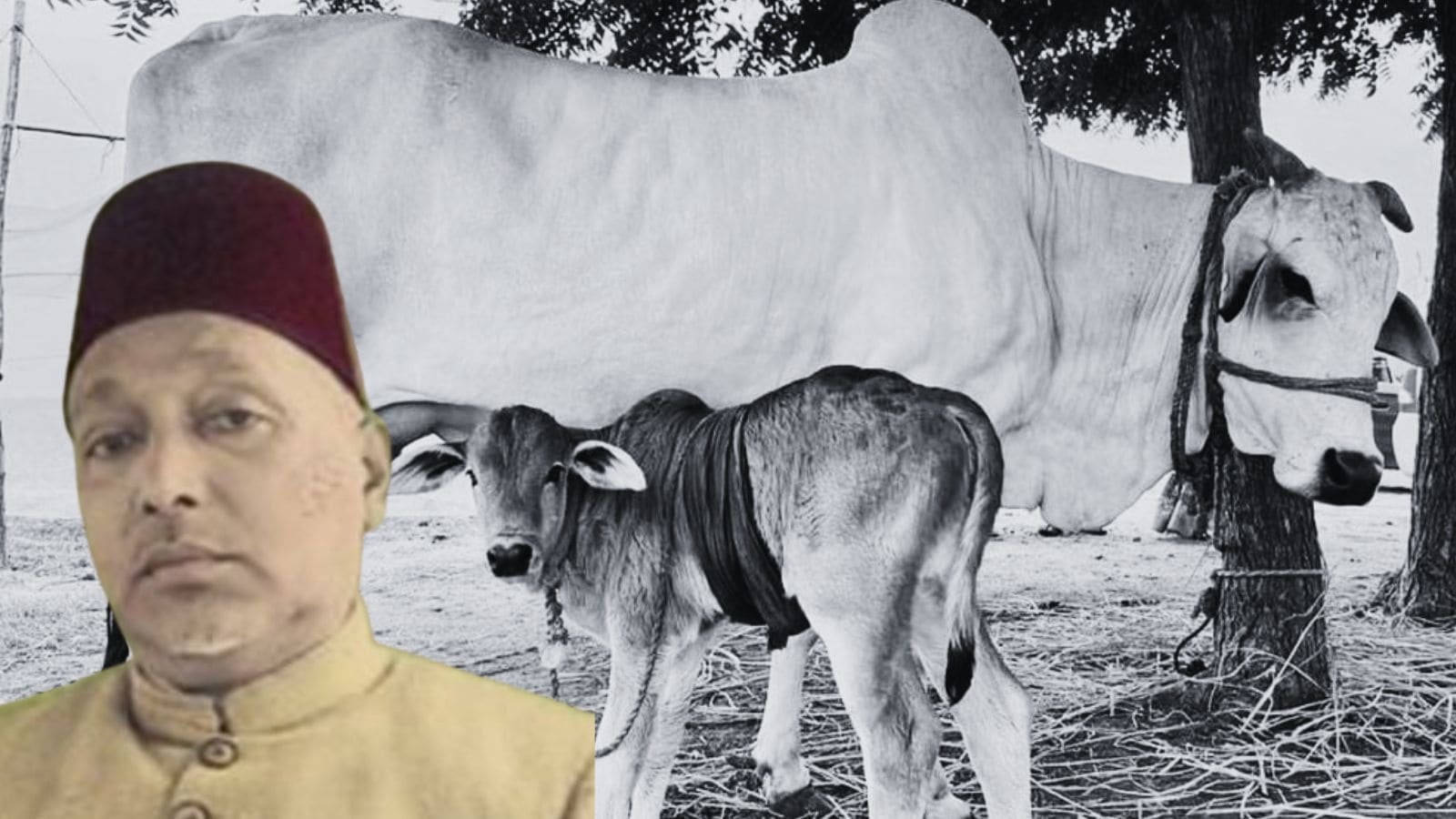
New Delhi: Amid calls from sections of the Muslim community that cow should be declared a national animal, a look at the Constituent Assembly debates shows that two Muslim members had sought an unambiguous spelling out of the state’s stance on cow slaughter, with one of them even calling for prohibiting it as part of fundamental rights.
Syed Muhammad Saadulla had cited a Quranic injunction – ‘La Ikraba fid Din‘, which means there ought to be no compulsion in the name of religion – to state that he did not want to obstruct the framers of the Constitution if they directly stated that cow should be protected from slaughter on religious grounds.
However, he said he would not support amendments related to cow protection if the reasons given were economic.
“I do not want to obstruct the framers of our Constitution, I mean the Constituent Assembly, if they come out in the open and say directly: ‘This is part of our religion. The cow should be protected from slaughter and therefore we want its provision either in the Fundamental Rights or in the Directive Principles’,” Sadulla had said during the debate in November 1948.
The debate was held to consider an amendment moved by Pandit Thakur Dass Bhargava, which said, “The state shall endeavour to organise agriculture and animal husbandry on modern and scientific lines and shall, in particular, take steps for preserving and improving the breeds of cattle and prohibit the slaughter of cow and other useful cattle, specially milch and draught cattle and their young stock’.”
Seth Govind Das had moved an amendment to the amendment moved by Bhargava, stating that the words “and other useful cattle, specially milch cattle and of childbearing age, young stocks and draught cattle” be deleted and the following be added at the end – “The word cow includes bulls, bullocks, young stock of genus cow”.
During the debate, Sadulla said that it was wrong to state that Muslims kill cows either to offend their Hindu friends or for any other purpose.
“Fortunately or unfortunately, Muslims are meat-eating people. The price of mutton is so high that many poor people cannot buy it. Therefore, on rare occasions, they have to use the flesh of a cow. From my own knowledge, it is only the barren cows that go to the butcher,” he said.
“Speaking for Assam, it is the hill people who are the worst culprits in this respect. In Shillong, there is only one Muslim butcher against 70 from the hill people who deal in beef… in the name of economic front, I cannot lend my support to the motion moved by Pandit Bhargava. I am sorry that for the reasons given already, I am compelled to oppose the amendment of Seth Govind Das,” he said.
Also Read
Two Muslim men lynched over cow theft suspicion in Assam’s Sonitpur
Z H Lari of the Muslim League had said that he appreciated the sentiments of those who want the protection of cows – may be on religious grounds or may be in the interests of agriculture in this country.
“I have come here not to oppose or support any of the amendments but to request the House to make the position quite clear and not to leave the matter in any ambiguity or doubt.
“The House, at the same time, must appreciate that Mussalmans of India have been, and are, under the impression that they can, without violence to the principles which govern the state, sacrifice cows and other animals on the occasion of Bakrid,” he had said.
It is for the majority to decide one way or the other, Lari said.
“We are not here to obstruct the attitude that the majority community is going to adopt. But let there not linger an idea in the mind of the Muslim public that they can do one thing, though in fact they are not expected to do that,” he said.
Therefore, if the House is of the opinion that slaughter of cows should be prohibited, let it be prohibited in clear, definite and unambiguous words, he said.
“I do not want that there should be a show that you could have this thing although the intention may be otherwise. My own submission to this House is that it is better to come forward and incorporate a clause in Fundamental Rights that cow slaughter is henceforth prohibited, rather than it being left vague in the directive principles, leaving it open to provincial governments to adopt it one way or the other, and even without adopting a definite legislation to resort to emergency powers under the Criminal Procedure,” Lari said.
During the debate, Bhargava, who moved the amendment, said he did not want that due to its inclusion in the Fundamental Rights, non-Hindus should complain that they have been forced to accept a certain thing against their will.
“So far as the practical question is concerned, in my opinion, there will be absolutely no difference if the spirit of the amendment is worked out faithfully, wherever this amendment is placed,” Bhargava said.
“This amendment is divided into three parts. Firstly, agriculture should be improved on scientific and modern lines. Secondly, the cattle breed should be improved; and thirdly, the cow and other cattle should be protected from slaughter,” Bhargava said.
The article that is part of the Constitution reads, “The state shall endeavour to organise agriculture and animal husbandry on modern and scientific lines and shall, in particular, take steps for preserving and improving the breeds, and prohibiting the slaughter, of cows and calves and other milch and draught cattle.”