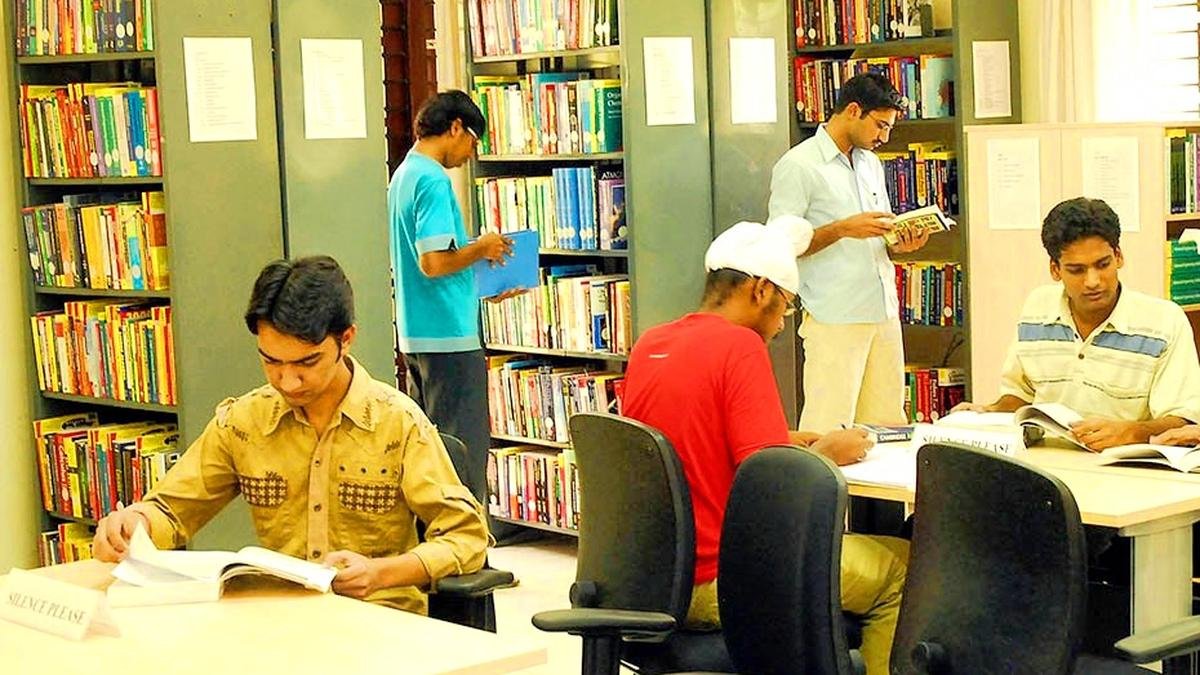
The University Grants Commission has sought feedback from stakeholders on the LOCF.
| Photo Credit: S. Mahinsha
The University Grants Commission (UGC) has released draft Learning Outcomes-based Curriculum Framework (LOCF) for anthropology, chemistry, commerce, economics, geography, home science, mathematics, physical education, and political science.
The LOCF stresses on the inclusion of Indian Knowledge Systems in each subject. The UGC has invited feedback from stakeholders on the LOCF. This new curriculum comes at a time when Opposition-ruled States are protesting against the focus on these systems on grounds of alleged ‘saffronisation’.
While the LOCF on chemistry starts with a salutation to Saraswati, the commerce curriculum suggests colleges to teach Kautilya’s Arthshastra. V.D. Savarkar’s Indian War of Independence has found a place in the reading list for the course on ‘Bharatiya Struggle for Independence’.
Also Read | Why higher education institutions in India should adopt outcome-based learning
Though the National Education Policy promotes multidisciplinary courses and wholistic education, the LOCF prioritises single-major pathways and most credits are allocated to discipline-specific courses, leaving limited room for multidisciplinary exploration. For example, in the chemistry under graduation course, the draft LOCF proposes 172 credits for BSc Chemistry (honours), of which 96 credits are for discipline-specific core courses and 32 credits are for discipline-specific electives, and nine credits are for general electives from chemistry. Commerce too has a similar credit distribution.
Every LOCF speaks in detail about how Indian systems should be added in the studies. Mandala geometry and yantras, rangoli and kolam as algorithmic art forms, temple architecture and āyādi ratios will be included in courses on mathematics. The objectives include exploring the foundational contributions of Indian mathematicians to arithmetic, geometry, algebra, and calculus, and analysing key mathematical concepts and techniques developed in India and their applications. Other objectives are to understand the historical progression of mathematical ideas and their cultural and intellectual contexts and to recognise the influence of Indian mathematics on global mathematical traditions.
‘Bhartiya philosophy’ will be added in commerce education. “Commerce education must incorporate the holistic learning approach derived from Bhartiya philosophy. The ancient Gurukul system emphasised the all-round development of individuals, encompassing physical, emotional, intellectual, and spiritual growth. These values, when applied to Commerce, promote ethical decision-making, responsible leadership, and sustainable business practices,” the LOCF said, adding that Kautilya’s Arthashastra provides insights into trade regulations, governance, and financial management, which remain relevant today.
“Additionally, concepts like ‘Ram Rajya’ (equitable governance) can be explored in the context of corporate social responsibility (CSR) and contemporary environmental, social, and governance (ESG) frameworks. The inclusion of the ‘Shubh-labh’ philosophy in discussions on profit-making ensures that students understand the balance between financial success and ethical responsibility,” it said.
Indian concepts of wealth and prosperity in dharmic thought; role of the king in economy; trade and labour ethics; guild codes and collective enterprise; ecological and agrarian values; principles of dana and indigenous exchange systems will be taught in economics courses.
In chemistry, in a module on “Chemistry of Alcoholic Beverages”, traditional Indian fermented beverages and preparation methods for kanji, mahua, toddy and chemical reactions involved in the conversion of sugars to ethanol during fermentation will be taught. Chemistry will have a brief idea of ancient Indian Knowledge of Parmanu. In a unit on atomic structure, recapitulation of concept of atom in ancient India will be taught along with Bohr’s theory and its limitations.
On Anthropology, the draft curriculum says ancient Indian thinkers like Charaka, Sushruta, Buddha, and Mahavira have long discussed the symbiotic relationship between nature and culture, offering indigenous perspectives on concepts central to anthropology. “By incorporating these traditional knowledge systems into the curriculum, Anthropology can be contextualized within the Indian framework, aligning with NEP’s emphasis on decolonising education and promoting Indian knowledge systems,” the LOCF on anthropology noted.
READ MORE
Published – August 22, 2025 10:36 pm IST