Minutes after England survived a World Cup scare against DR Congo to squeeze into the round of 16, the focus shifted to what’s next for the Three Lions.
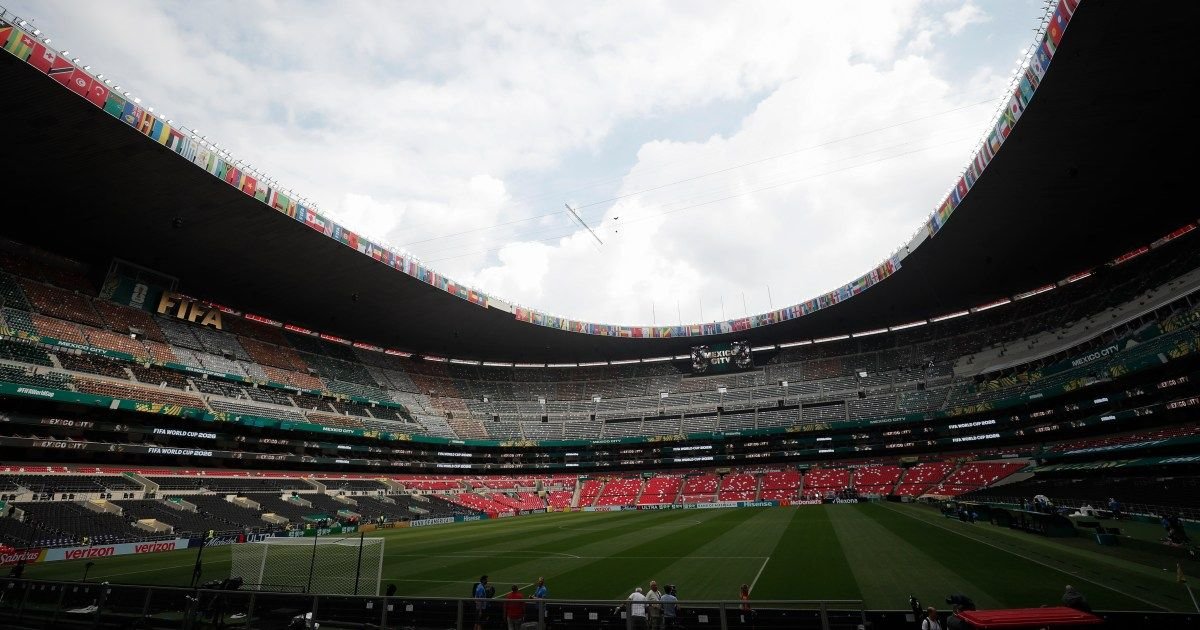
But it was not the threat of the in-form Mexico team that made the most noise, but the challenge of playing at the Azteca Stadium, the iconic football venue that can take your breath away, quite literally.
Recommended Stories
list of 3 itemsend of list
The Mexico vs England match on Sunday evening in Mexico City is the most talked-about fixture of this knockout round, with the discussion ranging from the change in kickoff time to the high altitude posing a huge challenge and the risk of adverse weather.
Al Jazeera breaks down the possible impact of those things on England’s chances of reaching the quarterfinals:
What time is England vs Mexico?
The match will kick off at 6pm on Sunday in Mexico City, which is 1am on Monday in London (00:00 GMT).
Why did FIFA consider changing the England vs Mexico kickoff time?
On Friday, media reports in the United Kingdom and Mexico said governing body FIFA was planning to move the kickoff at the Azteca Stadium from 6pm local time to midday due to concerns over forecast storms and flooding in Mexico City on Sunday.
But FIFA decided to stick with the scheduled time, as bringing the Mexico vs England game forward would have also meant delaying Brazil vs Norway on the same day in New York/New Jersey.
Why is Mexico City one of the toughest World Cup venues?
The 80,000-odd capacity Azteca Stadium, the largest in Latin America, is a fortress-like home of cohosts Mexico, who have lost just two of their 89 competitive games there.
According to stats provider Opta, Mexico are unbeaten in their last 22 competitive matches there (W16 D6), but the average FIFA Ranking of those opponents is just 57.
The venue of the 1970 and 1986 World Cup finals, the Azteca Stadium holds particular historical significance for England, who are playing there for the first time since a controversial 2-1 quarterfinal defeat by Argentina at the 1986 World Cup, famous for Diego Maradona’s “Hand of God” goal.
Diego Maradona of Argentina handles the ball past Peter Shilton of England to score the opening goal of the 1986 World Cup quarterfinal at the Azteca Stadium in Mexico City [File: Bongarts]
Is Mexico City at a high altitude?
The pitch in Mexico City sits 2,240 metres (7,350 feet) above sea level. At that altitude, the air is thinner, meaning each breath delivers less oxygen to the body, and the ball travels faster and farther.
By contrast, the Atlanta Stadium, where England beat DR Congo 2-1 on Wednesday, is just over 300 metres (984 feet) above sea level.
What has Thomas Tuchel said about Mexico City’s altitude?
England manager Tuchel was asked about the challenge of playing at the Azteca shortly after they won against DR Congo.
“It is maybe one of the most beautiful fixtures, the most exciting fixtures that you can have, to play against Mexico in the Azteca,” Tuchel said.
“And there will be a lot of obstacles waiting for us, not to mention the altitude will be, of course, a big disadvantage because we cannot physically adapt to it in four days. It’s just impossible.”
With the 2026 World Cup being held across the United States, Canada and Mexico, teams have a tight turnaround between games. The England squad travelled to Mexico City on Friday, reaching one day earlier than the norm, but it will not be enough to acclimatise to the unique conditions in the city.
“The recommendation is you either go 10 days before, which is too long for us, or last minute, which is not allowed,” Tuchel added.
Tuchel is hoping to lead his side to their second World Cup title [Claudia Greco/Reuters]
Mexico City’s elevation impairs aerobic capacity because less oxygen is physically dissolved in the blood, making it harder for the body to push oxygen into the cells.
For footballers, it means increased heart rate, shortness of breath, dehydration, quicker and more intense fatigue and delayed recovery.
There is also the matter of the football itself. The thinner air means less resistance, changing the speed and flight of passes and shots.
“It will fly maybe five yards [metres] more. It’s just difficult,” Tuchel explained, talking about the movement of the ball.
Will England be at a disadvantage against Mexico?
Yes.
While England don’t have enough time to adapt physiologically before the knockout tie, cohosts Mexico are accustomed to living and training at altitude and have played three of their four World Cup games at the Azteca. They won all three, beating the likes of South Africa and Czechia in the group stage and Ecuador in the last-32.
While the venue will be physically demanding for all players, it will be particularly difficult for goalkeepers, who could struggle to deal with the spin or flight of the ball, be it shots at goal or crosses in the box.
England striker Marcus Rashford, though, brushed aside suggestions that the altitude and atmosphere could prove decisive.
“It’s a game of football. We’ve all been playing football since we were kids and we’ve played in different environments, different atmospheres … It’s up to us to try and find a way to come out on top, and that’s what the focus is,” he said.
“We have to work together and try to bring as close to our best as we can, and we’ll be fine.”
Mexico’s Raul Jimenez, left, and Julian Quinones scored in the last game to send their team to the World Cup Round of 16 [Yuri Cortez/AFP]
Are there any short-term solutions?
Tuchel could change his tactics to keep up with the testing conditions.
England could opt to slow down their playing style against Mexico to allow the players time to recover between periods of high-intensity play.
They would likely want to keep possession, save energy and press forward when the right opportunity arises.