In a galaxy of Indian storytellers, Ms. Deepa Kiran stands out as a teacher trainer in the art of narration. Her training aims to enhance learning of the English language and diverse subjects. The one lesson she has learnt from a journey spanning almost three decades is, “Love and togetherness are what education should achieve”.
The Story Arts Foundation, a registered trust set up by Ms. Deepa, works with Central and State government schools and NGOs. It believes in learning, sharing, and growing through the oral tradition of storytelling. Speaking Hindi, English, Tamil, Telugu, and a smattering of regional languages, Ms. Deepa communicates effectively with simple expressions and musical instruments, without having to use any technological gadgets.
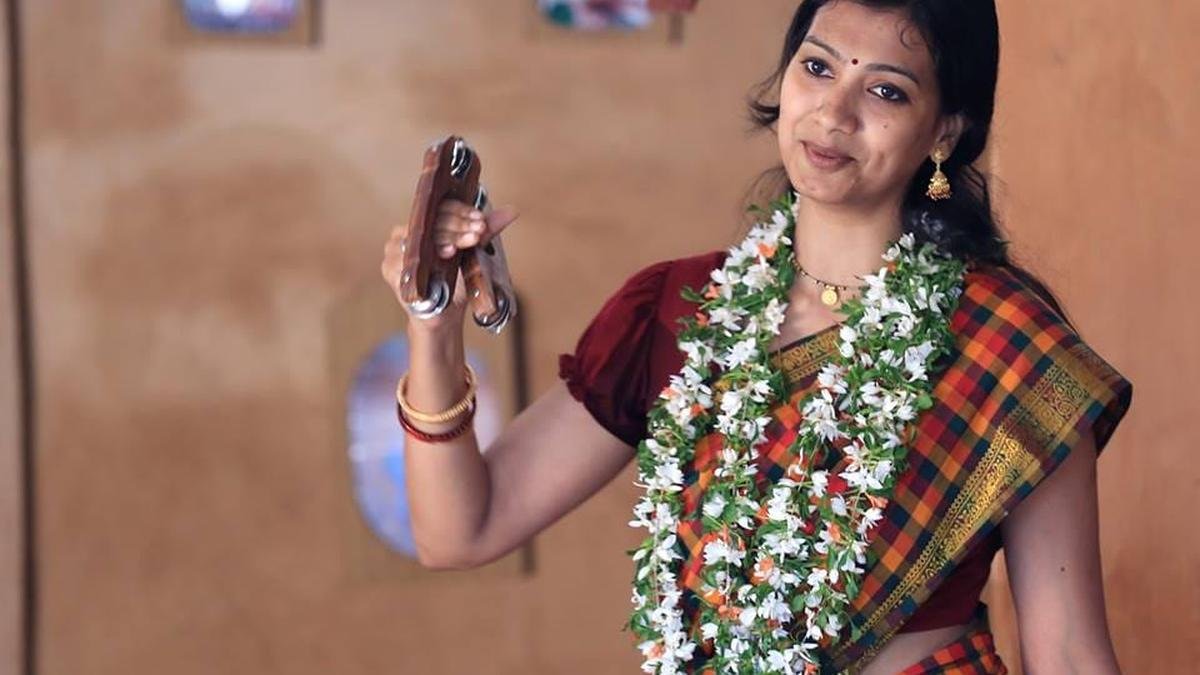
Ms. Deepa says informally, she has always been a storyteller in the sense that she was the one who would be asked to narrate a movie if someone missed it in the theatre. | Photo: Special Arrangement
She enters the classroom, shaking her wrists to produce a metallic medley emanating from alendus ~ Telugu for ringlets, worn by her to draw attention, much like the traditional storytellers. She introduces teachers to the art of storytelling and how to use it to impart knowledge to students. “I don’t offer only one single class of training model. I give three-day-long initial training followed by hand-holding across the next few months for implementation in the actual classroom,” she said.
Training is supposed to be practical, filled with activities, and help teachers arrive at new learnings experientially. It helps them embody performative elements, and build competency and confidence.
Stories are like frames
As a resource person of the Union Culture Ministry, her larger mission is to preserve the cultural heritage in various parts of the country through the mechanism of storytelling. There is a deeper dimension to her storytelling skills. “As an educator and parent, I am deeply interested in asking myself and other minds to question the stories around us. Who is making these stories, why, and who is going to serve and benefit, what benefit do they get?” she explains, adding, “Once we begin to ask these questions, we are in a beautiful space”.
With the ingress of social media and even before that, multiple stories have existed and will continue to, of the same event or issue, she notes. “But we have to be watchful of which ones to follow while being open to other stories. Stories are like frames capturing some things while leaving out others,” she reasons.
Her nation trotting has taken her to tribal areas including Santhal Paraganas in West Bengal, and Dharmashala in Himachal Pradesh, the home away from home of Tibetans in exile. She communicates with the teachers and students there in English and Hindi using interpreters arranged by the Central Tibetan administration. “Conceptualising in the context of the situation and context of the learner is very important to make learning more effective,” she explained in a chat with The Hindu.
Critical thinking and cognitive development
According to Ms. Deepa, oral storytelling not only serves the purpose of learning language but also serves three domains in education of cognitive learning, which are developing the skill of thinking, the adaptive domain of socio-emotional intelligence, and the psycho motor domain, which is related to the body and its movement.
In the context of storytelling for young children, knowledge of concepts relating to size, shape, and colour is imparted. Teaching Mathematics and Science to older children entails developing critical thinking skills. It is a holistic approach to language, not a separate vocabulary and pronunciation, and grammar. Not only the verbal aspect of language, but also the non-verbal aspect is integrated.
Ms. Deepa’s journey
Ms. Deepa says informally, she has always been a storyteller in the sense that she was the one who would be asked to narrate a movie if someone missed it in the theatre. She also worked with All India Radio part-time for a couple of years. She was the program executive selected to do an audio telling of Alice in Wonderland for the Radio. That was her earliest formal project back in 1997-98. “When I started using it in a structured manner in different Kendriya Vidyalayas from 2000, I would get contractual appointments for teaching English as a PGD course where I found students were either afraid of English or not inclined to learn it as a subject, I found story telling very helpful in narrating a chapter to pull them back to the text”, she said.
In the 2007-2008 period, she began to experience a kidney malfunction. “This continued for more than six months without any improvement in my condition. I used to take 80 tablets of steroids every day. After six months and no improvement, there was this moment of giving in and saying to divinity: Please take care, I don’t know the solution. Then I got this answer through an inner voice that I have to do what I love, and I realised that what I love is being with children, singing, dancing and telling them stories”.
She organised a three-week summer camp of three weeks in a small town of Maharashtra. Subsequently, she recovered. “From 2008, it was a conscious pursuit, a beautiful bonding to connect with those around me whether it was children or teachers or prison inmates or judges of the high court or research scholars at IIT”, she says.
What began in a small town in Maharashtra continued after she came to the city of Hyderabad, and slowly people got to know about it. I started getting more work in Hyderabad, and within a couple of years, there were some queries from other parts of the country.
Story Arts Foundation
The approach of keeping up despite hurdles led her to set up the Story Arts Foundation in 2017, and she worked with various government institutions and educational institutions, and traditional storytellers in reviving storytelling. “This has taken me across the country to literature festivals and cultural festivals like the Kala Ghoda in Mumbai, the Hyderabad Lit fest, and also to many international events, storytelling fests, and workshops like the Scottish International Fest, performing in the Edinburgh National Library, getting a standing ovation.
She also worked with municipal school children in Pretoria, South Africa; narrated stories of Mirabai in Iran; performed in seven cities across Austria, telling stories of Devi Mahatmyam in a church where the Mayor was present.
Her early influencers were her father, who told her stories and encouraged her to read books, and her mother, who introduced her to Bharatanatyam, which gave her knowledge of how to use the body to communicate non-verbally using mudras (gestures), expressions and movements synchronising with music.
Over the past year, she has also taught a course in storytelling and children’s literature at Delhi University as a visiting faculty. She has also written the first chapter in a book on Children’s literature from India, on oral traditions. She has shot a documentary in Ladakh to capture the simple and contended life of people there away from the hustle, bustle and madding crowds in cities, besides acting in Hindi and Telugu short films on social issues.